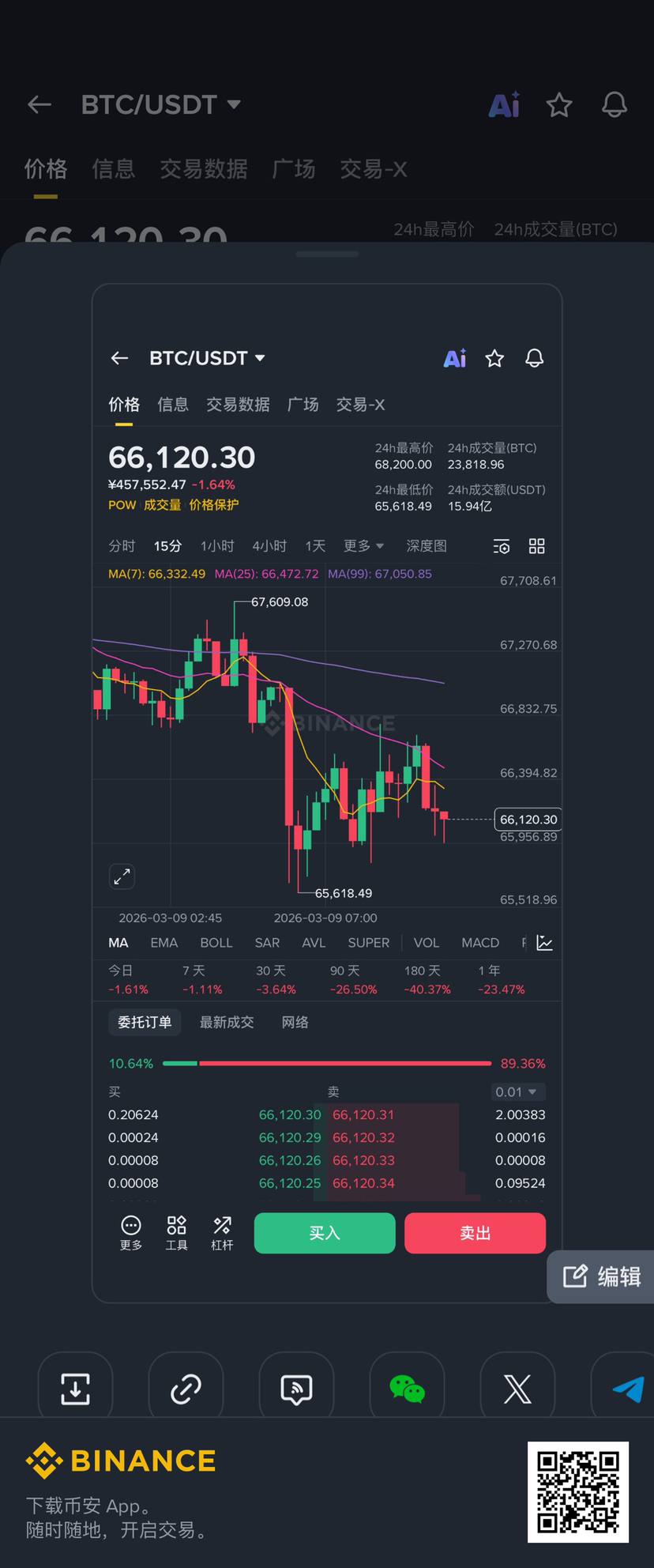
$BTC The aftermath of the halving combined with institutional flows, Bitcoin enters the six-figure era
In 2026, Bitcoin (BTC) experienced a historic price explosion. As of early March, the price had rebounded strongly from the beginning of the year in the range of $65,000 to above $93,000, with an increase of over 40% for the year, just a step away from breaking the historical high of $126,000 in December 2025. This surge is not the result of a random speculative frenzy, but rather the outcome of the resonance of four powerful forces: the halving cycle dividend, the implementation of global regulation, the influx of institutional funds, and the shift in macro liquidity, marking Bitcoin's official transition from a “marginal asset” to a global mainstream allocation.
One, Halving cycle bottoms out: Scarcity logic continues to ferment, supply-demand imbalance becomes core support.
In May 2024, Bitcoin will complete its fourth halving, reducing the block reward from 6.25 to 3.125 coins, with the daily new supply shrinking to about 450 coins, and the annualized inflation rate dropping below that of gold, further highlighting its 'digital gold' scarcity attribute. Although some believe that as Bitcoin's market cap surpasses $1.3 trillion, the marginal effect of halving is diminishing, 2026, as the 'mid-cycle of the upward phase' 18-24 months post-halving, will still see the effects of supply-demand imbalance continuing to release.
Historical data has long confirmed the power of halving cycles: after the halving in 2020, Bitcoin soared from $9,000 to $69,000 within 18 months, a more than 7-fold increase. This cycle has been extended due to deep institutional involvement; the brief peak and correction in 2025 did not break the long-term upward trend. On-chain data shows that since 2026, the number of addresses holding more than 100 BTC has approached 20,000, with long-term holders (HODLers) continuing to accumulate net, and miners reducing sales and hoarding coins, significantly weakening market selling pressure. This pattern of 'tightening supply and expanding demand' lays a solid foundational basis for a price surge.
Two, Regulatory landing clears obstacles: Global compliance framework takes shape, institutions transition from 'testing the waters to settling down'.
2026 will be the 'landing year' for global cryptocurrency regulation, completely reversing the market's concerns about policy uncertainty. After the U.S. approved the spot BTC ETF in 2024, it further refined legislation related to stablecoins and market structure in 2026, clarifying Bitcoin's 'commodity attributes' and tax rules. The EU's (Market in Crypto-Assets Regulation) (MiCA) officially came into full effect, and Japan also completed revisions to its (Virtual Currency Act), leading to greater unification of regulatory frameworks among major global economies, significantly reducing compliance costs for institutional entry.
Clear regulations have directly triggered a wave of institutional allocations. Global asset management giants like BlackRock and Vanguard accelerated their holdings in 2026, with an expected increase of over $50 billion for the year. The spot BTC ETF has become the core channel for fund inflows; although there was a brief net outflow at the beginning of 2026, as the market stabilized, funds flowed back in. By early March, the total assets under management (AUM) of U.S. spot BTC ETFs had surpassed $250 billion. More critically, Wall Street is 'officially taking over' the Bitcoin market, with institutional holdings rising to over 4.2 million coins, and large banks beginning to allow advisors to recommend Bitcoin ETFs to clients, making institutionalization the core driving force of the market.
Three, Macro liquidity shifts: Expectations of interest rate cuts heat up, Bitcoin becomes a dual target of 'hedging + appreciation'.
The core change in the global macro economy in 2026 is the expectation of a shift in the Federal Reserve's monetary policy. Although U.S. employment data performed strongly at the beginning of the year, temporarily compressing the space for interest rate cuts, the market generally predicts that as inflation gradually falls to around 2.5%, the Federal Reserve will initiate a rate-cutting cycle in the second half of 2026, with the policy rate expected to approach 3% by the end of the year, and quantitative tightening (QT) will also pause.
The liquidity easing brought by the expectation of interest rate cuts injects strong momentum into risk assets like Bitcoin. On one hand, rate cuts reduce the opportunity cost of holding non-yielding assets, continuously stimulating retail and institutional investment enthusiasm; on the other hand, after a nearly 10% decline in the dollar index in 2025, the downtrend continued in 2026, further highlighting Bitcoin's value preservation attributes. Notably, in 2026, a rare 'decoupling of stocks and Bitcoin' phenomenon occurred: while U.S. stocks experienced downward volatility, Bitcoin rose against the trend, indicating that the funds driving the market were not speculative hot money from the stock market, but 'hedging funds' flowing from the bond and gold markets.
Against the backdrop of ongoing geopolitical conflicts, Bitcoin's 'decentralized safe-haven channel' function is fully demonstrated. The turmoil in the Middle East and the rising uncertainty of the global fiat currency system have led institutions to include Bitcoin in the traditional safe-haven portfolio of 'U.S. Treasuries + gold', as 'alternative insurance' to hedge against black swan risks, which has also become an important driving force behind the significant rise of BTC in 2026.
Four, Technological breakthroughs empower: Layer 2 implementation, with Bitcoin's practicality and liquidity both enhanced.
If the cycle and capital are the 'fuel' for price increases, then technological breakthroughs are the 'engine'. In 2026, Bitcoin's Layer 2 technology (such as the Lightning Network) will achieve large-scale implementation, with TPS (transactions per second) breaking 100,000+, a significant increase from 30,000 in 2024, while transaction fees will decrease by 90%, from $1 per transaction to below $0.10.
Technological upgrades have completely changed the inherent impression that Bitcoin is 'suitable for storing value, but not for payment'. The implementation of cross-border payments, small transfers, and other scenarios has significantly enhanced Bitcoin's practicality, with the number of global holders surpassing 100 million and the total number of cryptocurrency users exceeding 500 million. At the same time, technological optimizations have also improved market liquidity, allowing institutional funds to enter and exit the market more smoothly, further amplifying the momentum for price increases.
Five, Outlook: The era of six figures is approaching, high volatility remains the norm.
For the second half of 2026, institutions generally hold an optimistic view. Bernstein has raised its target price to $150,000, while institutions like Bitwise and Grayscale predict that Bitcoin will refresh its historical peak in the first half of 2026, with the potential to stabilize above $120,000 by the end of the year. In terms of valuation, Bitcoin's current market cap is about $1.3 trillion, while gold's market cap exceeds $15 trillion, leaving substantial room for growth.
But what needs to be vigilant is that high volatility remains an inherent feature of the Bitcoin market. Although improved regulation and reduced leverage have lowered the risk of 'flash crashes', there are huge discrepancies in institutional forecasts, with target prices ranging from $10,000 to $225,000. Factors such as the Federal Reserve's policy shift, ETF fund flows, and geopolitical conflicts may still trigger wide price fluctuations.
The significant rise of BTC in 2026 is not only a price rally but also a 'coming of age' for the digital asset industry. It proves that Bitcoin's cyclical logic remains valid and marks the completion of its transformation from a 'speculative asset' to a 'global mainstream asset'. For investors, this surge is both an opportunity and a test—while embracing the dividends, only by maintaining rationality and managing risks effectively can one stand firm in the tide of the new and old financial order's alternation.