
After many years of deep cultivation in the cryptocurrency industry, I would like to share a more rational view on the vision of ROBO and Fabric Foundation—discussing both potential and risks.
An observation of ROBO by an old player
In nearly ten years in the cryptocurrency industry, I have been closely following market dynamics. In recent days, I have particularly paid attention to the market trends of ROBO and the developments of Fabric Foundation, and my feelings can be described as mixed.
After ROBO was listed on multiple mainstream exchanges, there was significant volatility in the spot market, with a 24-hour amplitude exceeding 15% at one point. Market sentiment quickly heated up, but controversies also followed. Many people entered the market at high prices, only to be shaken out soon after, with voices of praise and doubt rising and falling within the community.
Let’s clarify one thing: ROBO is not a worthless air coin, but it is certainly not the myth that some KOLs promote that 'the robot economy will inevitably dominate.' The vision of the Fabric Foundation is indeed grand, but the challenges in reality are far more complex than imagined. Next, I will analyze from three perspectives: project logic, points of doubt, and potential value.
① Current market conditions
After ROBO was listed on several mainstream exchanges, market sentiment quickly returned from frenzy to rationality. Prices adjusted after a rapid rise, and although trading volume remained high, chip turnover was very frequent, indicating significant short-term capital speculation.
Essentially, this is the market's early pricing of Fabric Foundation's 'robot economy narrative.'
Everyone knows that robots + Web3 may be an important track for the future, but no one can clearly state when ROBO's real applications will land. This gap between expectation and reality is the root of the current price fluctuations.
From project documents and community information, the core logic of the Fabric Foundation is to create a decentralized robot collaboration network. By breaking down hardware barriers between different brand robots through the OM1 system, allowing robots to have on-chain identities and possess autonomous payment capabilities.
In this ecosystem, ROBO serves as a value medium, undertaking core functions such as payment, staking, governance, and task settlement. In other words, it attempts to create an 'economic identity + universal currency' system for the robot world.
This direction aligns with the current trends of DePIN and physical intelligence, which is also an important reason why institutions are willing to invest and the market is willing to speculate.
② Why I remain cautious
Even if the narrative is very appealing, I still maintain a reserved attitude towards the current development stage of the Fabric Foundation.
Currently, the entire ecosystem is still in the early stages of protocol construction and hardware adaptation. The so-called autonomous robot economy and cross-brand cooperation mostly remain in the white paper and testing phases, lacking truly large-scale commercial application scenarios.
Therefore, most of the people currently holding ROBO are not actually doing so for ecological use, but rather for narrative and speculation.
This situation is actually very similar to early public chain projects. Back then, many projects claimed to disrupt the internet, but in the early stages, there were almost no decent DApps, and token prices were completely supported by market sentiment.
ROBO currently has similar characteristics — high popularity, but the ecological foundation is still relatively weak.
③ Questions about project narrative
I also want to criticize the project's promotional methods. Many promotions emphasize 'the robot economy revolution,' but deliberately downplay the difficulties and timeframes of technology implementation.
The robotics industry itself is capital-intensive and has a long cycle. Hardware compatibility, data collaboration, and security compliance are all very complex.
Fabric Foundation aims to break industry barriers through decentralized protocols, which means they need to:
Convincing traditional robot manufacturers to integrate into the system
Building an on-chain collaboration network
While simultaneously addressing the ethical and regulatory issues posed by automated machine behaviors.
These issues are definitely not solvable by simply launching a token and listing on a few exchanges.
Additionally, from the perspective of the token economic model, the early circulation and unlocking rhythm of ROBO also raise my concerns about future selling pressure. Short-term speculative capital frequently enters and exits, easily amplifying price fluctuations.
For ordinary investors, blindly chasing highs is very dangerous.
④ Why this project is still worth paying attention to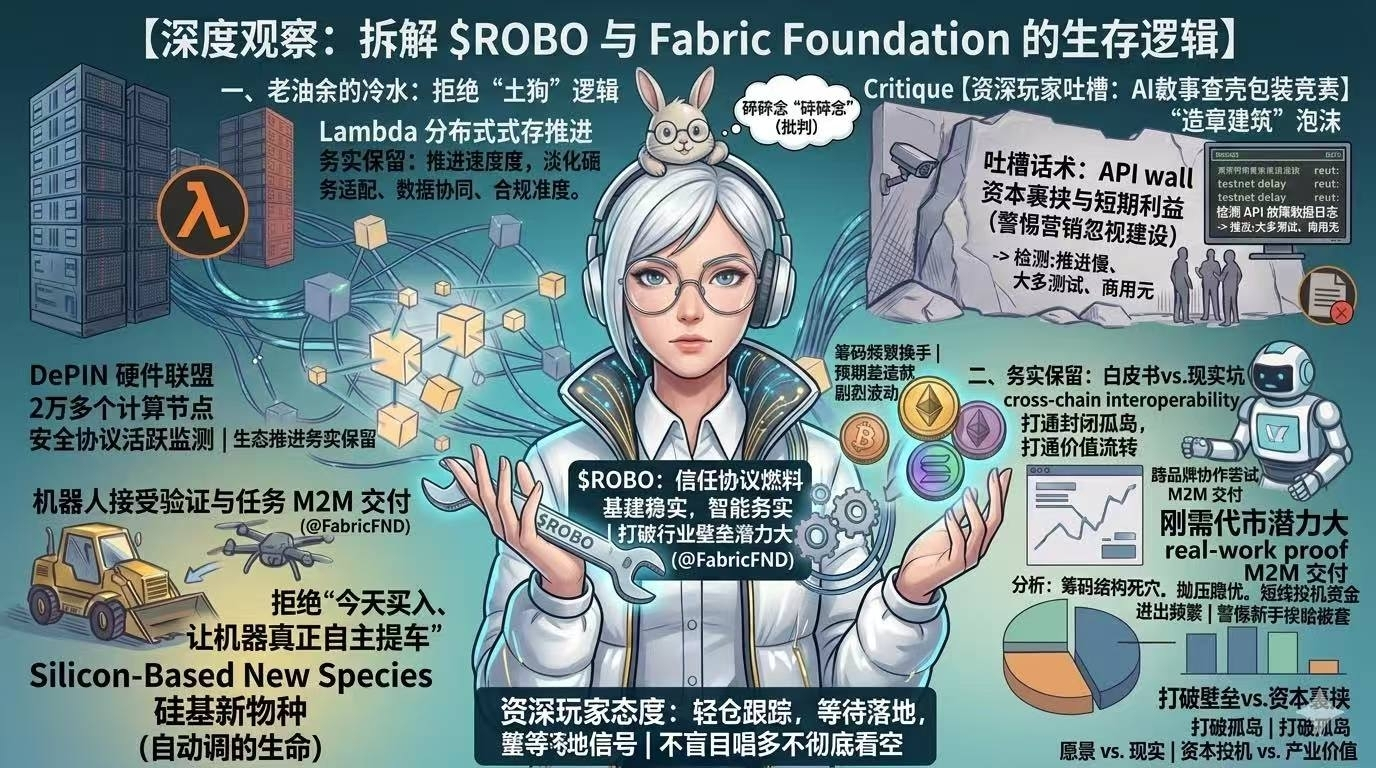
Of course, criticism does not equate to denial.
The core value of the Fabric Foundation is still worth paying attention to.
One of the biggest problems in the current robotics industry is ecological closure and data silos. Different manufacturers can hardly collaborate, data cannot interconnect, and cooperation costs are extremely high.
This is actually very similar to the 'information islands' of the early internet era.
The decentralized protocol of Fabric essentially aims to become the 'universal interface' of the robot world, achieving value transfer and collaboration through ROBO.
If in the future, the OM1 system can achieve compatibility with multi-brand robots and truly realize on-chain task collaboration and payments, then ROBO will no longer just be a speculative target, but may become the core token in the robot economy ecosystem.
This is also why I continue to pay attention to this project — it does indeed have potential, but it is still far from the time to realize it.
⑤ My investment strategy
As an old player, my attitude towards ROBO is very simple:
Maintain a light position, do not blindly be bullish, nor completely bearish.
Before truly seeing signals of ecological implementation, I will not significantly increase my position.
The crypto world has never lacked grand narratives, but what it truly lacks is practical, grounded execution.
If the Fabric Foundation only indulges in marketing and market value management while neglecting ecological construction, then ROBO may ultimately just become a passerby in the speculative market.
But if they truly focus on protocol development and industry cooperation, then ROBO may have the opportunity to become an important foundational token in the robot economy era.
⑥ Final thoughts
From a broader perspective, humanity creates technology to break down barriers and improve collaboration efficiency.
However, whether in the blockchain or robotics industry, we are often swept up by capital sentiment and short-term interests, forgetting that the essence of technology is to serve real needs.
The story of ROBO and the Fabric Foundation is essentially a game between future vision and real progress.
As participants, we must seize the opportunities of the era while remaining clear-headed.
Truly valuable projects never rise based on slogans, but rather speak through results.
I hope that in the future, ROBO can rid itself of purely speculative attributes, and the vision of the robot economy can truly become a reality. I also hope that in this volatile market, we can all remain rational and not forget our original intentions.
@Fabric Foundation #ROBO $ROBO
