
> When the encrypted signature of industrial hardware appears in the DePIN protocol's function call,
> robots are no longer just tools for work; they are becoming economic participants with identities on the chain.
> Behind this is a new battleground of TEE verification, device fingerprints, and the competition for physical layer resources.
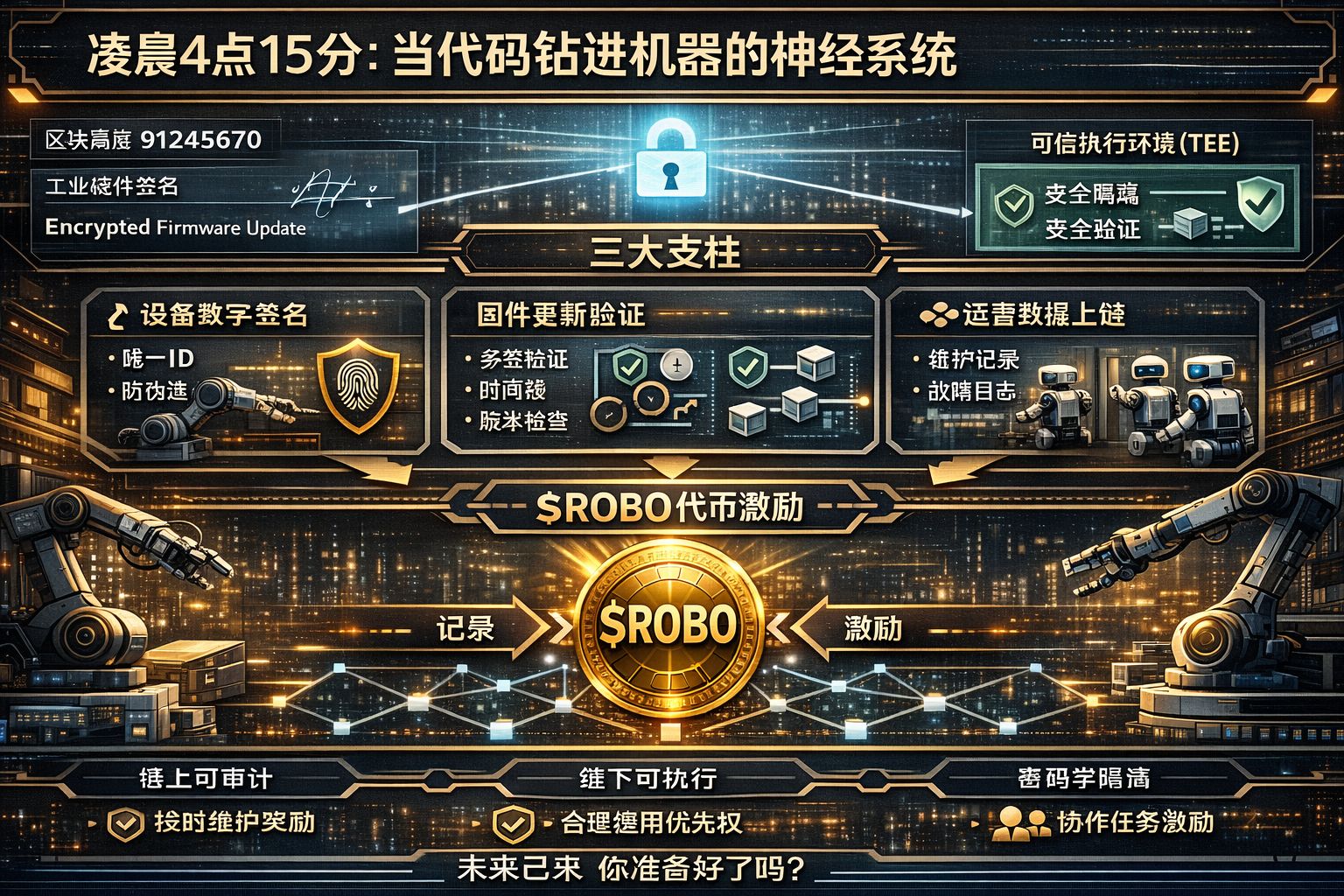
At four fifteen in the morning, the blue light of Base Scan was still flickering on my face. I had been staring at the main Fabric contract page for several hours, and just now, I captured an unusual Function Call — not a regular $ROBO token transfer, but a firmware update instruction with an encrypted signature, the signature from a major industrial hardware manufacturer. This is not a proof of concept in the lab. This is a legitimate OEM-level signature, publicly appearing on the chain like this. I leaned back, and the chair creaked. There was only one thought in my mind: this thing has really started.
One, when code penetrates the machine's nervous system
Block height 91245670, on March 5th, what I saw was not a transaction, but a leap in industrial logic. What was firmware verification in the past? It was a black box operation within the factory. What code was burned when the hardware left the factory, how it was upgraded later, the outside world could not see at all. Let alone auditing—you wouldn't even know when it updated what.
But now it's different. That instruction means: from today on, every iteration in the 'nervous system' of this machine will be recorded on the public ledger. The code is no longer sleeping in the wallet; it has started to penetrate the physical world. My first reaction at that moment was not excitement, but confusion—are those traditional manufacturing companies, who view privacy and control as more important than life, really ready to let their machines connect to decentralized protocols? After studying Fabric's solution carefully, I realized the key: Trusted Execution Environment (TEE). Sensitive code is isolated in the enclave of the robot's processor; only the legality of the instructions is verified on the chain, without touching the specific data. The core logic is: auditable on-chain, executable off-chain, with cryptography providing isolation in between. I tried to recall the scene a few years ago when I first connected ordinary sensors to the DePIN protocol—it was quite a hassle, needing to write an adaptation layer, handle data formats, worry about data being tampered with, and explain 'why blockchain is needed' to hardware engineers. But now it's different. The manufacturing side has begun to actively adapt to this logic because, for them, the combination of TEE and hardware signatures solves a long-term pain point: how to prove that my machine is trustworthy. This is not a technical issue; it is a trust issue.
Two or three pillars
At 4:15 AM, I poured myself a glass of cool water and wrote three lines in my notebook:
First, device digital signatures. Each robot has a chain that cannot be forged 'fingerprint' built into the hardware layer when it leaves the factory. This is not an ordinary public-private key pair but a unique identifier bound to the physical chip. You cannot copy it, cannot counterfeit it, and even if you dismantle the chip, you cannot read it.
Second, the verification mechanism for firmware updates. Not everyone can update whenever they want. Any modification to the machine's software must be confirmed through conditional contracts—such as multi-signature verification, time locks, and version compatibility checks. This eliminates the possibility of 'secretly changing the code in the middle of the night.'
Third, independent records at the operational level. When the machine was maintained, when it was upgraded, when it malfunctioned—these operations will all leave traces on the chain. They are not logs that can be deleted or modified in the internal database of the enterprise; they are records stamped with timestamps on the blockchain.
After I finished writing, I stared at these three lines for a long time. To be honest, the first two are technical issues; the third one is what truly excites me—because it turns the behavior of machines into auditable economic activities.
Three, physical layer bottleneck
But I have always had a concern: what if the sensors were tampered with before they were put on the chain? I saw a real case last year in a logistics tracking project: the hardware was physically replaced, and the forged data was passed all the way to the chain, with the smart contract accepting it all. By the time the blockchain detected anomalies, the goods had already been lost for three days. The records on the chain are transparent, but if the source is rotten, transparency is useless. Fabric's approach reassured me a bit—they require the processor to provide TEE Attestation internally, proving that this machine has not been opened or modified since it left the factory. This is not software-level verification; it is hardware-level proof of 'I am who I am.'
But there is a more realistic bottleneck: resource competition. You can imagine this scenario: multiple robots rush to an elevator entrance at the same time, or all need to go to the same charging station, or meet each other in the same narrow passage. Each machine's local decision-making logic is reasonable—I want to go to the fifth floor, I want to charge, I want to pass through—but from a global perspective, it is highly likely to become a mess. This is not a problem that intelligence can solve. This is a coordination problem. I pondered that one possible solution is to introduce a temporary access rights mechanism. Set time windows, usage costs, and expiration rules for scarce resources, linking the behavior of machines occupying resources to the overall system's efficiency. Moreover, it must record actual usage situations; it cannot simply report 'task completed'—this way, it can distinguish responsible behaviors from pure resource occupation. If this mechanism matures, the physical space itself may become a programmable coordination environment. Walls, doors, elevators, corridors—if these physical entities can respond to on-chain permission commands, then the 'traffic rules' between robots will no longer be locally governed algorithms but a collaboratively verifiable protocol across the network.
Four, the role of $ROBO
Speaking of this, the position of $ROBO becomes clear. It may not be for speculation; it is meant for recording and incentivizing—linking reliable behavior to the health of the entire system. For example:
- Machines that complete maintenance on time receive rewards
- Machines that use resources rationally gain priority
- The behavior of assisting other machines in completing tasks is recorded and incentivized
This is not a fantasy. If every action of the machine can be verified, recorded, and quantified, then tokens become a ledger of actions rather than merely speculative tools. Of course, the boundaries must be well designed. Not all resources are suitable for on-chain management—over-coordination will increase many costs and cause trouble; but too little coordination will lead to chaos. The key is to find the right scale to balance efficiency and cost.
Five, in conclusion
At 4:30 AM, I switched the monitoring screen back to the main interface and stared at that string of transaction hashes for a long time. Many might feel that this is still far from us. But I tell you, the moment the actual factory's cryptographic signature corresponds with the record on the chain, you will suddenly realize—this might be what the future looks like. A future woven little by little with silicon, code, and verification mechanisms. The real question is not how smart the machines are, but how to build the surrounding coordination system when they really start to participate in actual work. No matter how strong the capability is, it is just a starting point; what can truly go far is the structure. This is also why I have been focusing on Fabric—it is not just playing with concepts; it is genuinely trying to build a public coordination framework. For machines to execute tasks, record behaviors, and participate in value flow, they need verifiable identities, traceable records, and clear accountability mechanisms.
Finally, I want to ask you all:
Do you prefer to manage the updates, verification, and resource usage of machines through this public and transparent on-chain mechanism, or do you trust the traditional human supervision method more? The future is not that far away. It is hidden on the assembly line of the factory, in my monitoring screen late at night, in every verification record on the chain, gradually revealing itself. (Lastly, a reminder: all of the above is my own research, for informational purposes only, and does not constitute any investment advice. Everyone should view it rationally and not blindly follow the trend!)