

Inflows into Bitcoin ETFs have turned positive, while gold ETFs are recording record outflows after a historic rally. Is capital starting to rotate from gold to Bitcoin?
The flows of Bitcoin exchange-traded funds (ETFs)
BTC60.184 €
has registered a net positive balance in the last 30 days, while the demand for gold ETFs has started to slow down after nine consecutive months of inflows. This change occurs even as gold prices remain high and sentiment around Bitcoin continues to cool.
With these contrasting trends in ETF flows and the historical pattern of Bitcoin's performance cycles against gold, analysts are now examining data that may indicate a gradual shift in investor demand between the two assets.
Are ETF flows starting to rotate?
According to the Kobeissi Letter, the largest gold-backed ETF in the US, GLD, recorded an outflow of $3 billion on Wednesday, the largest daily withdrawal in over two years. This move followed a 4.4% drop in gold prices, the most pronounced since the mass sell-off on January 30.
Gold ETFs attracted $18.7 billion in January and another $5.3 billion in February, marking the beginning of the two strongest months recorded in a year and extending a nine-month streak of inflows. The latest outflow suggests that investors are taking profits after the massive gold spike in 2025.
Bitcoin ETF flows moved in the opposite direction over the last month. The net flow over 30 days shifted to an inflow of $273 million on March 6, from an outflow of $1.9 billion on February 6.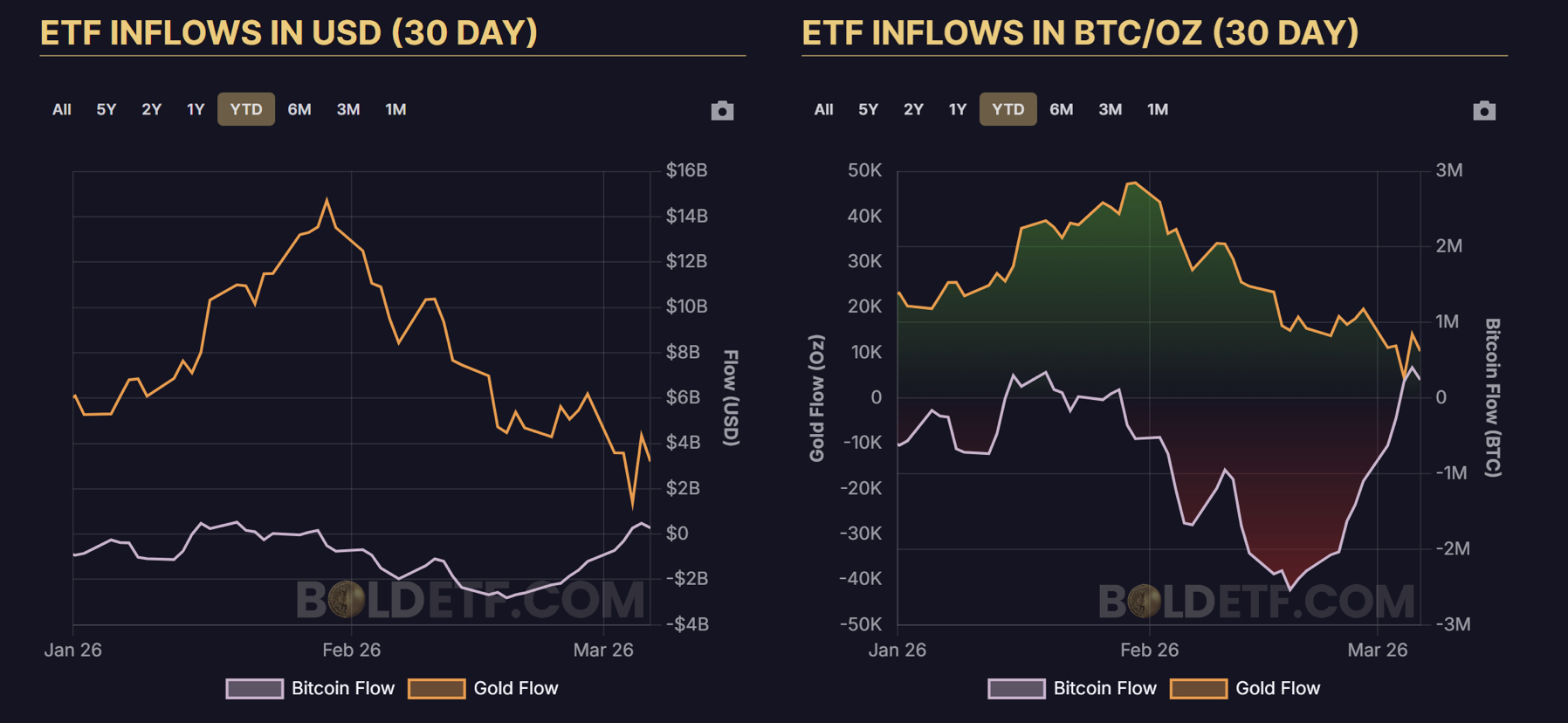
The data on holdings measured in native units shows the divergence most clearly. Bitcoin ETF balances shifted to a net increase of 4,021 BTC on March 6, from -42,275 BTC on February 6. Gold ETF holdings decreased from 1.4 million ounces to 621,100 ounces during the same period.
Native units represent the real underlying asset held by funds, rather than the dollar value of those holdings. Tracking BTC or ounces isolates the real accumulation or distribution without the distortion created by price movements.
Horizon’s growth director, Joe Consorti, summarized the current trend and said:
“Gold is stagnating while Bitcoin is soaring. BTC is about to surpass gold's percentage growth over the last month, as the US economy accelerates and risk sentiment improves. The anticipated rotation from 'risk aversion' to 'risk appetite' could be underway.”
The spikes in gold precede Bitcoin recoveries
In a "2026 Look Ahead" report published in late December 2025, Fidelity Digital Assets analyst Chris Kuiper noted that gold's 65% return in 2025 was the fourth largest annual gain since the end of the gold standard. Regarding previous spikes, Kuiper indicated that gold is potentially near the final stages of its leadership cycle between the two assets. Kuiper said:
“Historically, gold and Bitcoin have taken turns outperforming. With gold shining in 2025, it wouldn't be surprising if Bitcoin takes the lead next.”
However, the rotation may take some time to develop in the market.
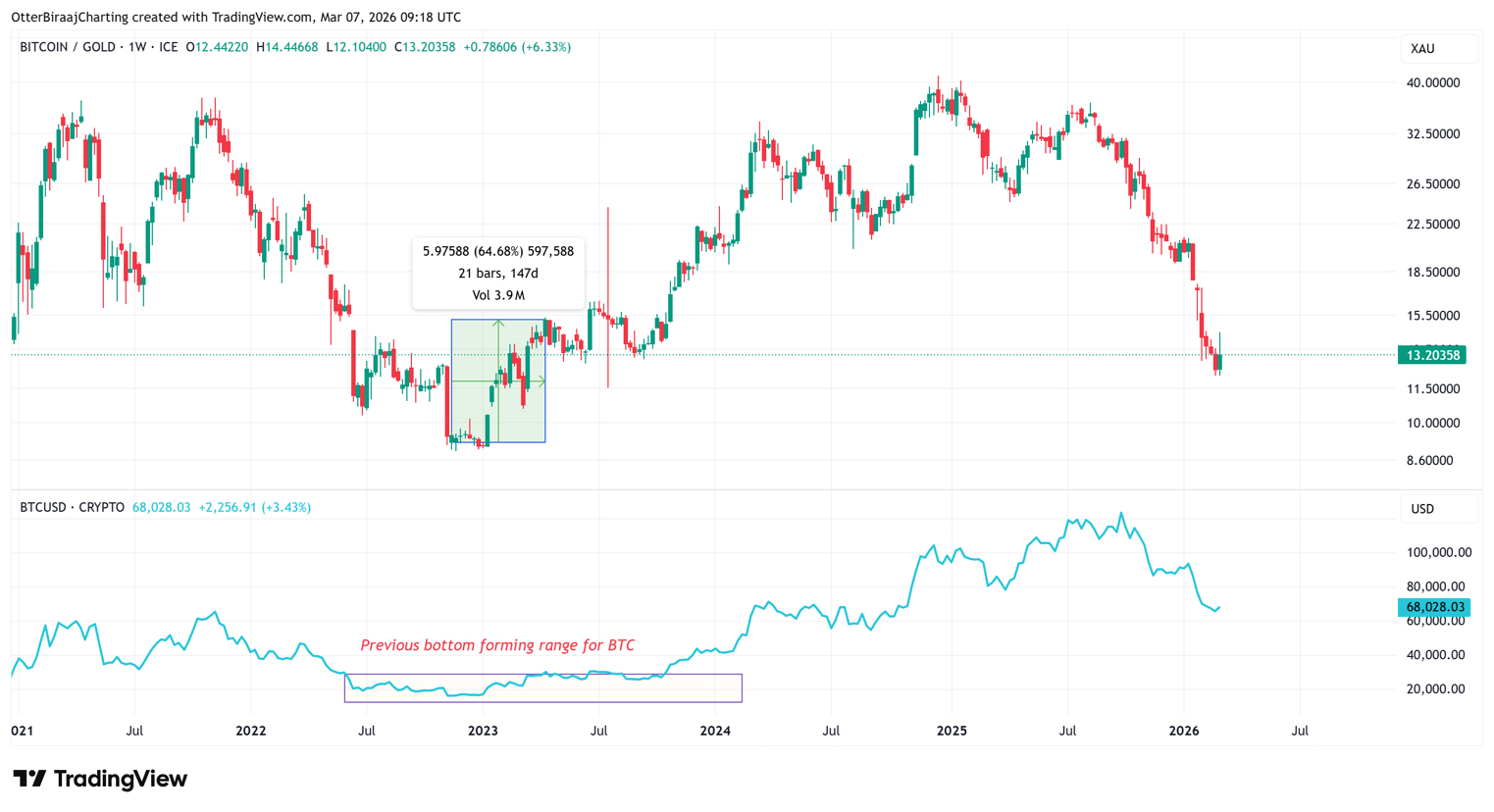
As illustrated in the chart, BTC needed approximately 147 days or 21 weeks to establish a sustained trend of outperforming gold after Bitcoin's low in 2022. The period marked a consolidation phase before the ratio began to rise.
The BTC-gold ratio is currently trading near the same consolidation zone observed during previous rotation phases in 2022-2023.
Kuiper also added that both assets can benefit from persistent fiscal deficits, trade tensions, and geopolitical uncertainty, as investors seek neutral stores of value outside traditional monetary systems.
The ongoing war between the US, Israel, and Iran has strengthened the demand for traditional safe-haven assets, which previously supported gold spikes during periods of geopolitical stress.
Meanwhile, macroeconomic strategist Lyn Alden expects Bitcoin to outperform gold over the next two to three years, following the recent gold spike in recent months.