
Today I spent the entire afternoon on the square, and it was extremely frustrating. The screen was full of lobsters, the Yi Yi War, pictures brought over from Twitter, and all sorts of土狗币 shouting orders. After wandering around for a long time, I was really tired, and even more tired that this time ROBO didn't make it into the top 100, so anxious ah ah ah ah ah!! I found that everyone seems not to care about what problems the underlying technology is really solving, and they are all just deceiving each other for some meaningless traffic. This kind of suffocating feeling of 'treating retail investors as fools' reminded me of a recent loss I had.
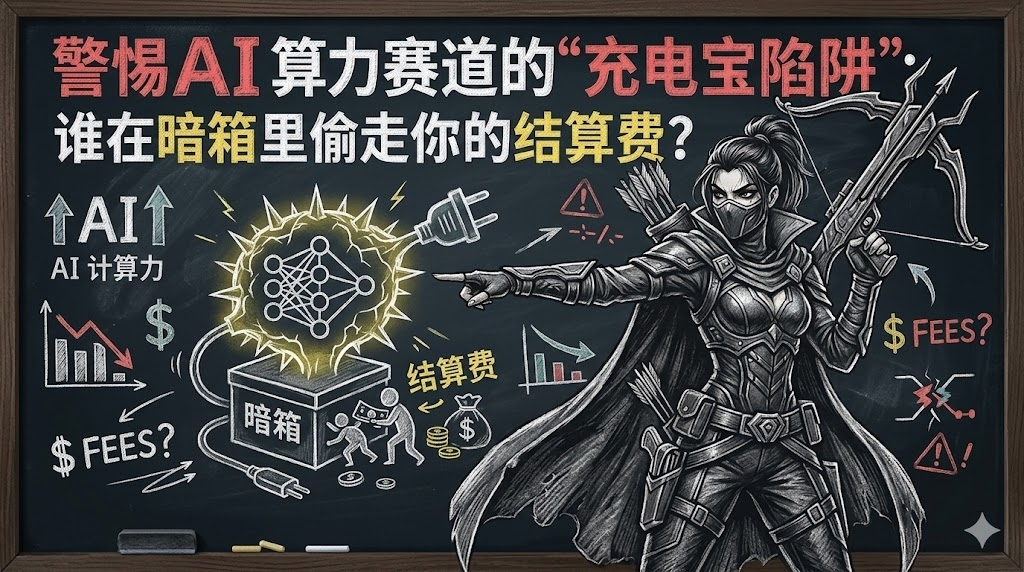
At that time, I went to the mall to play, and when my phone ran out of battery, I borrowed a Meituan power bank. After using it, I clearly plugged it back into the cabinet perfectly, and the indicator light was on, so I went home with peace of mind. As a result, after walking two streets, my phone suddenly popped up a notification saying it was still charging by the hour! I contacted customer service to file a complaint, but the customer service representative was like an emotionless machine, asking me to 'provide a photo of the cabinet on-site.' I was two kilometers away, where was I supposed to take a photo? In the end, I could only watch helplessly as it charged me the maximum amount of 99 yuan according to the霸王条款. This phenomenon of 'the device has been returned, but the digital system is still mindlessly charging' is purely capital exploiting a black box system to fleece people.
One | The so-called intermediary black box of 'machine interconnection'
If you are deeply disgusted by this system's black box, you should really take a magnifying glass to examine the myriad Web3 AI and so-called smart machine interconnection projects currently flying around. You will despairingly find that many ecosystems are simply enlarged versions of countless 'shoddy charging cabinet machines.'
They painted a grand vision in the white paper, claiming that future AI agents and smart devices can autonomously collaborate and transact with each other. But the most fatal flaw lies in: after the machines have done their work, who exactly is keeping the accounts and distributing the money? Currently, the vast majority of projects have not established a peer-to-peer trust bridge between machines, relying instead on the opaque centralized server of the project side to act as the 'settlement center.' Retail investors buying these ecosystem tokens are equivalent to putting money into a centralized app that can randomly deduct fees or even arbitrarily alter data at any time. Once the official server crashes or acts maliciously, the entire so-called intelligent network collapses instantly, leaving no foundation of trust.
Two | @Fabric Foundation : The 'truth ledger' of the physical world
In this chaos filled with data falsification and confusion, I would rather face the interference of a screen full of fluff today than to thoroughly write down the underlying logic of the Fabric Protocol. Because it fundamentally reconstructs the underlying infrastructure of 'anti-cheating' in the machine world.
It is a completely decentralized open settlement network. We must ask, what role does it play in this network? The answer is: acting as the 'truth ledger' and 'anti-counterfeiting meter' when machines transact with each other.
Imagine a delivery drone running low on power, making an emergency landing at a private shared charging station. The drone needs to buy electricity, and the charging station needs to collect money; how do these two cold machines, with no foundation of trust, conduct business?
Three | Refusing to pass the buck: Cryptographic proof and second-level flow payment
Faced with this deadlock of trust, Fabric provides an extremely hardcore solution. In this scenario, the drone and charging station do not require any centralized institution for guarantee but rather rely directly on the Fabric network to establish a low-friction 'flow payment' channel.
Note that there is no room for any disputes in this settlement. Every milliamp of electricity output from the charging station to the drone must be submitted in real-time on the underlying network as an immutable 'physical workload cryptographic proof.' The Fabric network acts like an absolutely neutral and strict auditor, instantly verifying this proof—confirming that the electricity is indeed being charged, not a fabrication by the charging station.
Only when the proof has been verified will the smart contract in the drone's wallet trigger, sending the corresponding $ROBO in real-time to the charging station. Data flow, physical workload, and funds flow are absolutely bound at the microsecond level. If the charging station encounters a fault midway or attempts to forge charging data, once the cryptographic proof fails, the funds flow will instantly be cut off by the smart contract.
Four | Work completed, accounts settled
The machines only take as much money as the work they have done; there can be no extra charges or any money that can be evaded. #ROBO This completely eliminates the black box disaster of 'equipment has been returned but fees are still being deducted.' In the face of this frictionless infrastructure, those projects that rely solely on fake data for support are simply not sustainable. Instead of following the crowd in the square to watch those nutritionally void machine press releases, it is better to calm down and see the underlying logic that can truly change the commercial friction in reality.