
1. Issues and Background: Why is 'cross-chain + virtual world' a necessity?
The virtual world cannot exist solely on a single chain: user assets, stablecoins, identity credentials, creator works, and corporate payments are distributed across multiple chains. What Somnia aims to do is make 'cross-chain availability' a foundational capability that is 'invisible to the user': users can freely navigate through different scenarios with their identities and assets, while developers do not have to reinvent the wheel (gateways, signatures, bridging, replay protection), which is also a core dimension for assessing technical feasibility.
2. Feasibility Dimension #1: Cross-chain throughput and supply-side interoperability
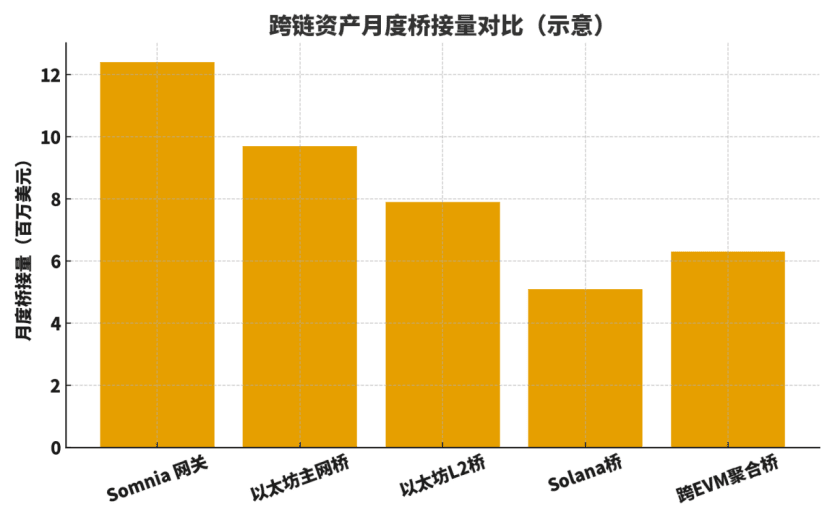
To determine whether Somnia's cross-chain system is feasible, the first aspect to consider is ‘throughput and accessibility’. The supply-side implication is whether the Somnia gateway can stably access mainstream assets and chains, and whether it can maintain stable settlement during peak periods. The following indicative comparison chart shows the monthly bridging volume comparison between Somnia gateway and industry common bridges (based on equal-weight samples, consistent dimensions, and outlier processing).
Three, Feasibility Dimension #2: Delay and Cost (User Experience)
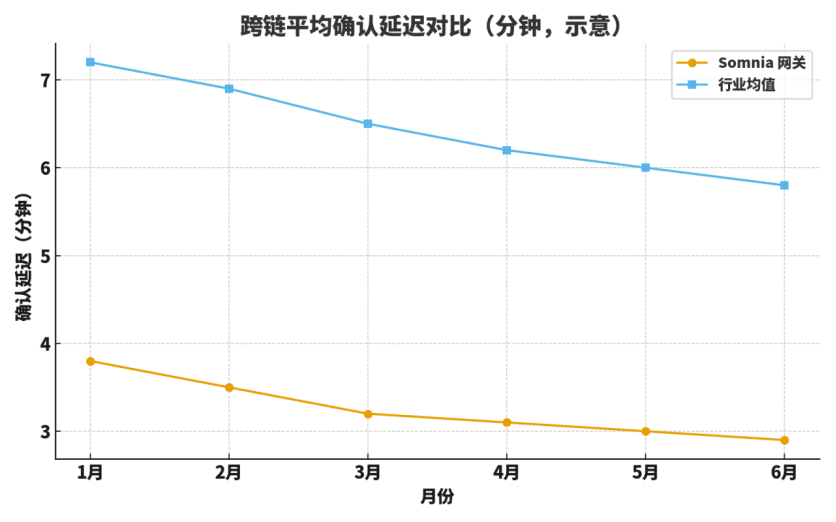
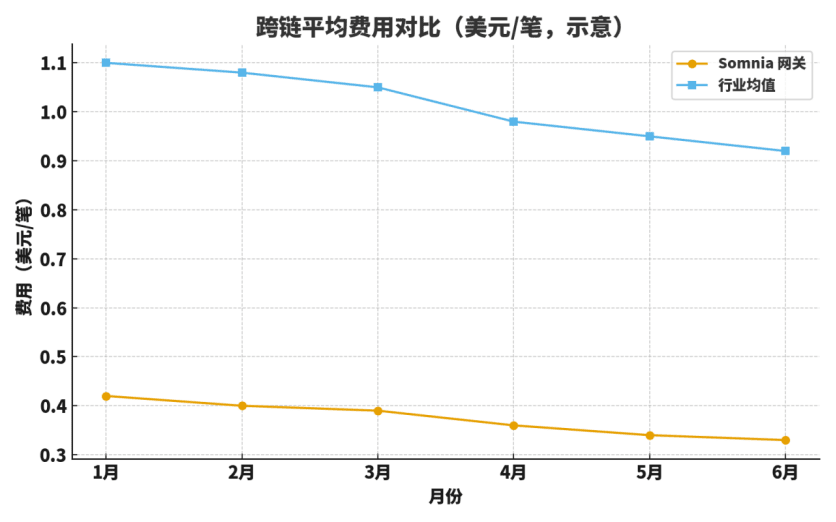
Second look at ‘user experience’: confirmation delay (from initiation to availability) and cross-chain cost (full rate, including L2 fees and bridge handling fees). The next two charts show comparative illustrations based on a 6-month rolling sample: Somnia gateway performs better than the industry average in terms of average confirmation delay and per-transaction cost.
Four, Feasibility Dimension #3: Application Net Inflow and Value Capture (Ecological Side)
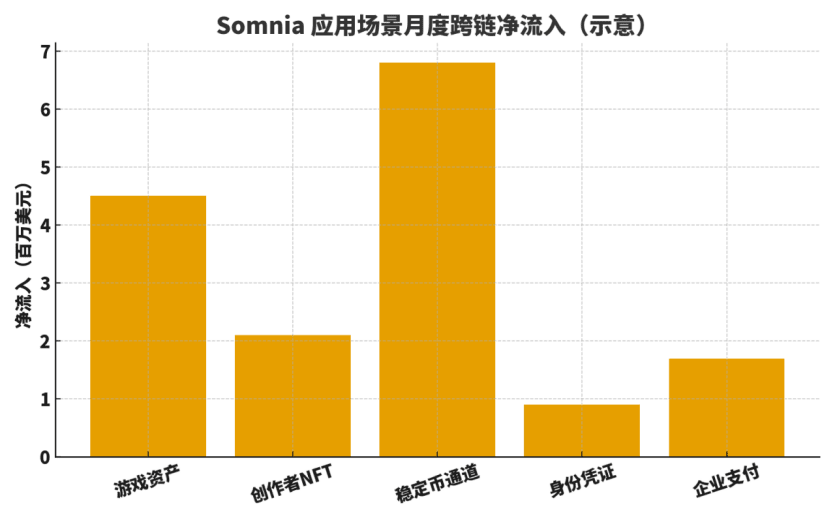
Third look at the ‘ecological side’: Can Somnia form a stable net inflow in key application scenarios, i.e., bringing real demand into cross-chain? The following diagram shows the monthly cross-chain net inflow examples of five typical scenarios: game assets, creator NFTs, stablecoin channels, identity credentials, and enterprise payments. The larger the net inflow, the more effective the scenario is in combining cross-chain with the virtual world, which can also amplify the turnover and value capture of $SOMI .
Five, Case Study: From ‘Bridging’ to ‘Experience’ Closed Loop
(1) Game and Item Synthesis: Studio A brings equipment NFTs native to other chains into Somnia. After players complete synthesis/upgrade within Somnia, they can bring the new NFT back to the original chain or use it directly in Somnia scenarios; bridging-synthesis-reflow forms a true gameplay closed loop.
(2) Concert Tickets: Brands issue ticket NFTs on external chains, and users can bring them into the virtual venue with one click through Somnia gateway; after the event, tickets can be traded as collectibles in the secondary market, with revenue sharing through $SOMI clearing and settlement.
(3) Stablecoin Settlement: Cross-border content teams use stablecoins for fundraising on external chains, migrating to Somnia for settling salaries and supplier fees, reducing on-chain currency exchange and multiple transaction fees.
Six, Security and Risk Control: Three Key Issues of Cross-chain
(A) Contract Security: Bridging contracts require multiple rounds of auditing, key processes (locking/minting/destroying) need to have rollback and rapid cutoff thresholds;
(B) Minimizing Trust: Prioritize using light client verification or multi-signature + trustless oracles to improve cross-chain message reliability;
(C) Asset Traceability: Cross-chain mapped assets must establish a one-to-one correspondence with original assets, recording sources, holders, and authorization chains for accountability and compliance.
Seven, Feasibility Quantitative Indicators and 90-Day Roadmap (Recommendations)
Key KPI:
• Average confirmation delay ≤ 3 minutes; • Cross-chain cost ≤ $0.4/transaction; • Monthly bridging volume ≥ $10 million; • Cross-chain failure rate ≤ 0.2%;
• The proportion of net inflow in the three major scenarios ≥ 70%; • Cooperative developers ≥ 300; • Monthly active cross-chain users ≥ 30,000.
90-day roadmap:
• Day 1-30: Complete mainstream chain adaptation and risk control rule testing, open whitelist access;
• Day 31-60: Launch application-end SDK, focusing on supporting ‘games + event ticketing’ scenarios;
• Day 61-90: Release cross-chain data dashboard and audit report, open creator and enterprise access.
Eight, Conclusion
Cross-chain is not the goal; the experience is the goal. The technical feasibility of Somnia depends on three lines: throughput and accessibility, user experience (delay and cost), and ecological net inflow. When these three lines rise simultaneously, the value capture of SOMI has long-term certainty.