

I’m watching another idea slowly circulate through the crypto world, and I’ve learned over time that the quiet ones are usually the most interesting to sit with for a while. Not because they promise the biggest upside or the loudest narrative, but because they’re usually trying to solve something the rest of the market doesn’t spend much time thinking about.
Fabric Protocol has been sitting in the back of my mind lately.
Not in the way hype-driven projects usually do, where every timeline suddenly fills with price predictions and ecosystem threads. This feels different. It’s more like noticing a small structural experiment happening in the background while most of the industry is still busy trading tokens against other tokens.
After watching crypto for years, one thing becomes very clear: the industry is incredibly good at building systems that only interact with themselves.
Liquidity moves between exchanges, lending platforms, and derivatives markets. Yield strategies stack on top of other yield strategies. Protocols reward users with tokens that are often immediately reinvested somewhere else inside the same ecosystem. It’s a surprisingly complex financial machine, but it often exists inside a closed loop.
That loop has always felt like one of crypto’s quiet limitations.
The moment you step outside it, things become much harder. Suddenly you’re dealing with real-world verification, real-world incentives, and messy physical systems that can’t be reduced to a few lines of code.
That’s where Fabric caught my attention.
From what I’ve been observing, the protocol seems to be exploring the idea of machines participating in decentralized economies. Not humans controlling machines, but machines themselves acting as economic participants in a network.
The longer I sit with that idea, the stranger it becomes.
For most of human history, machines have always been tools. They perform tasks, but they don’t exist inside markets in the same way people do. A robot in a warehouse might move packages all day, but it doesn’t hold a wallet. It doesn’t request payment for the work it performs. It doesn’t negotiate with a network for tasks.
Crypto changes that dynamic in a subtle way.
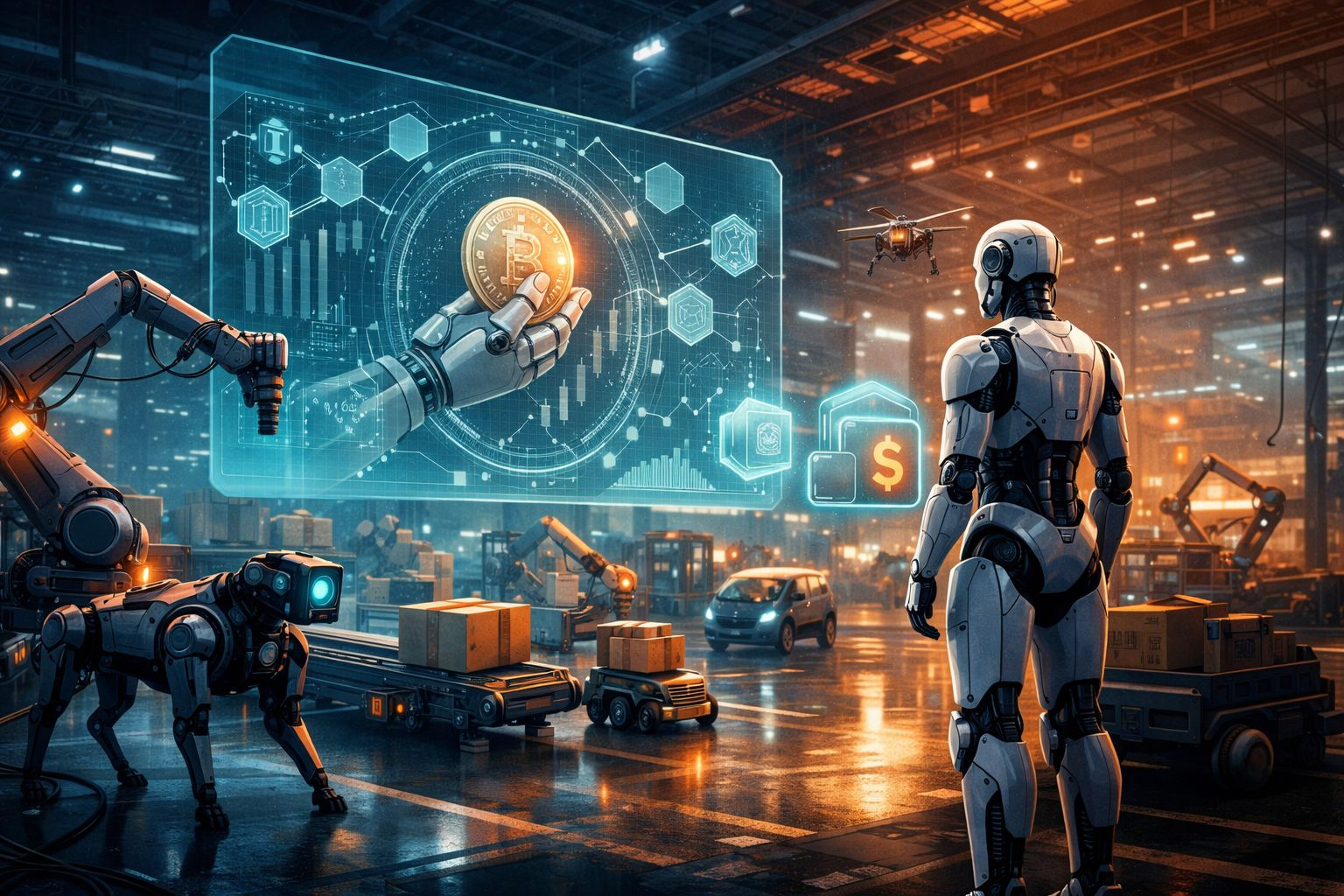
Blockchains don’t really care who or what controls a wallet. From the network’s perspective, an address is just an address. Whether it belongs to a person, a script, or a machine is mostly irrelevant to the system itself.
That neutrality opens a strange possibility.
If machines can hold identities and interact with smart contracts, they could theoretically request work, complete tasks, and receive payment automatically. The network simply sees activity, verification, and settlement.
Fabric seems to be exploring infrastructure for that kind of environment.
I find myself thinking less about the technology and more about the incentives such a system would create. Incentives are where most crypto experiments reveal their true shape.
Every time a protocol introduces rewards for some form of activity, people immediately start looking for ways to optimize around those rewards. Sometimes that means genuine participation. Other times it means finding loopholes.
DeFi went through this phase repeatedly. Liquidity mining turned into elaborate capital rotation strategies. Governance systems became arenas for power concentration. Yield farms often rewarded whoever could move funds the fastest rather than whoever added the most value.
That history makes me curious about how a machine-based economic system would behave.
If a network rewards machines for performing work, someone will eventually try to simulate that work. If the system pays for robotic output, someone somewhere will attempt to fake robotic output.
And that’s not necessarily a failure of the system. It’s actually part of the process. The moment people start trying to exploit a network is usually the moment you discover whether its verification model is strong enough.
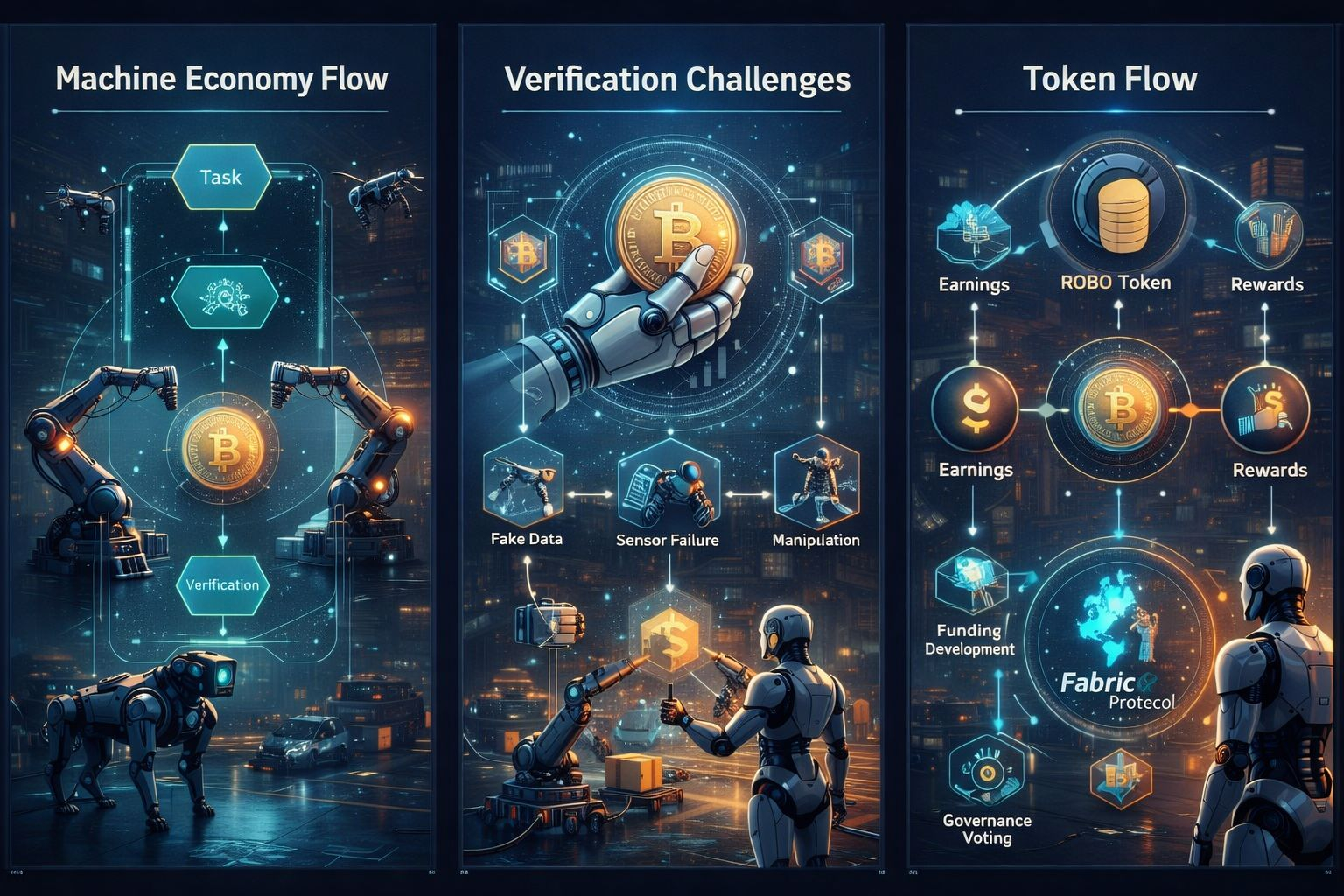
Fabric seems to be approaching this through the idea of verifiable machine activity, where tasks performed by robots or autonomous systems can be confirmed and rewarded on-chain. Conceptually it sounds straightforward, but the moment you think about real-world conditions the complexity appears quickly.
Machines exist in unpredictable environments. Sensors fail. Hardware behaves imperfectly. Data can be manipulated if someone has the right incentives.
Connecting the digital certainty of a blockchain with the messy unpredictability of physical machines is not a trivial problem.
Still, there’s something about the direction itself that keeps pulling my attention back.
Crypto has spent more than a decade building financial infrastructure. Exchanges, lending protocols, derivatives markets, collateral systems. These tools are powerful, but they mostly circulate value within the digital economy.
Machines represent a potential bridge between that digital economy and physical activity.
Automation is slowly expanding across industries. Warehouses, farms, logistics networks, manufacturing lines — more and more systems are becoming autonomous or semi-autonomous. AI agents are also becoming capable of performing tasks with minimal human oversight.
If those systems ever begin operating independently at scale, they might need a way to interact economically.
They might need identities. Payment channels. Ways to request work and settle transactions without relying on a centralized operator controlling everything.
That’s the kind of environment where a decentralized coordination layer starts to make more sense.
What Fabric seems to be experimenting with is the idea that blockchains could serve as that coordination layer for machines the same way they currently coordinate financial transactions.
But crypto has a long history of imagining futures that arrive much slower than expected.
Markets tend to move at internet speed while real-world infrastructure evolves at industrial speed. Hardware adoption takes time. Regulations take time. Entire ecosystems need years to mature.
That mismatch often creates strange cycles where tokens representing future infrastructure trade long before the infrastructure itself actually exists.
I’ve seen this happen enough times to be cautious about early narratives.
The market might focus on price movements or exchange listings, but those signals rarely tell you whether a system is actually working. What matters is whether activity begins to form around the protocol for reasons other than speculation.
Real usage tends to emerge quietly.
Developers build things without much attention. Systems get tested in small environments. Edge cases appear. Incentives get adjusted. Over time the network either stabilizes into something useful or it slowly fades away.
Fabric still feels like it’s somewhere near the beginning of that process.
There are many unanswered questions about how machine verification works at scale, how incentives remain balanced, and how the system prevents participants from gaming the rewards.
But those questions are exactly what make the idea worth watching.
Because if machines ever begin participating directly in decentralized economies — earning, spending, and coordinating through open networks — the structure of crypto changes in a meaningful way.
Instead of purely financial systems circulating digital assets, the networks would start interacting with physical production and automated labor.
That would be a very different kind of crypto economy.
Right now, though, it’s still just an experiment forming in the background.
And after spending enough time around this industry, I’ve learned that the most useful position in moments like this is simply observation.
So for now I’m watching how the system evolves, how the incentives develop, and whether the architecture slowly moves closer to the real world instead of remaining inside the familiar loop of crypto talking to itself.