


𝗕𝘂𝘁 𝗧𝗵𝗲 𝗜𝗻𝗳𝗿𝗮𝘀𝘁𝗿𝘂𝗰𝘁𝘂𝗿𝗲 𝗜𝘀 𝗔𝗹𝗿𝗲𝗮𝗱𝘆 𝗕𝗲𝗶𝗻𝗴 𝗕𝘂𝗶𝗹𝘁 𝗔𝗿𝗼𝘂𝗻𝗱 $𝗥𝗢𝗕𝗢
When people hear about robots working in the economy, many still imagine a distant future.
Something that may happen decades from now.
But in reality, autonomous machines are already operating in many industries today.
Warehouse logistics systems rely on automated machines to move goods.
Inspection robots monitor pipelines, bridges and industrial facilities.
Autonomous delivery systems are being tested in multiple cities.
The presence of robots in real-world environments is already growing.
However, there is an important challenge that often receives less attention.
Robots today mostly operate inside isolated systems.
Each robotics company builds its own hardware, software environment and coordination system.
As a result, machines cannot easily interact with systems outside their own ecosystem.
This limits how robotics networks can scale.
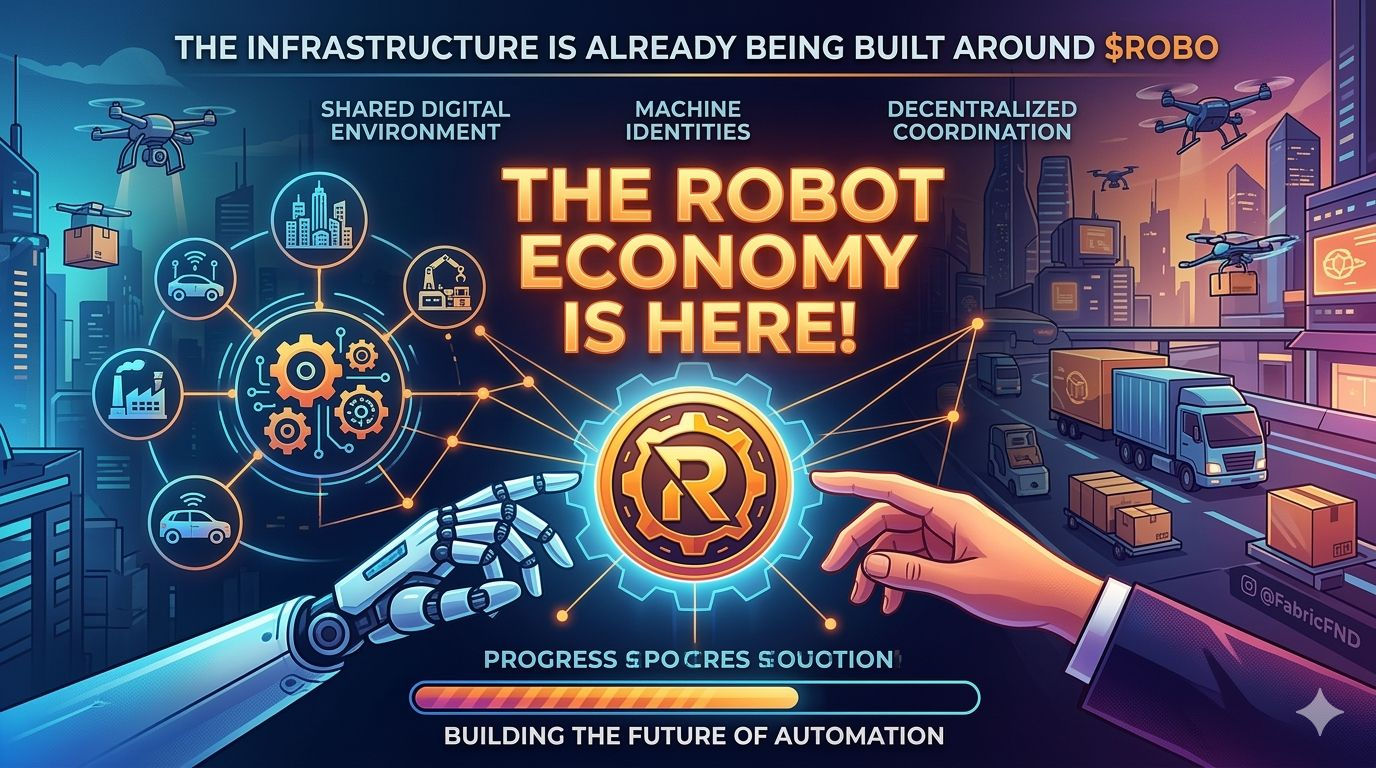
The ecosystem surrounding Fabric and $ROBO explores a different approach to this problem.
Instead of treating robots as isolated devices, the architecture introduces a shared infrastructure where machines can operate within a coordinated digital environment.
Within this network, machines can register identities and interact inside a verifiable system.
This makes it possible to track machine activity, coordinate tasks and enable interactions between different participants in the ecosystem.
Infrastructure becomes especially important as the number of autonomous machines increases.
When thousands of machines begin operating across logistics networks, manufacturing systems and infrastructure environments, coordination becomes critical.
Fabric explores how decentralized infrastructure can support this coordination layer.
In this architecture, $ROBO functions as the economic and governance layer supporting the ecosystem.
The token can enable participation in the network, support governance mechanisms and help coordinate activity between participants.
This allows developers, machine operators and infrastructure providers to interact within the same technological framework.
The key idea behind this model is simple.
The robot economy may not begin when machines become more intelligent.
It may begin when machines can interact, verify actions and coordinate inside shared digital networks.
Projects like Fabric are exploring how this infrastructure layer could support that transition.
And if robotics adoption continues accelerating across industries, the systems coordinating those machines may become just as important as the machines themselves.