

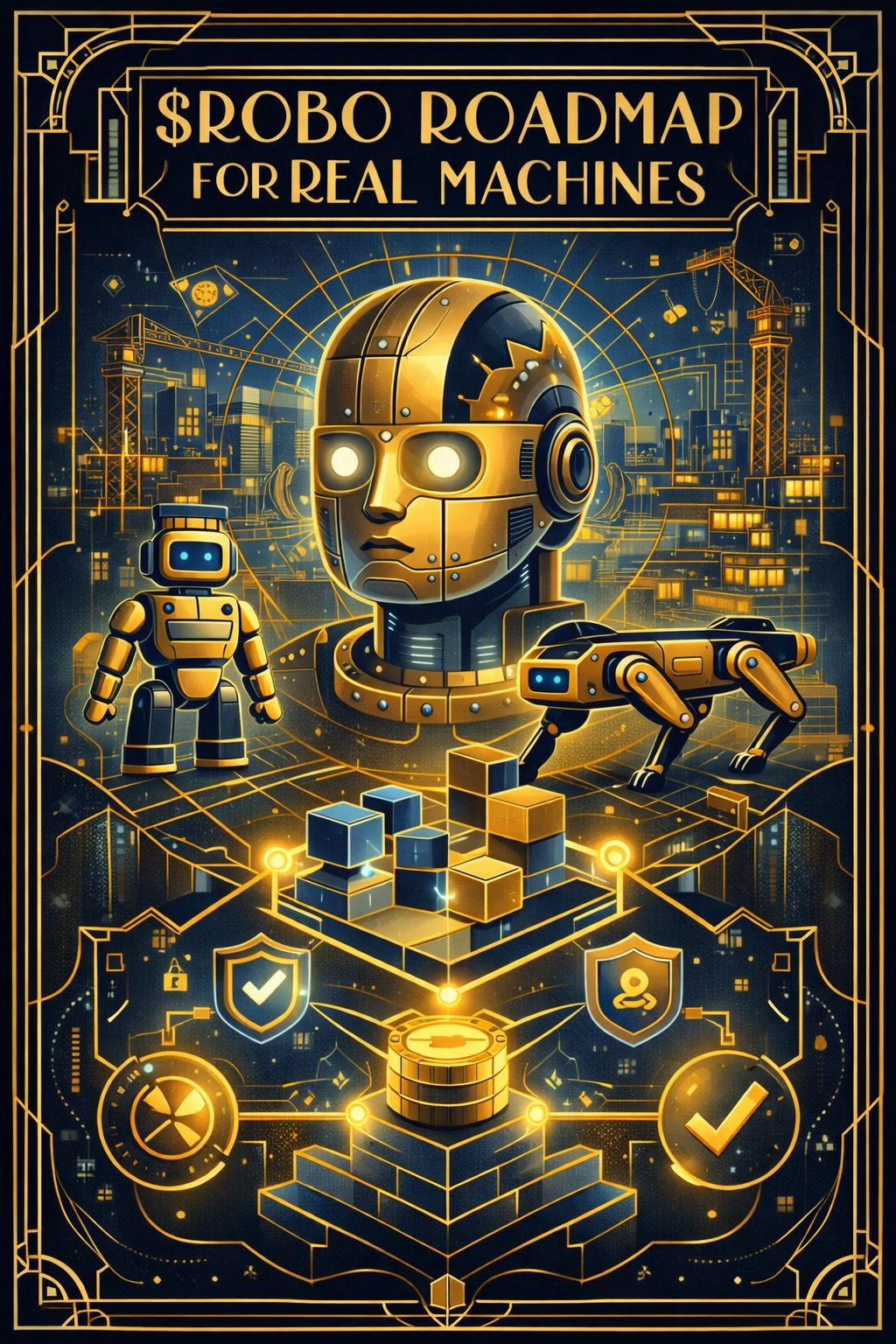
 Few days ago I was looking through the roadmap around the $ROBO ecosystem, and something about it felt different from the typical crypto roadmap you usually see.
Most projects in this space publish roadmaps filled with upgrades, new features, token utilities, and ecosystem partnerships. Everything moves quickly because the systems involved are mostly digital.
But when the technology starts involving real machines, things move differently.
Robots are not like smart contracts. You cannot simply deploy a new version overnight and expect thousands of devices to update instantly. Machines operate in physical environments where reliability, safety, and coordination matter just as much as innovation.
That is why the direction around the $ROBO ecosystem seems less focused on fast feature releases and more focused on slowly building infrastructure that real machines could actually use.
The first thing that stood out to me was the focus on machine identity.
If robots from different manufacturers ever begin interacting in open environments, identity becomes a surprisingly important problem. A machine cannot simply appear in a network and start requesting services without some way of proving what it is and what it can do.
Think about something simple like a delivery robot arriving at a charging station.
Before allowing access, the station would probably need to know a few things. Is this machine legitimate? Has it successfully completed tasks in the past? Does it follow the same operating rules as the rest of the network?
Without some form of verifiable identity, machines would have no reliable way to trust each other.
This is where the identity layer described in the ecosystem becomes interesting. Robots can maintain persistent on-chain identities that record their operational history over time. Instead of relying on a central company database, machines build a track record that other devices in the network can reference.
In many ways it starts to look like a reputation system for machines.
But identity alone is not enough.
The next challenge appears when machines start claiming that work has been completed. In purely digital systems this problem is relatively simple. A computation runs, the output is returned, and the result can usually be verified mathematically.
Robotics environments are much more complicated because machines interact with the physical world.
A robot might claim it delivered an item, inspected a location, or transported equipment across a warehouse. But confirming that action requires evidence coming from sensors, logs, or environmental data.
That is where the idea often referred to as Proof of Robotic Work begins to make sense.
Instead of simply saying a task was finished, machines can attach verifiable data that shows what actually happened. Sensor readings, system logs, or other measurable signals can become part of the verification process.
Over time this information forms a record of activity connected to each machine’s identity.
Once identity and verification exist, another layer naturally follows: economic interaction.
If machines can prove who they are and verify what they do, then they can start exchanging services with each other in a much more structured way.
This is where the role of the ROBO token begins to appear in the system.
Rather than functioning purely as a speculative asset, the token acts as the settlement layer for machine-to-machine services inside the network. A robot accessing electricity, data processing, or specialized services from another machine could potentially complete the interaction and settle the cost automatically.
In other words, machines start paying each other for useful work.
But the roadmap also hints at another interesting detail around incentives.
Instead of relying entirely on fixed token emissions, the ecosystem describes an Adaptive Emission Engine that adjusts rewards depending on network activity and performance conditions.
If participation in the network drops, emissions can increase to encourage more activity. If service quality falls or the system becomes unstable, emissions can decrease.
The idea is to keep incentives aligned with real usage rather than passive token holding.
Another piece of the puzzle sits slightly underneath the protocol itself.
The ecosystem connects to the OM1 operating system, which acts as a shared robotics environment capable of supporting machines from multiple manufacturers. Companies like UBTech, AgiBot, Deep Robotics, and Fourier have been associated with this layer.
If robots built by different organizations can run inside the same operating environment, the coordination layer built around ROBO becomes much more meaningful.
Instead of isolated robotics ecosystems, machines could eventually operate inside a shared network where identity, verification, and economic coordination exist as infrastructure.
Of course, building something like this is not easy.
Robotics environments demand extremely high reliability. Machines operate in real-world settings where mistakes can have physical consequences. Integrating decentralized networks into that environment will take time and careful testing.
But the direction automation is moving makes these questions increasingly important.
As robots spread across logistics networks, factories, hospitals, and public infrastructure, machines will inevitably encounter devices built by other companies. They will need ways to verify each other, exchange services, and coordinate work without constant human supervision.
The roadmap around $ROBO seems to be exploring how that kind of machine interaction network might gradually take shape.
And if automation continues expanding at its current pace, the most interesting question may not be how intelligent robots become, but whether the networks connecting them are capable of supporting millions of autonomous machines working together.