

#ROBO $ROBO @Fabric Foundation
When I first heard about Fabric Protocol, it wasn’t the robotics part that grabbed me. Robotics has been making headlines forever. What actually made me stop and think was this idea of treating robotics infrastructure like crypto networks treat storage or computing power—a shared, open resource that anyone can tap into.
That hit me as a sign of a bigger shift happening, mostly under the radar.
You look at the AI boom, and the whole conversation centers on models. Who’s got the biggest, fastest, most powerful one? But there’s something a lot more physical underneath all that hype. AI needs hardware—sensors, robots, machines that actually move and interact in the real world.
And let’s face it, that hardware isn’t cheap.
Right now, robotics is mostly locked up inside big companies and research labs. Building robots means you need gear, data, places to test things, and you have to keep tweaking everything. Not many people have access to all that. So the folks designing smart software and the ones building the machines are often separated by big piles of money.
That’s where Fabric Protocol gets interesting.
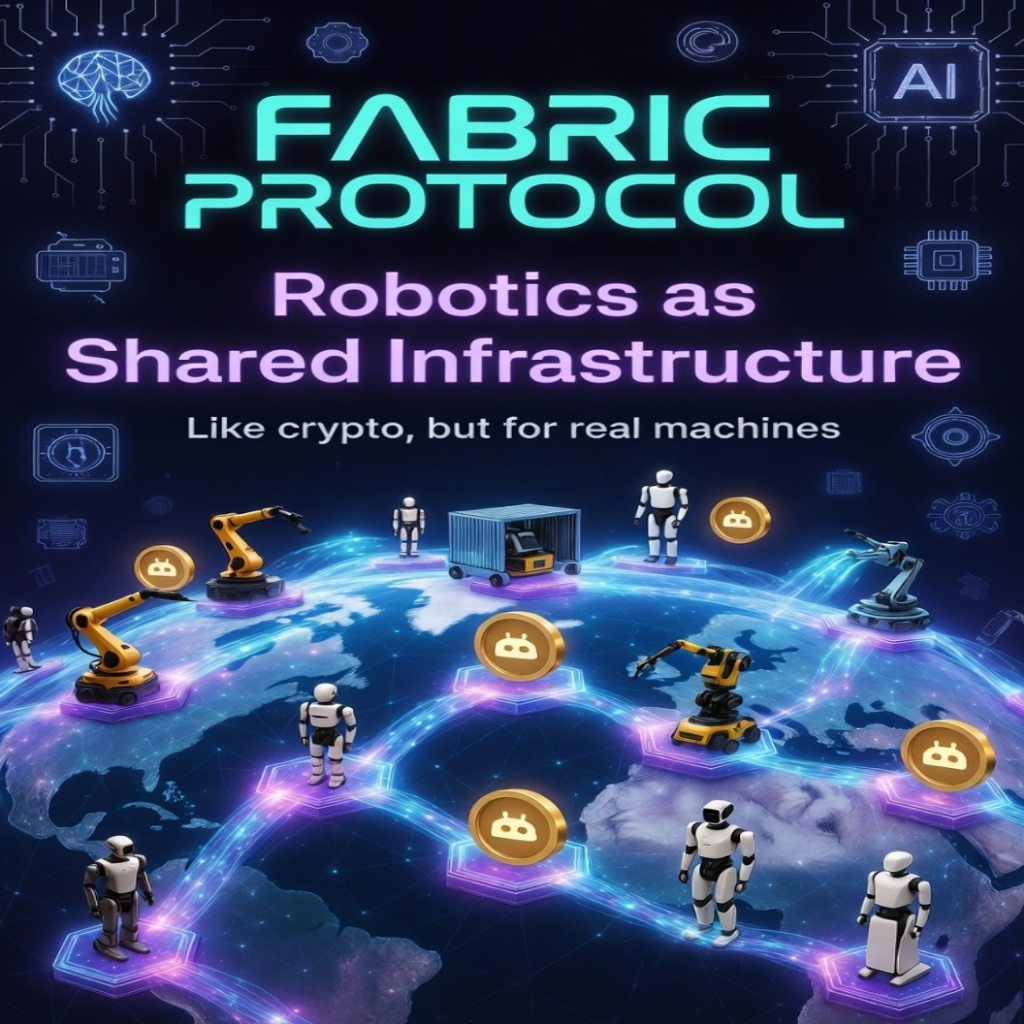
Instead of seeing robotics hardware as something only a big lab or company owns, Fabric treats it like network infrastructure. The idea’s pretty simple: anyone—whether you’re an individual, a developer, or an organization—can contribute robots or related equipment to this decentralized network. Others can then use those resources through the protocol, instead of building from the ground up every time.
When I tried to wrap my head around it, the closest thing I could think of was decentralized compute networks, but this time you’re talking about real machines, not just GPUs.
Everything hinges on a coordination layer. Hardware providers register their devices, and developers or AI systems interact with them through standard interfaces. Tokens keep things moving—they reward people for sharing hardware, help manage who gets access, and keep everyone motivated to participate.
What sets this apart from most AI-crypto projects is it’s not just about digital stuff. Most projects in this space focus on sharing data, training models, or spreading out compute power. Fabric’s going for something more tangible—giving people access to actual robotics systems.
In theory, this lowers the barrier for robotics and automation experiments. Say you’re a developer working on AI for warehouse logistics. Instead of needing to own a bunch of robots, you could test your algorithms on shared machines.
Still, there are some real challenges.
Coordinating physical infrastructure is way messier than handling cloud servers. Robots need maintenance, safety checks, fine-tuning, and you have to deal with location issues. Latency, uptime, and liability all get a lot trickier when you’re dealing with things that can move and break in the real world.
Then there’s the adoption problem. Decentralized networks only work if enough people chip in meaningful hardware. If that doesn’t happen, the whole thing stays theoretical.
But the overall direction feels important.
Crypto infrastructure has been quietly branching out beyond finance for a while now. We’ve seen networks for storage, compute, wireless, and data. If that trend keeps going, it’s not hard to picture robotics becoming just another shared layer.
At its core, Fabric Protocol is an early shot at treating physical automation the same way decentralized systems handle digital resources. It’s a way to coordinate, access, and scale robotics through networks instead of central ownership.
Will it work? Hard to say right now. But the idea itself hints at a future where building smart machines might be less about owning hardware, and more about plugging into a global network and just using what you need.