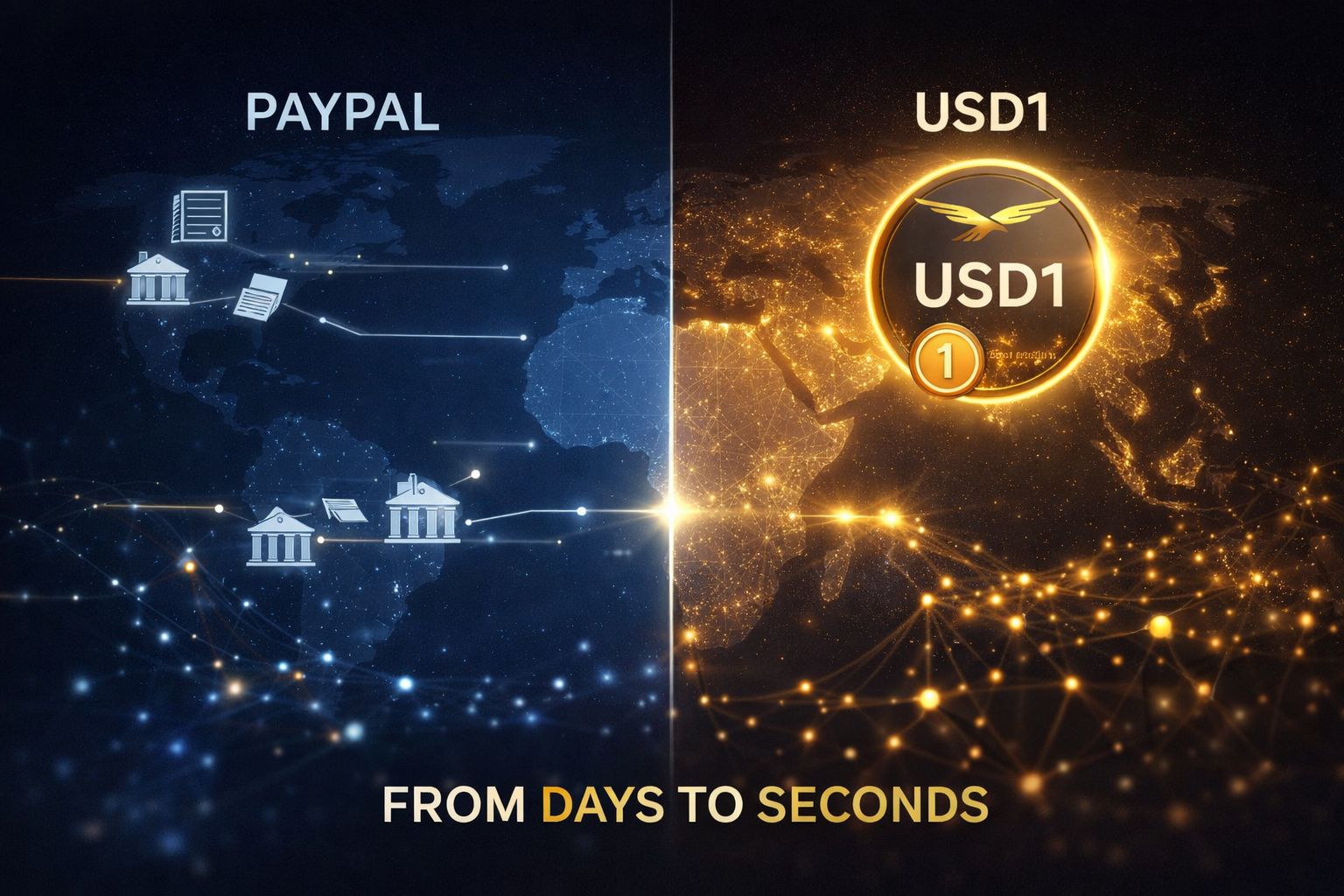
The real loss to USD1 for PayPal is not the fees, but the payment period.
Many people discuss cross-border payments, but the first reaction is always to focus on the rates.
But those who have done B2B know that what is truly expensive is often not that 1% or 2%. It's that the money clearly belongs to you, yet it gets stuck on the road for 3 days, 5 days, or even longer.
This is the most invisible and often overlooked cost of cross-border payments.
➰Whether it's PayPal or traditional cross-border payments, the issue has never just been about being expensive.
The problem is that the process is too long.
Confirm
Clearing
Intermediary bank
Foreign exchange
Weekday restrictions
Pause on weekends
On the surface, you are receiving payments, but in essence, you are waiting for the system to slowly release them. What businesses fear most is not paying fees, but having their cash flow held up by time.
➰So I'm increasingly convinced that what USD1 really wants to replace isn't another stablecoin.
It's not USDT.
It's not USDC.
It's not even a competitor on any ranking list. What it really wants to replace are the invisible frictions in cross-border B2B payment terms.
That's the key point.
➰The official website clearly states that USD1 is not intended for emotional purposes.
It's for businesses and developers, and the emphasis is on:
24/7
cross-border payments
seconds settlement
reduced costs。
This rhetoric has already made its direction clear: it doesn't aim to create coins that are easier to speculate on.
What it wants to do is create a more convenient dollar button in the enterprise backend.
➰This matter becomes much easier to understand once you put it from a corporate perspective.
For businesses, the most important thing is never whether a token is popular or not. It's three things:
Can it be settled at any time?
Can cross-border settlement be achieved?
Can you reduce the amount of cash flow you're using?
If the answer is:
24/7 available
Settlement can be completed in seconds.
It can reduce payment waiting time
Then it's not a cryptocurrency tool.
It's more like a new payment track.
➰I think many people are still underestimating this issue.
Because most people looking at stablecoins still only look at market capitalization, trading volume, activity, and APR.
But businesses don't see it that way.
Businesses are focused on when they'll receive payment after shipping the goods today. If they have to wait several days for payment, that's a cost. If they can settle payments in seconds, that's efficiency.
The real value of stablecoins lies not in their price fluctuations, but in how they alter the arrival time of money.
This is why I believe that USD1 is the most worthwhile asset to buy, regardless of its ranking in the cryptocurrency market.
Rather, it is the next generation of corporate settlement tools.
Because once businesses begin accepting a new default payment method, the story no longer revolves around the exchange. Instead:
Merchant backend
Developer Interface
Cross-border payments
Capital Market Settlement
This line of work is much bigger than simply creating a popular stablecoin. USD1 doesn't want to replace another coin, but rather the invisible frictions in cross-border payment terms.