

Key Highlights
The HIP-4 upgrade introduces outcome-based contracts that allow users to trade on event probabilities directly on Hyperliquid’s platform.
The initial testnet markets feature fully collateralized YES/NO contracts that eliminate leverage and liquidation risks.
Hyperliquid increased its USDH supply cap to 500 million and raised borrowing limits to support larger trading volumes.
Hyperliquid, one of the most prominent decentralized perpetuals exchanges, has activated the HIP-4 (Hyperliquid Improvement Proposal 4) upgrade on its testnet. The update marks an important step in the platform’s evolution, expanding its capabilities beyond perpetual futures and moving toward a broader derivatives ecosystem.
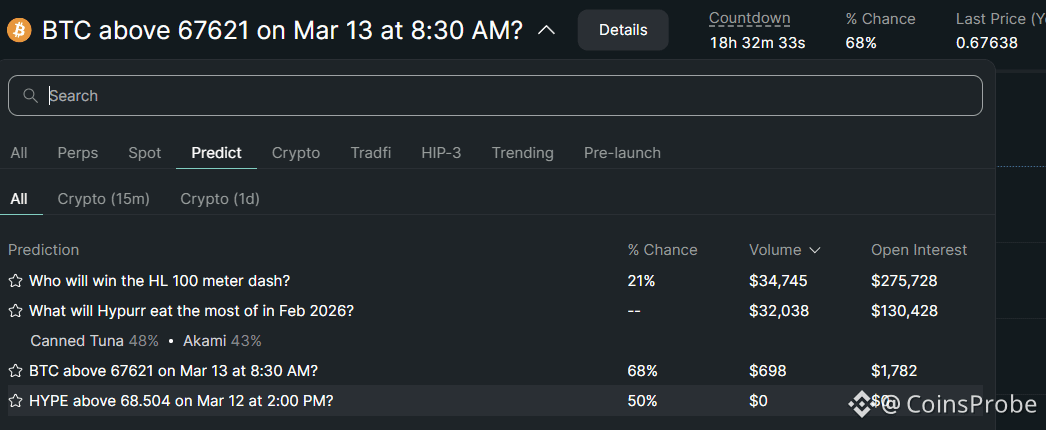
With HIP-4, Hyperliquid introduces native outcome markets, enabling prediction-style trading directly on its infrastructure. The feature places the platform in closer competition with established prediction market platforms such as Polymarket and Kalshi.
 Source: hyperliquid
Key Features of the HIP-4 Upgrade
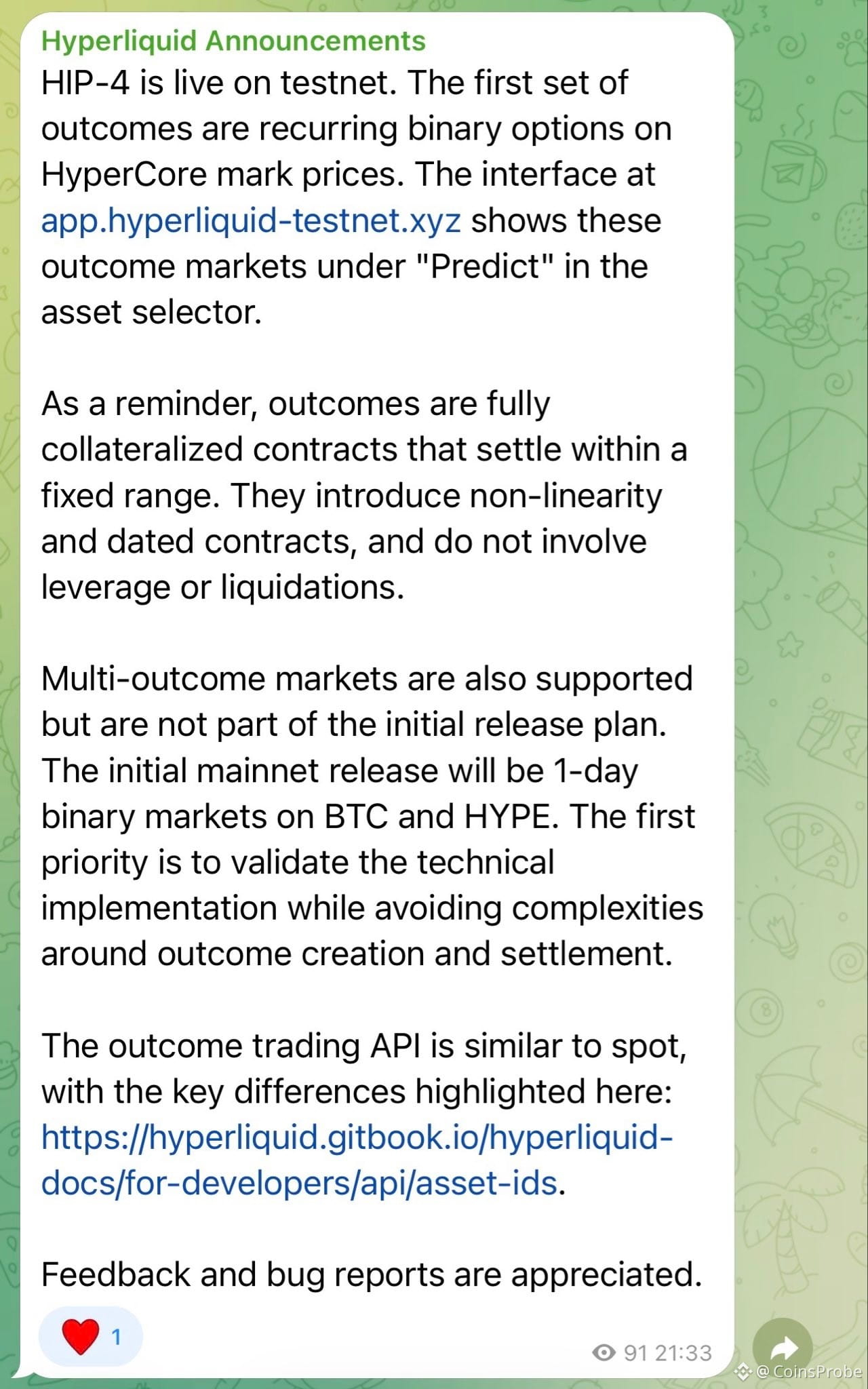
The HIP-4 rollout, which went live on the testnet around March 10, 2026, introduces a new on-chain trading primitive called Outcome Contracts. These instruments allow traders to speculate on the probability of specific events occurring, similar to prediction markets.
Several technical characteristics define these contracts:
Fully collateralized structure: Traders must deposit 100% collateral upfront, eliminating leverage and the risk of forced liquidations.
Settlement in USDH: All outcome markets settle using USDH, Hyperliquid’s native stablecoin.
Binary market design: The initial testnet markets consist of simple YES/NO contracts based on HyperCore mark prices.
Unified margin system: Unlike most prediction platforms, Hyperliquid integrates these contracts into the same portfolio margin framework used for perpetual futures, allowing advanced hedging strategies across different instruments.
This unified design could enable traders to combine outcome positions with perpetual markets, creating more complex strategies within a single trading environment.
Expansion of USDH and Portfolio Margin Limits
Alongside the HIP-4 upgrade, Hyperliquid has introduced significant changes to its Portfolio Margin system to support greater liquidity and trading capacity ahead of the eventual mainnet launch.
The updated limits include:
Global USDH supply cap: Increased to 500 million USDH
Global borrowing cap: Raised to 100 million USDH
Individual user limits:Up to 5 million USDH in supply
Up to 1 million USDH in borrowing
These adjustments are scheduled to take effect with the platform’s next network upgrade. By expanding liquidity thresholds, Hyperliquid is preparing its infrastructure to support larger trading volumes and institutional-level participation, particularly as it expands into new derivatives products.
 Source: telegram
HIP-4 vs. HIP-3: Different Approaches to Market Creation
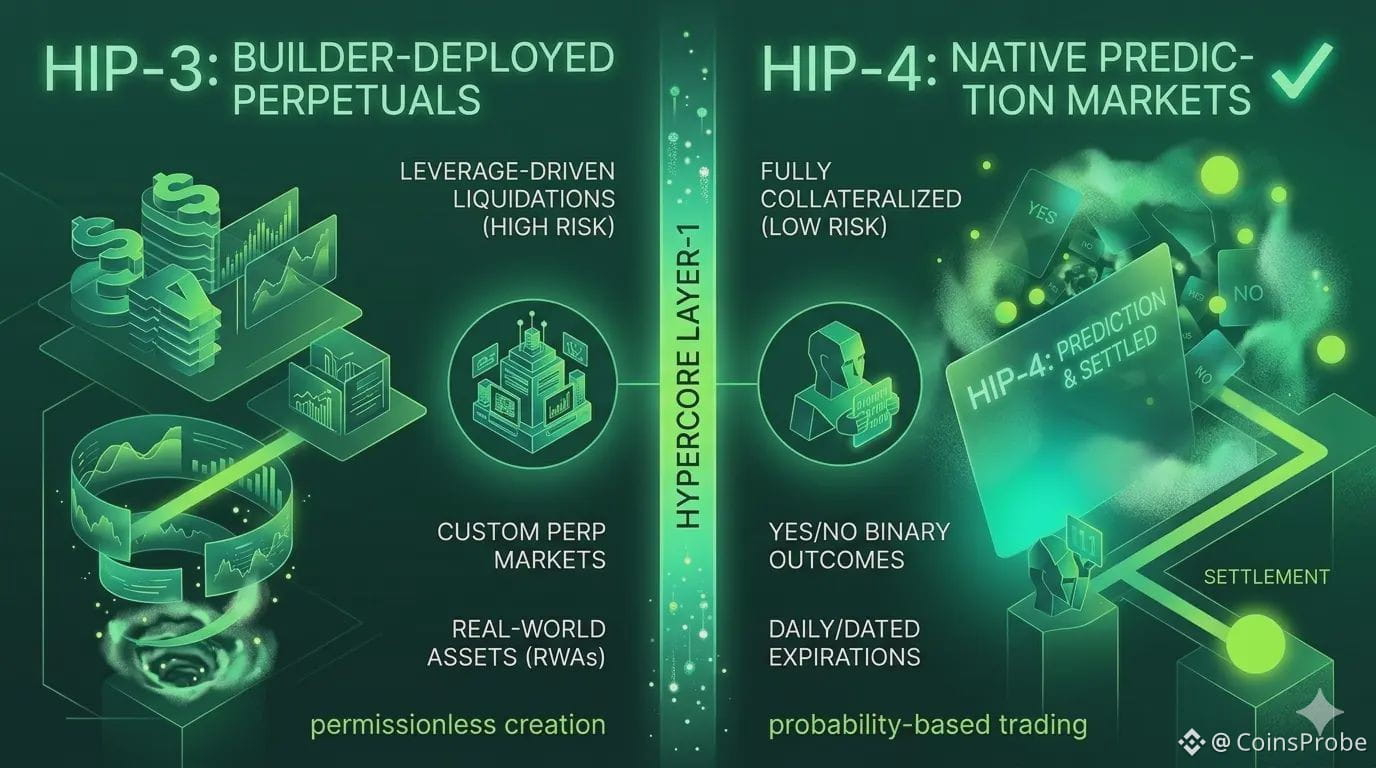
HIP-4 follows the earlier HIP-3 upgrade, which launched in late 2025 and introduced Builder-Deployed Perpetuals. That upgrade allowed developers to create custom perpetual futures markets for assets such as stocks, gold, or foreign exchange.
While HIP-3 focuses on open-ended perpetual markets, HIP-4 introduces a different trading model centered on fixed outcomes.
Key differences include:
Perpetual vs. fixed duration: HIP-3 markets run indefinitely, while HIP-4 contracts have fixed expiration dates.
Funding rates vs. bounded payouts: Perpetual futures rely on funding mechanisms, whereas outcome contracts settle within predefined payout ranges.
Event-based trading: HIP-4 is designed specifically for event futures, allowing traders to speculate on the probability of outcomes.
The first mainnet version of HIP-4 is expected to feature one-day expiry contracts, creating short-term markets for event-driven trading.
 Comparison Image HIP-3 vs. HIP-4
Mainnet Plans: BTC and HYPE Binary Markets
According to the Hyperliquid team, the initial mainnet release of HIP-4 will likely include one-day binary markets tied to the price movements of Bitcoin (BTC) and Hyperliquid’s native token HYPE.
Developers can already experiment with the system through the testnet and access the outcome trading API. The API uses a specialized asset identification structure in which outcome contracts are assigned IDs starting at 100,000,000.
For example, an asset identifier such as 100000010 represents a specific outcome paired with one side of a binary contract.
This standardized system is intended to simplify integration for developers building applications or trading tools on top of Hyperliquid.
Market Reaction and Industry Implications
The HIP-4 announcement has sparked discussion across the crypto trading community. Market observers note that embedding prediction markets directly into a high-performance Layer-1 trading infrastructure could unlock new forms of composability.
Rather than operating as standalone platforms, event markets could interact with perpetual futures, portfolio margin systems, and on-chain liquidity, creating a more integrated derivatives ecosystem.
Despite broader market volatility in early March, Hyperliquid’s $HYPE token has remained relatively stable following the announcement, reflecting continued interest in the platform’s expanding capabilities.
If successfully deployed on mainnet, HIP-4 could position Hyperliquid as one of the first major crypto exchanges to combine perpetual derivatives, real-world asset markets, and prediction trading within a single execution layer.
Disclaimer: The views and analysis presented in this article are for informational purposes only and reflect the author’s perspective, not financial advice. Technical patterns and indicators discussed are subject to market volatility and may or may not yield the anticipated results. Investors are advised to exercise caution, conduct independent research, and make decisions aligned with their individual risk tolerance.