
Last week, I had drinks with a guy who works in traditional multinational supply chains, and he complained about an incredibly outrageous situation. Their company originally wanted to be trendy and put some core supplier settlement documents on a certain Ethereum L2 to run smart contracts, but after just a month of testing, their secrets were completely exposed by competitors. Why? Because traditional public blockchains are essentially a bizarrely exposed square. Your purchase prices, your customer addresses, and your capital flow frequency are all clearly written on the chain. The guy, blushing, cursed: "This is not a Web3 business revolution; it's simply a tailor-made free business espionage system for competitors!"
That's why I have always felt disgusted by those who brag every day about 'putting everything on-chain'. As long as you're still using that fully transparent distributed ledger, those traditional giants holding real orders worth hundreds of billions of dollars will absolutely not be able to bring their core business in. Who would expose their business secrets online just to save a little friction cost? But if you turn to pure dark web privacy coins like Monero, regulatory agencies can easily take your executives down. This is the deadlock in the current business world: either enter the transparent public chain naked or retreat back to the cyber prison of traditional centralized servers, obediently paying extremely expensive ecological taxes. It wasn't until I recently revisited the underlying infrastructure protocols that I discovered how sophisticated the underlying logic of this network called Midnight ($NIGHT), created quietly by the Cardano team (IOG), really is.
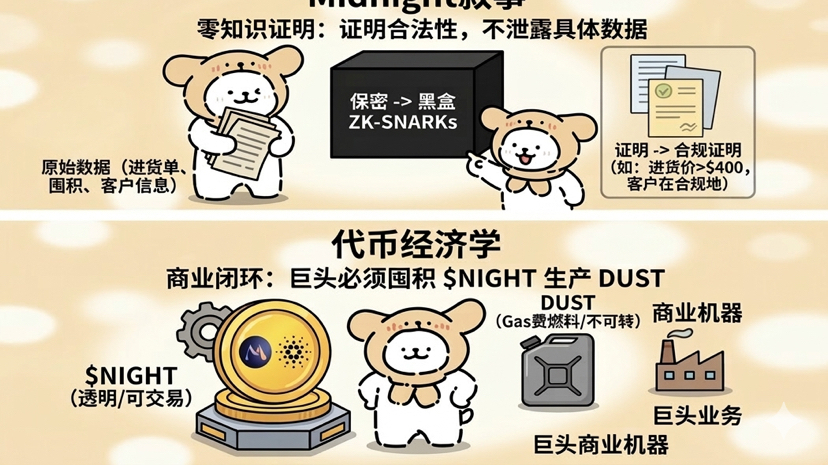
These academic geeks don't play around; they directly pulled out a set of dimensionality reduction 'programmable privacy' systems. Midnight is like a jailbreak operation against the naked running mechanism of traditional public chains. Its underlying ZK (zero-knowledge proof) technology allows businesses to lock commercial secrets in a local black box while simultaneously submitting a no-blame cryptographic proof to networks and regulators. It can prove to the world that 'my accounts are fine, I paid my taxes' without revealing what exactly is written in the ledger. It requires both privacy in business barriers and absolute legal compliance. What I find particularly chilling is the economic model of the token $NIGHT . People see the current price of $NIGHT on Binance at a few cents and think it's just another new coin. But if you look closely at its dual-token mechanism: those smart contracts that protect privacy on this network must consume a fuel called DUST (which cannot be traded, only consumed). The only way to acquire DUST is to hold and lock $NIGHT , creating an extremely cold-blooded business closed loop.
In the future, multinational companies, medical institutions, or financial giants that want to settle safely on this network are not here to cut losses with retail investors.
To maintain the daily operation of their huge business chains, they must hoard a large amount of $NIGHT on their balance sheets, treating it as a 'generator' that continuously produces network fuel. Compared to investing in those hardware pieces that only tumble every day, this rigid demand, which doesn't care about market sentiment but focuses on actual business consumption, is the true moat that can solidify wealth.
Watching the screen filled with friends still speculating on various meme coins and desperately trying to wring out that little liquidity in the existing pool, I find it quite surreal that while traditional giants quietly start hoarding these 'compliant black box' tickets, many are still researching which meme can pump the price. This weekend, I'm planning to clear out those dead positions in old public chains. It's too exhausting to cut each other in this circle; it's time to focus on those underlying protocols that can truly make Wall Street dare to lay their cards on the table.@MidnightNetwork #night