
I have Been watching Robo closely and 👀 there's a mechanic in Section 6.4 of the whitepaper that most token holders are completely misreading — and the misread matters.
Fabric's delegation system, called Stake-to-Contribute, lets Robo holders allocate tokens to augment a robot operator's bond. The immediate reaction from anyone who's spent time in PoS networks is: "I stake behind a validator, it earns, I earn." That instinct is wrong here, and the whitepaper is unusually direct about why.
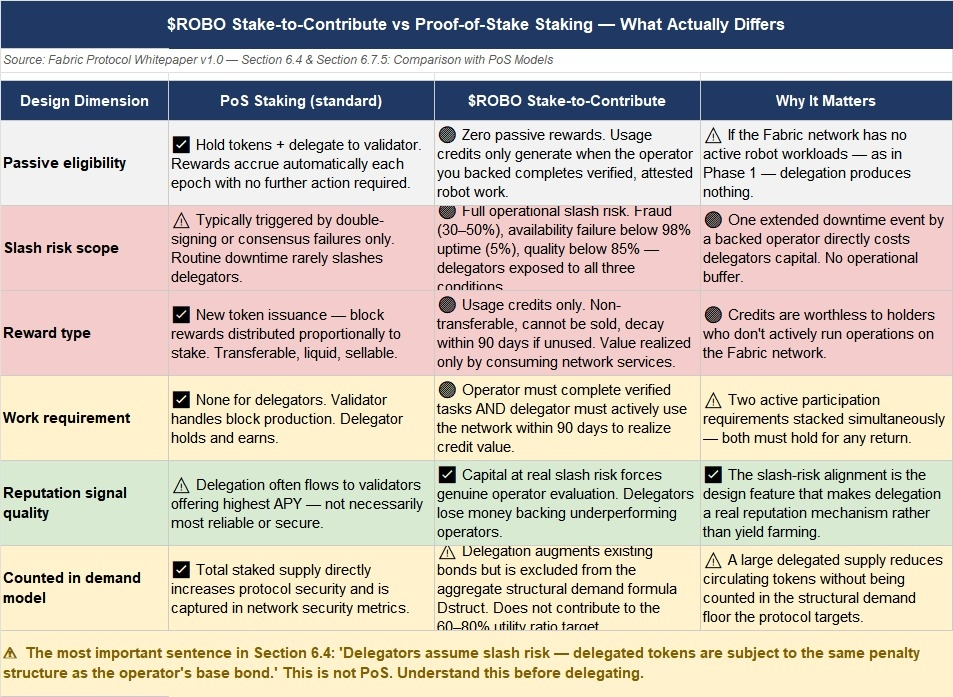
The first thing delegation actually does is expand operator capacity. An operator's task selection probability and maximum task size are both capped by their bond. Delegating Robo to an operator temporarily increases their available collateral beyond the base reservoir, letting them accept larger, higher-value tasks. The benefit flows to the operator's capacity first. Delegators don't passively clip yield - they're underwriting expanded oprations.
The second function is reputation signaling. Because delegation requires real capital at slash risk, it acts as a market-based endorsement. Operators who attract significant third-party delegation are effectively being vouched for by people who would lose money if things go wrong. The whitepaper describes this as a reputation signal - what it doesn't describe is any mechanism for delegators to verify operator quality before delegating
You're betting on past track record, not on audited performance data.
I keep coming back to the slash risk sharing clause. Delegated tokens are subject to the same penalty structure as the operator's base bond. If an operator commits fraud or drops below the 98% availability threshold, delegators get slashed alongside them. This is the design decision that separates Fabric's delegation from PoS staking fundamentally — in PoS, delegators typically face slashing only for validator double-signing
Here, delegators share the full operational risk of every robot they back.
An operator's internet goes down for a month
the delegator loses bond too.
The rewards structure is worth stress-testing. Delegators may receive usage credits -non-transferable, contingent on verified task completion, proportional to delegation share and operator performance, and subject to decay if unused within 90 days. Four constraints stacked on top of each other. These are not yield. They're not passive income. They're operational rebates - modest discounts on future network services, only if the operator completes verified work, only if the delegator actually uses the network within 90 days of earning them
The whitepaper describes what delegators might receive. It doesn't describe what a realistic credit accumulation rate looks like at current network scale, which right now is close to zero.
Here's where the design breaks down slightly. Delegation bonds are excluded from the aggregate structural demand formula entirely. The whitepaper notes this explicitly
They augment existing work bonds rather than creating independent demand.
Which means the demand-floor proposition that protects Robo price doesn't count delegated capital. That's not a flaw, it's an accounting choice
But it means the portion of supply locked in delegation contributes to reducing circulating tokens without being captured in the structural demand math that the protocol targets at 60–80% of token value.
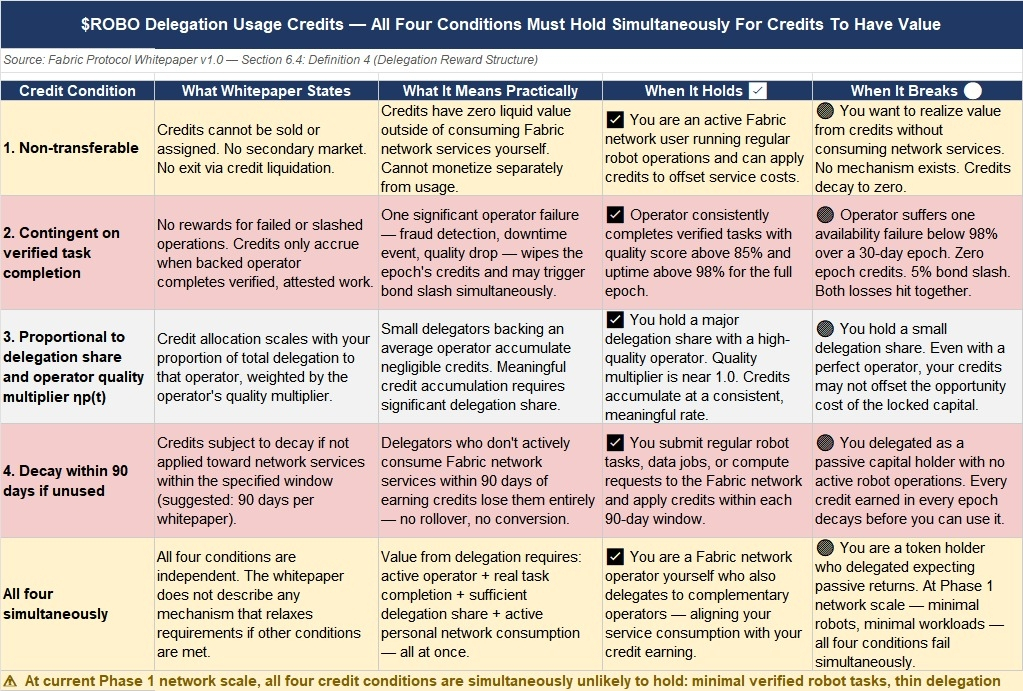
Builders got the slash-risk alignment right. Making delegators genuinely exposed to operator performance is the correct design - it forces real operator selection rather than yield farming behind whoever offers the highest credit rate. The question I'd want answered: at what network maturity does delegation become economically meaningful for delegators, given that usage credits require active network consumption to realize value, and active network consumption requires robots doing real work at scale, and that scale isn't in the 2026 roadmap??
🤔
#ROBO @Fabric Foundation $ROBO
