

Privacy as Architecture, Not as Service
In the current moment of blockchain maturation, most innovations arrive wrapped in rhetoric about disruption and wholesale replacement of existing systems. Midnight Network takes a different path. Rather than presenting privacy as a monolithic service layer or a sidechain with its own governance tax, it reconceptualizes privacy and computation as programmable properties that live directly in application logic.
This shift—from privacy-as-infrastructure to privacy-as-design—represents a genuine rethinking of how decentralized systems should distribute capability and control. The project does not attempt to copy traditional finance's privacy model, where secrecy flows downward from institutions to users. Instead, it asks: what if users and developers could compose their own privacy contracts, verify them transparently, and maintain sovereign control over when and how they're executed?
This is not a small distinction. It reflects a deeper understanding that the blockchain industry has, over the past five years, largely been solving the wrong problem. The challenge was never "how do we make privacy work on-chain?" The real challenge—the one that matters to institutions, to developers, and to users—is "how do we make privacy work without asking people to trust intermediaries?" Midnight's architecture answers that by treating opacity as something applications create when they need it, not something the protocol imposes.
The Right Time for Credible Infrastructure
Markets move in cycles, but incentives never lie. Two years ago, capital was flooding into projects promising to revolutionize everything. Today, the conversation has shifted. Institutions are moving into crypto, but they're doing so with skepticism. They demand transparency in tokenomics, clarity in governance, and auditable incentive alignment. Developers have grown tired of retrofitting legacy assumptions onto new technology. This shift creates an opening for projects that deliver substance over narrative—and Midnight arrives exactly when the market is ready to reward that restraint.
The broader context matters too. As regulatory frameworks for crypto mature, the advantage of claiming to be "decentralized" without actually distributing power has eroded. The market now values projects that can actually defend their claims. Midnight's emphasis on transparent, composable primitives rather than closed ecosystems appeals directly to this new rigor. It is the kind of project that passes institutional due diligence not because of marketing, but because the architecture itself is legible and verifiable.
Modular Design Meets Market Maturity
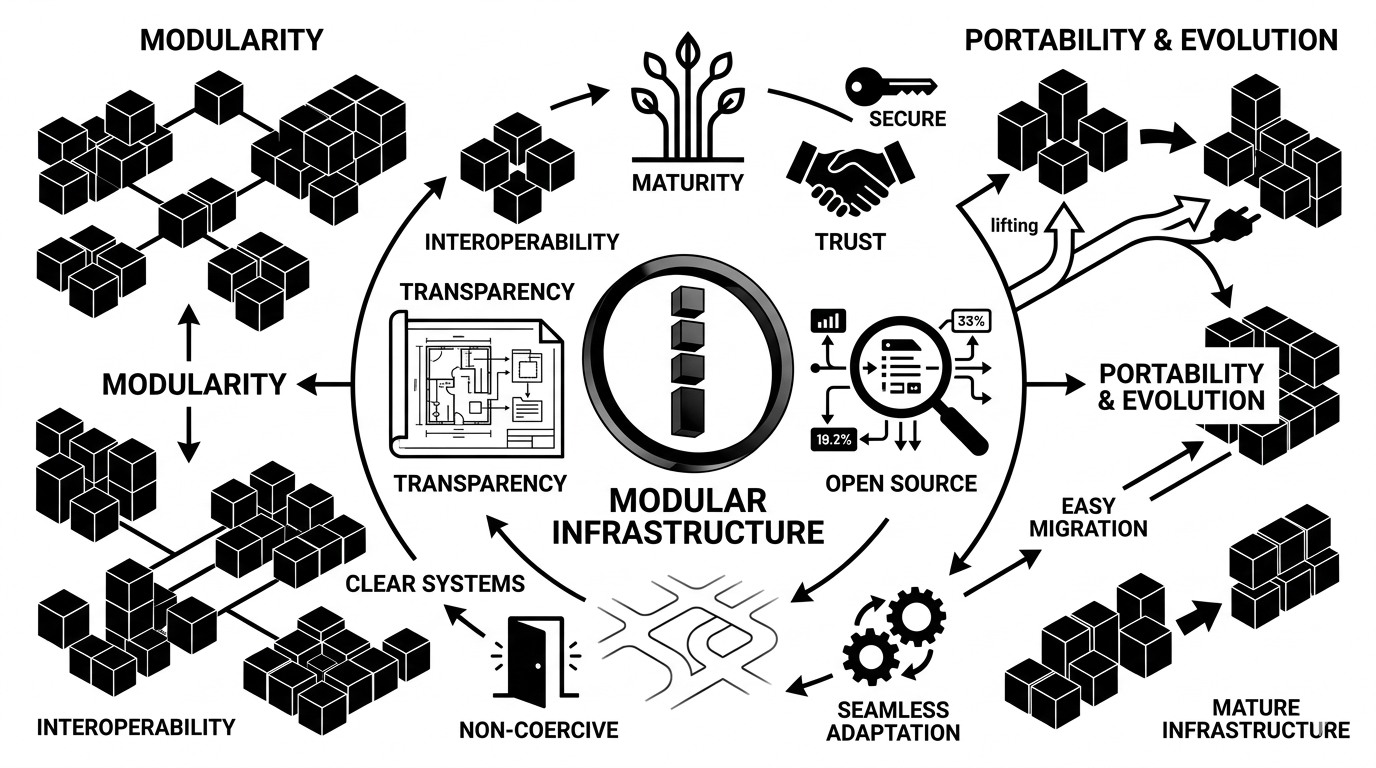
Several technical choices distinguish Midnight's approach. Its modular architecture allows developers to integrate privacy into applications as a component rather than adopting a monolithic privacy framework. This means applications can optimize for their specific use case—financial protocols may require different privacy guarantees than identity systems or supply chain applications.
Second, @MidnightNetwork 's commitment to transparent incentive design makes governance and token mechanics explicit and auditable, reducing information asymmetry and building institutional credibility. Third, the protocol enables verifiable computation that remains portable across chains, preventing lock-in and allowing users to move assets and logic across ecosystems without friction.
These three features compound each other. Modularity enables developers to build faster and more confidently. Transparency builds trust. Portability ensures the protocol remains relevant as the ecosystem evolves. Together, they signal maturity—an acknowledgment that infrastructure works best when it is modular, legible, and non-coercive.
Why This Moment, Why This Design
The implications extend further than technical architecture. By treating on-chain capital as something to be composed, optimized, and intelligently layered—rather than replaced wholesale—Midnight opens a path for traditional finance to adopt blockchain infrastructure without sacrificing regulatory clarity or operational control. The protocol's design patterns may become a template for how future systems should approach privacy, governance, and user sovereignty.
Midnight Network deserves attention not as the next moonshot promising to revolutionize finance, but as a marker of how the industry is maturing. It shows what happens when developers take the unglamorous work of making privacy practical seriously. It refuses to sacrifice ownership for convenience, or transparency for efficiency. In that restraint lies something rare: a project that is both technically ambitious and philosophically honest about what decentralization should mean.
That alignment—between what the market actually needs and what the protocol actually delivers—is why this matters now.
