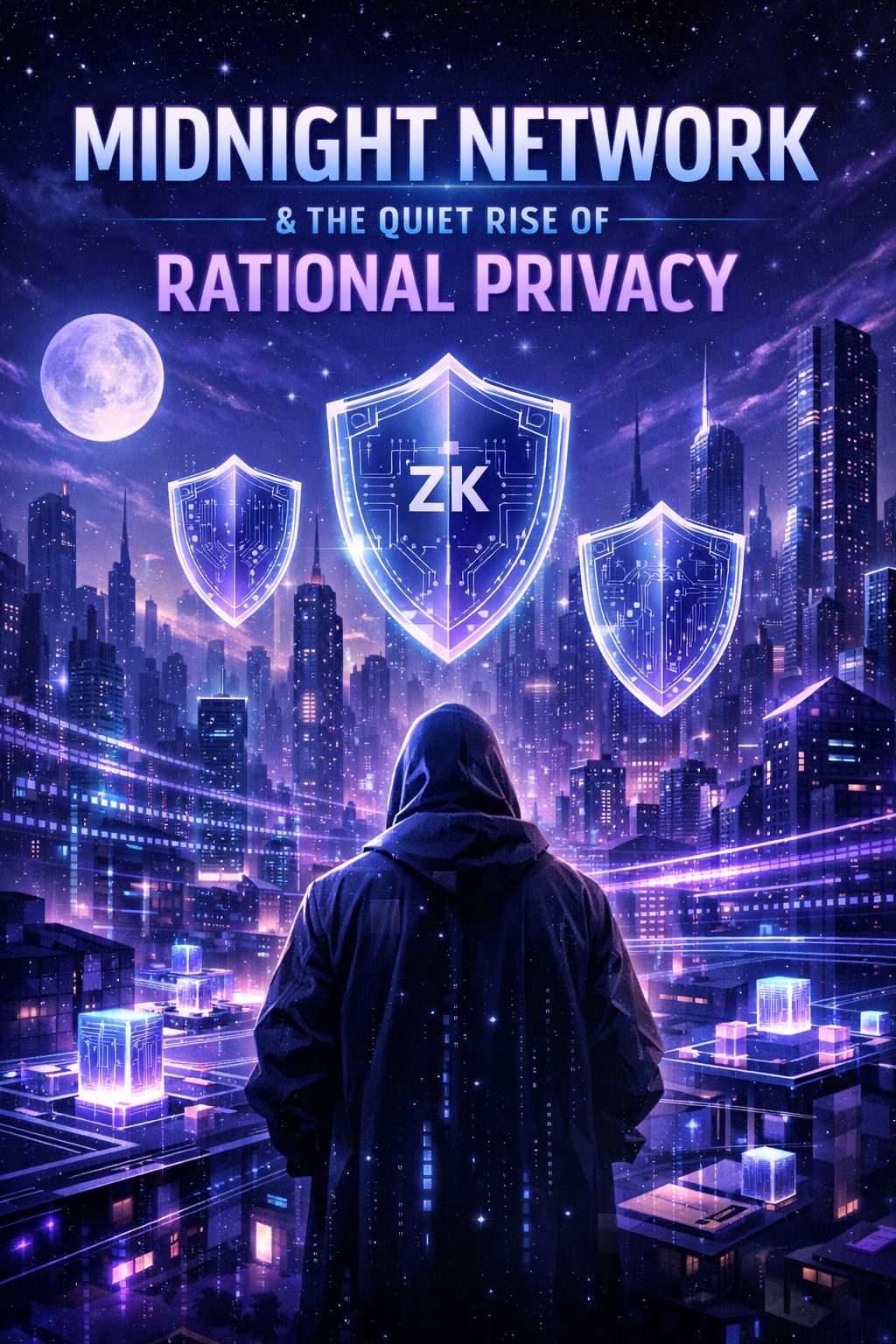
Midnight Network feels important because it begins with a problem many people in crypto already understand deep down. Public blockchains gave the world transparency, openness, and verifiability, but they also created a system where too much of human activity can become permanently visible. That works well for some use cases, yet it becomes uncomfortable the moment real life enters the picture. Businesses cannot run sensitive operations on a ledger that exposes every detail to competitors. Hospitals cannot protect patients if confidential information is tied to systems built for radical openness. Ordinary people cannot enjoy financial freedom if every move leaves a public trail forever. Midnight was built around this tension, and that is why its message lands differently. It does not ask people to choose between utility and privacy. It argues that both should exist together.
What gives Midnight its distinct identity is the idea of rational privacy. That phrase matters because it shifts the conversation away from secrecy for its own sake. Midnight is not trying to glorify hiding. It is trying to build a world where people and institutions can prove what needs to be proven without exposing everything else. That sounds simple, but it represents a major change in how blockchain can be imagined. Instead of forcing every interaction into full transparency or full invisibility, Midnight is built around selective disclosure. In human terms, that means the system should reveal only what is necessary for trust, compliance, or execution, while protecting the rest. It feels closer to how life actually works. Most of the time, we do not need total exposure. We only need enough truth to move forward with confidence.
The technology that makes this possible is zero knowledge cryptography, and that is where Midnight starts to become more than a philosophical project. Zero knowledge proofs allow one party to prove a statement is true without revealing the private data behind it. That unlocks something powerful. A user can show they meet a requirement without revealing their entire identity. A company can prove compliance without publishing confidential records. A system can verify that rules were followed without broadcasting the underlying details to the world. This is why Midnight feels like an attempt to mature blockchain rather than merely extend it. It takes the ideals of decentralization and verifiability and asks what happens when those ideals are forced to grow up and face the demands of the real economy.
Midnight also understands that advanced cryptography means very little if only a tiny circle of specialists can use it. That is why the project puts so much emphasis on developer accessibility. Its design tries to turn privacy infrastructure into something builders can actually work with instead of something they only admire from afar. The choice to make its smart contract environment more approachable reflects a deeper ambition. Midnight is not content with being a brilliant niche experiment. It wants privacy aware development to become normal. That part is easy to overlook, but it may end up being one of the most important decisions in the entire project. If developers feel blocked by complexity, even beautiful ideas remain trapped in theory. If developers can build with confidence, the network has a real chance to become part of everyday digital life.
Its economic structure follows the same logic. Midnight separates long term value and governance from day to day network usage through NIGHT and DUST. NIGHT represents participation, governance, and the broader economic layer of the network. DUST is the resource used for transactions and private execution. Underneath the technical language, the philosophy is surprisingly elegant. Midnight is trying to avoid a world where every private action becomes another visible market signal. It wants activity on the network to remain practical, flexible, and less exposed. That matters for businesses, for developers, and for users who do not want the economics of every private interaction to become another public clue. In that sense, the token design is not only about efficiency. It is part of the privacy architecture itself.
The way Midnight approached distribution also reveals something about its values. Rather than building its identity around extreme exclusivity, it aimed for broad participation through major token allocation events that reached across multiple ecosystems. That kind of launch matters more than it first appears. A project that speaks constantly about dignity, control, and choice cannot afford to feel socially narrow at its foundation. Wide distribution does not solve everything, but it gives the network a better starting point. It spreads ownership, expands awareness, and helps the project feel less like a closed idea owned by a few insiders and more like a public infrastructure layer that many communities can grow into.
There is also a practical seriousness to the way Midnight is developing. It is not presenting privacy as a fantasy feature for people who want to vanish from the world. It keeps framing privacy as a requirement for real adoption. That is why the use cases feel grounded. In finance, institutions need ways to verify transactions, credentials, and regulatory conditions without turning sensitive commercial activity into public theater. In healthcare, systems need ways to confirm permissions and data integrity without exposing deeply personal records. In identity, governance, and enterprise applications, people often need proof without surrender. Midnight is being built for exactly those moments. It treats privacy not as rebellion against reality but as a structure that allows reality to function with more dignity.
At the same time, the project is not free from risk. In truth, Midnight is trying to solve one of the hardest problems in blockchain. Privacy technology is difficult. Regulation around privacy and compliance continues to evolve. Institutional adoption is never guaranteed. Markets can turn quickly, and narratives alone do not build durable systems. Midnight still has to prove that its model can scale, that developers will keep building, that real applications will emerge, and that its vision can survive contact with the messy demands of production use. A network like this cannot rely only on elegant writing or strong community energy. It has to show results in code, in usage, in resilience, and in trust earned over time.
That proving phase is what makes the current stage of Midnight so interesting. The project sits in a space between promise and demonstration. It has enough structure to feel serious, enough ambition to feel bigger than a niche experiment, and enough complexity to remind everyone that success is far from automatic. Yet there is also something refreshing about the way Midnight presents itself. It does not seem obsessed with chaos, hype, or theatrical extremism. It feels more patient than that. It feels like a project trying to build infrastructure for a future where privacy is not treated as suspicious, but as a normal part of digital existence.
What makes Midnight worth paying attention to is not just the cryptography, the roadmap, or the token mechanics. It is the emotional truth beneath the design. We live in a time when digital systems ask for more of us every year. More data, more surveillance, more exposure, more permission to turn human life into permanent records. Midnight pushes back against that direction without rejecting the benefits of modern networks. It suggests that the next meaningful step for blockchain may not be louder transparency or deeper opacity, but something more balanced and more human. It suggests that freedom is not only about access. It is also about boundaries.
If Midnight succeeds, it may help change the tone of the conversation around blockchain itself. It may prove that privacy does not have to mean hiding, and that compliance does not have to mean surrender. It may show that trust can be built through selective truth rather than total visibility. That would be a meaningful shift, not only for crypto, but for the broader digital world. Because at its core, Midnight is asking a very human question. Can we build systems that respect people while still remaining open, verifiable, and useful? If the answer becomes yes, then Midnight will represent more than another blockchain project. It will stand as part of a more mature and more respectful internet.