
When people hear that a blockchain project has two tokens, the first reaction is usually skepticism. In the crypto world, multiple tokens often mean extra complexity or an excuse for another token sale.
But the Midnight blockchain introduces a two-token system that actually solves a real problem in blockchain design.
Instead of mixing ownership and network usage into one asset, Midnight separates them into two different resources: NIGHT and DUST.
This design might look unusual at first, but once you understand it, the logic becomes surprisingly clear.
What Is Midnight?
Midnight is a privacy-focused blockchain developed by Input Output Global, the research team behind Cardano.
Most blockchains today are fully transparent. Every transaction, balance, and contract interaction is visible to the public forever.
That level of transparency works well for financial transfers, but it creates problems for real-world data such as:
Healthcare records
Payroll information
Legal contracts
Business supply chains
Companies cannot store this type of sensitive information on a completely public ledger.
Midnight solves this problem using Zero-Knowledge Proofs.
This technology allows someone to prove that something is true without revealing the underlying data.
In simple terms, Midnight provides privacy with selective disclosure. Organizations can keep their information private while still proving compliance to regulators when necessary.
NIGHT – The Ownership Token
NIGHT is the primary token of the Midnight ecosystem.
Key characteristics include:
• Fixed supply: 24 billion tokens
• No new minting after launch
• Used for governance and staking
Network validators earn NIGHT rewards from a pre-allocated reserve rather than from user transaction fees.
The most interesting part of the design is that NIGHT is never used to pay transaction fees.
Your NIGHT balance stays intact even if network usage grows.
The token represents ownership and participation in the network, not payment for every transaction.
The project launched through the Glacier Drop, distributing more than 3.5 billion NIGHT tokens to over 170,000 wallets.
Eligible participants included holders of major networks like Bitcoin, Ethereum, Solana, and Cardano.
DUST – The Network Resource
The second element of the system is DUST.
DUST functions as the fuel of the network, similar to gas on other blockchains.
However, it behaves very differently from typical crypto tokens.
Instead of being purchased or traded, DUST is generated automatically by holding NIGHT.
The more NIGHT you hold, the more DUST your account generates over time.
Three Unique Features of DUST
1️⃣ Private Transactions
DUST transactions are shielded by default.
The sender, receiver, and transaction amount are protected using zero-knowledge proofs.
2️⃣ Non-Transferable
DUST cannot be bought, sold, or transferred between users.
This prevents speculation and stops fee markets from driving costs higher.
3️⃣ Decaying Supply
If you move your NIGHT tokens or change the address that generates DUST, the previously accumulated DUST begins to expire over time.
This design prevents hoarding and ensures the resource keeps circulating.
Why Two Tokens Make Sense
One of the biggest issues in blockchain networks is the link between token speculation and network fees.
For example, during the 2021 crypto boom, transaction fees on Ethereum sometimes reached $100 per transaction.
This happened because the same asset was used for both ownership and network usage.
When demand for the token increased, the cost of simply using the network increased as well.
Midnight separates these roles:
• NIGHT = ownership and governance
• DUST = network usage
Because DUST cannot be traded and regenerates automatically, network fees remain predictable and stable.
This model makes it easier for companies and developers to estimate operating costs without worrying about extreme fee volatility.
Challenges Still Ahead
Although the design is innovative, there are still questions about how it will work in practice.
For example:
• The DUST decay rate must be carefully balanced.
• Onboarding may be more complex since users need NIGHT before generating DUST.
• The system still needs testing under real-world network demand.
These challenges do not invalidate the idea, but they highlight the importance of execution.
Final Thoughts
The NIGHT and DUST system is not just another two-token marketing strategy.
It represents a thoughtful attempt to separate network ownership from network usage, something that has caused problems across many major blockchains.
If the Midnight team can successfully implement this design, it could become an important model for future blockchain ecosystems.
For now, the concept looks promising.
The real test will be how well it performs once the network goes live.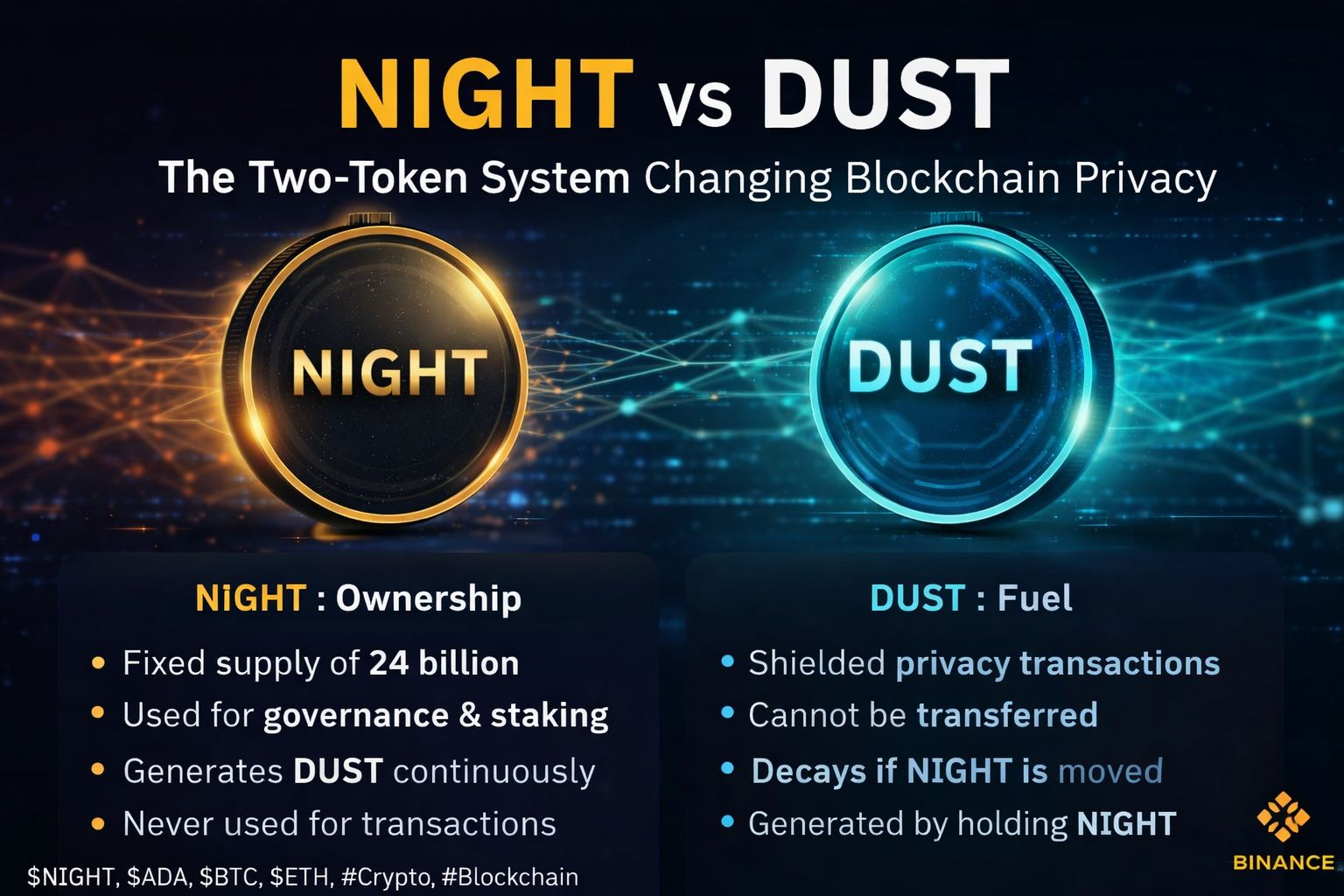
$SOL
#Blockchain
#Binance