
That night I saw a report. It stuck around in my thoughts more than most things do. Something about it just didn’t let go.
A figure on screen moved slowly turns out it was her, caught mid-step during morning routines. Odd thing though - the lens wasn’t planted by a stranger. Bought online months ago, meant for protection, now replaying moments never intended to be saved.
Trying to report it only brought back the same replies. Police told her to reach out to the maker instead. That company insisted everything was locked down tight. Yet somehow, clips still showed up on the web. With each reply, less made sense than before.
It wasn’t just the article that unsettled me, those replies underneath made it worse. Sentences twisted sideways, some short, others trailing off like thoughts left unfinished. Punctuation shifted midstream. Words landed where you wouldn’t expect. Rhythm changed with every line. Meaning stayed fixed, though. The discomfort lingered longer than I wanted.
She put up a camera, which made some folks angry right away. Paying for ease with privacy, that idea split opinions among others. Curious ones started wondering out loud about how to see the footage.
The screen went dark, yet the idea lingered on. One moment it was there, then gone, still humming beneath my thoughts long after.
Footsteps echo through the rooms whenever it clicks on. A quiet reminder something watches even when I forget.
That little thing stays quiet in the corner of my living room. Years back, I got it just so I could keep an eye on things while gone. Facing the sofa, it watches me most nights, phone in hand, eating food from boxes, sometimes dozing off while the television runs. Silence settles there more often than not.
A lens stood witness to endless everyday scenes.
Maybe it notices the moment I open my eyes, tracks when I walk through the door, also sees how often I sit awake staring at screens. Oddly enough, my habits could be clearer to this thing than they are to some folks who know me.
Out of nowhere, Mom posed a basic question the other day.
“Can that camera see me?”
That made me laugh. I told her it just looked at the walls, nothing more. Still, she stayed quiet. Her voice came back slow cameras never leave her alone inside.
Back then, I just ignored it.
That evening, my thoughts circled back no longer stuck on Mom facing the lens. Instead, a quiet unease crept in: what if others were seeing too? Someone unseen could have been looking. The idea settled slowly, without noise.
Every day, unnoticed watchers stay close. Movement gets traced by phones, while habits get studied through apps, yet rooms are filmed by small cameras too. Information moves nonstop behind the scenes. Life feels simpler so agreement comes naturally.
Yet if a problem hits - like what happened to that girl - the entire setup begins to seem shaky.
Something popped up while mulling it over - a notion tied to the Fabric Foundation, actually. It stuck around in my thoughts.
Some mention a place known as the Global Robot Observation Station.
It starts like this: smarter robots mean every move they make might get logged into an open record. Think of it as a window - anyone can look through and see exactly what choices a machine makes. Their behavior, moment by moment, sits out in the open. Watching becomes possible, not because someone allows it, but because the setup demands clarity.
A trace would show up where everyone can see it, not tucked away beneath layers of silent gears.
Right away, reading that brought a pair of ideas rushing in together.
A strange pity came first, aimed at machines. Picture someone staring nonstop as you do your job. Each move saved without end. Not liberty, really, more like existence behind clear walls.
Yet another idea turned toward people.
Out here, daily routines unfold within a kind of hidden system. What people search, click, even where they walk, it's caught by gadgets and apps without much notice. Yet most never lay eyes on the logs built from their own actions.
Here's when the Fabric Foundation’s concept starts to shift ground. Not silent monitoring tucked into corporate systems, but a setup leaning toward open responsibility.
Facing driverless vehicles, package drones, medical helpers or automated city systems might push people to figure out what these machines actually do.
Openness acts like glue for belief between people.
Something from long ago came back while thinking. There was a bulky tape player in our house once. He said not to go near it, naturally, that sparked interest. In the quiet of one afternoon, I lifted its cover to peek inside. By nighttime, it would not turn on anymore. 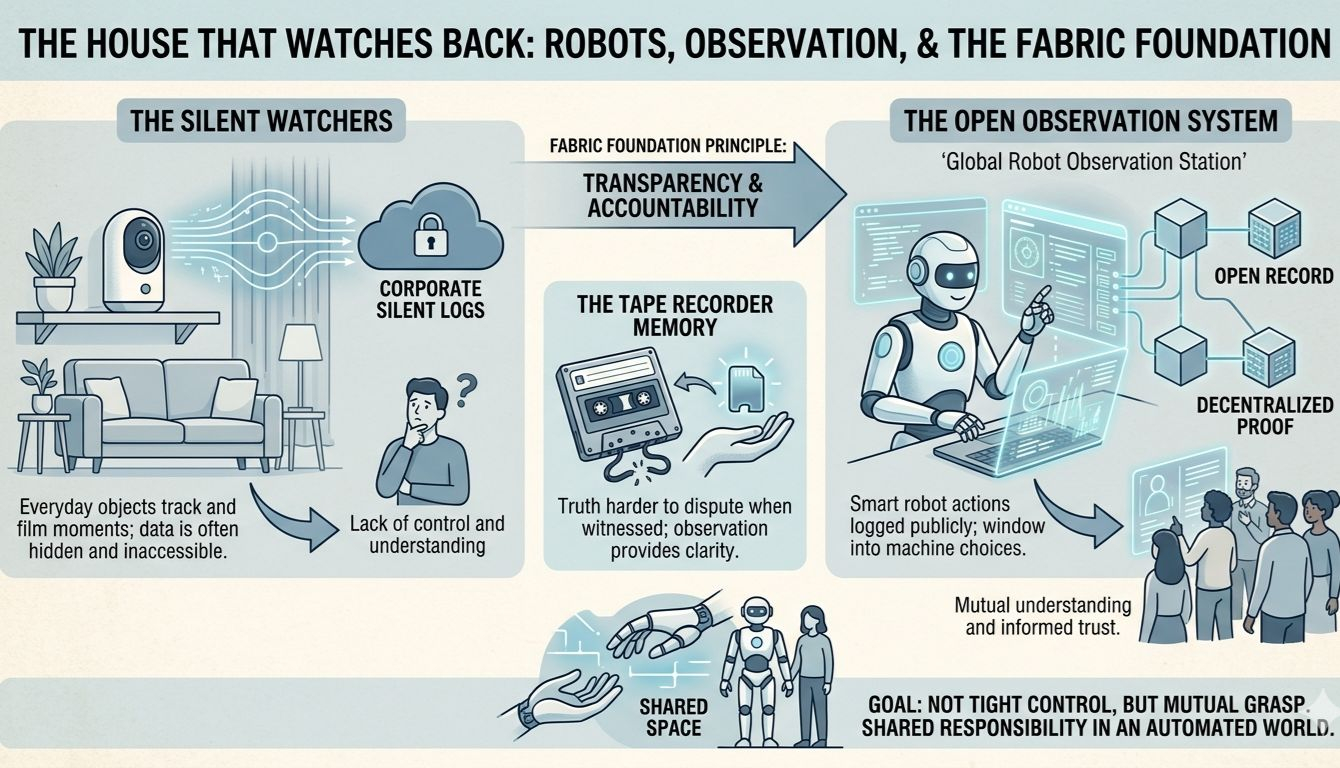
Home, he wondered aloud about who had moved it. Not my doing, I told him. After that quiet moment, into the deck went a cassette, then his finger hit play. That machine ran on a timed record setting. On the flickering display appeared me, up on a chair, reaching toward the device.
It hit me then, truth slips away easier once it’s written down.
Yet looking on brings up something else. Someone has to keep an eye on those doing the watching.
Most times, a human checks the robot data collected at monitoring spots. When that happens, who watches what those humans do matters just as much. Slowly it becomes clear: leaning on one person's honesty isn’t enough. Instead, proof needs to spread across many points so everyone sees the same truth.
Just watching isn’t enough to keep things safe. Even when systems track daily actions, some people work hard to avoid being seen. Yet seeing still plays a role.
One day, smart machines might stand next to people in daily life. For this to work, humans must grasp how these systems act. Maybe the real aim of the Fabric Foundation isn’t tight command - just mutual understanding. What matters could be seeing eye to eye, not pulling levers.
Machines bring unknowns, that much stays true. Yet seeing why they do what they do might just open a path - learning to share space with them follows close behind.
@Fabric Foundation #ROBO $ROBO
