
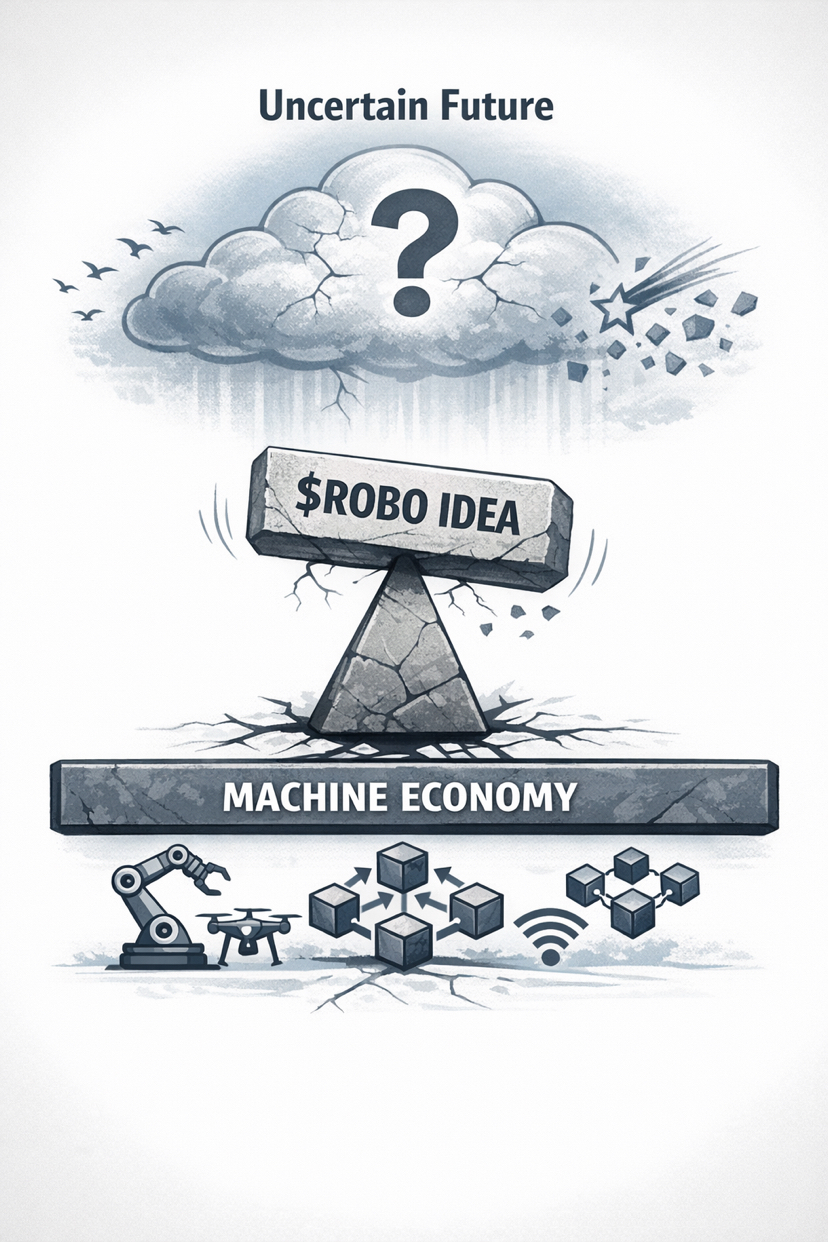
There’s something about the $ROBO conversation that feels… slightly fragile.
Not because the idea is weak.
But because it depends on a future behavior that hasn’t fully revealed itself yet.
The Fabric Foundation is clearly positioning around a machine economy — autonomous systems interacting, coordinating, and settling value without constant human supervision.
Conceptually, that future feels logical.
But logical futures don’t always arrive in the way we imagine.
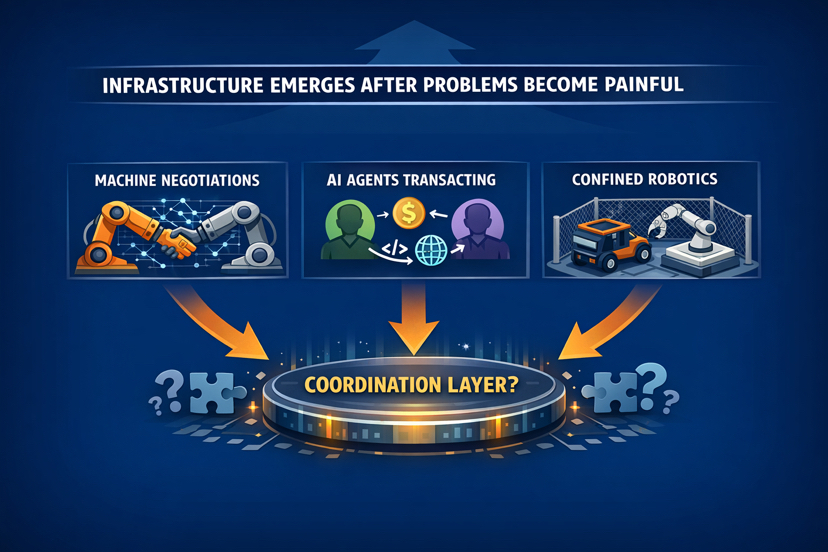
One thing I’ve noticed in technology cycles is that infrastructure usually emerges after a problem becomes painful.
Rarely before.
And that’s the tension here.
Fabric is building around a coordination problem that isn’t widely visible yet.
Machines aren’t widely negotiating with each other.
AI agents aren’t routinely transacting across independent networks.
Robotics systems still operate mostly inside controlled environments.
So the friction that would justify a neutral coordination layer hasn’t fully surfaced.
At least not publicly.
That creates a strange perception gap.
From the outside, the architecture might look premature.
From the inside, it might actually be preparing for something inevitable.
Those two interpretations can coexist for a long time.
And during that period, it’s extremely hard to know which one is correct.
I’ve made the mistake before of dismissing infrastructure simply because the ecosystem wasn’t ready yet.
But I’ve also seen elegant systems built for problems that never quite materialized.
Both outcomes look identical early on.
Quiet development.
Abstract use cases.
A lot of theoretical potential.
The difference only becomes visible much later.
Another thing that complicates this thesis is how machine systems evolve.
Human adoption spreads through narratives and communities.
Machine adoption spreads through efficiency.
If autonomous agents eventually adopt coordination infrastructure, it won’t be because of hype. It will be because interacting through those rails becomes the easiest or safest option available.
Until that point arrives, the architecture remains mostly optional.
And optional infrastructure rarely scales quickly.
So when I look at $ROBO, I don’t see an obvious trade.
I see a directional bet.
A bet that autonomous systems will eventually interact across environments they don’t control, creating enough friction that neutral coordination becomes necessary.
If that moment arrives, the infrastructure suddenly looks obvious.
If it doesn’t…
Then this entire layer risks remaining a solution waiting for a problem.
That uncertainty is what makes the thesis interesting — and slightly uncomfortable.
Because the real signal we’re waiting for isn’t price movement.
It’s behavioral change in how machines interact.
And right now, that behavior still feels like it’s somewhere in the early stages of forming.
Maybe quietly.
Maybe slowly.
Or maybe not in the direction this architecture expects.
I’m not convinced either way yet.
Which is probably why I keep thinking about it.
#ROBO @Fabric Foundation $ROBO
