There is a quiet moment many people experience before clicking “accept” on a website or uploading a document online. A small pause. A subtle feeling that something personal is about to leave their control. It happens when we verify our identity, connect a wallet, sign up for a platform, or make a digital payment. In those moments, most of us rarely stop to think about where our data will travel or how long it will live inside servers we will never see. We simply trust that the system will protect it.
For years the digital world has operated on a silent exchange. Platforms give us convenience, global communication, financial access, and endless services. In return, we give them data. Names, locations, identification numbers, financial activity, and personal behavior slowly build a digital portrait of who we are. Over time those fragments form something deeply personal, yet once that information leaves our hands it often stops belonging to us.
This growing tension between convenience and privacy has quietly shaped the internet. People want the power of digital systems, but they also want dignity and control over their identities. Unfortunately, the more technology expanded, the more personal information systems demanded. Data became the fuel of the modern internet economy. Companies collected it, analyzed it, stored it, and sometimes lost it through breaches or misuse. With every major leak or privacy scandal, trust in digital systems weakened just a little more.
When blockchain technology appeared, it brought a powerful new idea into the world. Instead of relying on banks, corporations, or centralized institutions to verify transactions, a network of independent computers could maintain a shared ledger where everyone could confirm the truth together. Trust could be built through mathematics instead of authority. It felt revolutionary because, for the first time, systems could function without needing a central gatekeeper.
Yet even this breakthrough carried a contradiction. Most blockchain networks are transparent by design. Every transaction, balance, and movement of funds can be inspected on a public ledger. This openness is what keeps the system honest. Anyone can verify that the rules are being followed. But at the same time, this transparency creates a world where financial activity can be analyzed forever.
Imagine a future where every payment you make leaves a permanent trail that anyone can examine. Even if your name is not attached directly, patterns can slowly reveal identities and behaviors. What started as a system built for trust can begin to feel like a system built for surveillance.
For individuals, this level of exposure can feel uncomfortable. For businesses and institutions, it can be completely unacceptable. Companies cannot reveal confidential financial operations. Governments cannot expose sensitive infrastructure activity. People simply do not want their entire financial history permanently visible to strangers.
The blockchain world needed a new way forward. A way to keep the trust that transparency created while protecting the privacy people deserve.
This is where one of the most elegant ideas in modern cryptography began to reshape the future. The concept is known as zero knowledge. It sounds technical, but the idea behind it is beautifully simple and deeply human. What if you could prove something is true without revealing the information that proves it?
Zero knowledge proofs allow someone to demonstrate that a statement is correct without exposing the underlying data. Instead of sharing sensitive information, a system generates a cryptographic proof that confirms the statement is valid. The verifier becomes confident in the result, yet the private details remain hidden.
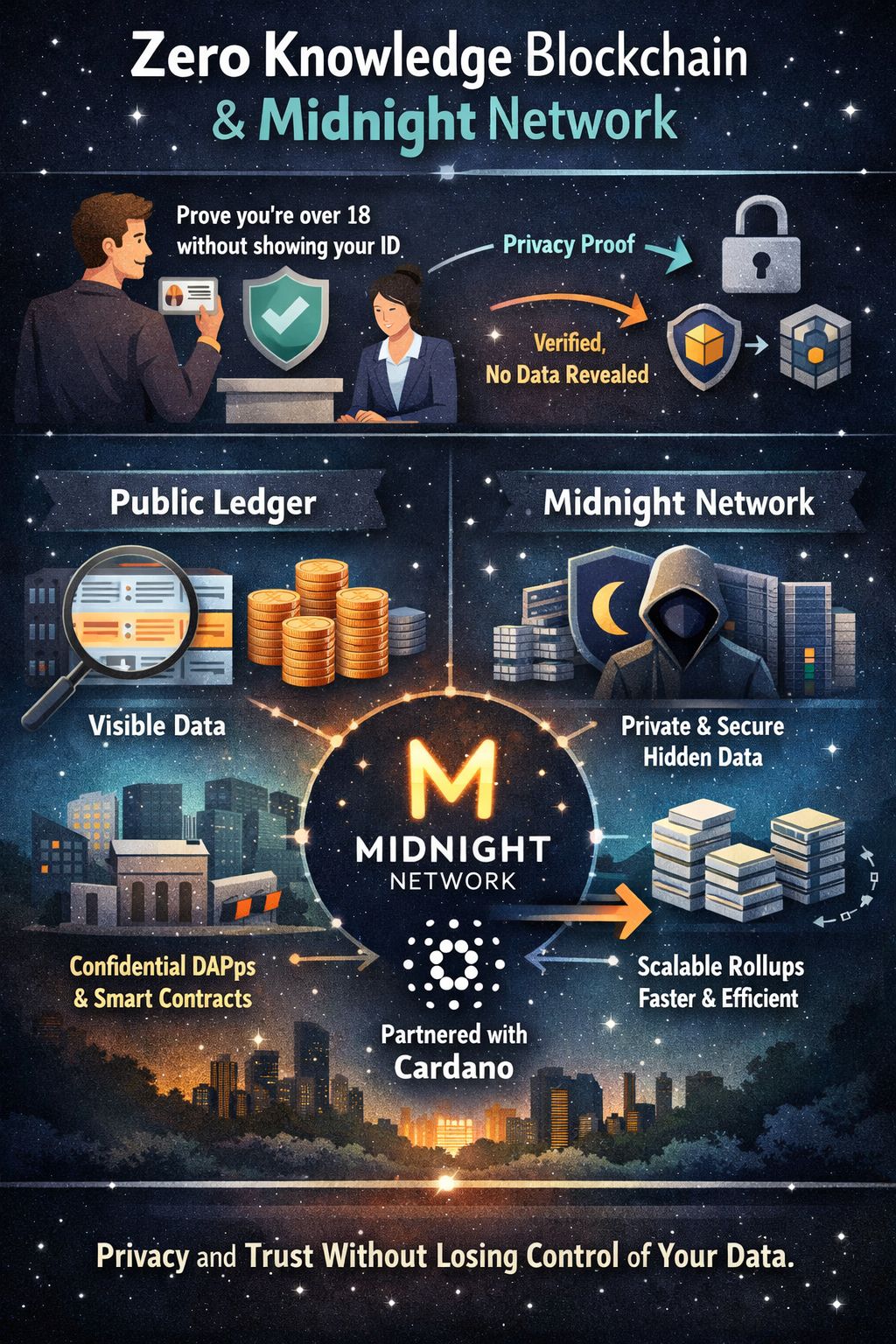
Imagine needing to prove that you are over eighteen years old to access a service. Normally you would present identification that reveals far more than necessary. Your name, birth date, address, and identification number all become visible even though the service only needs to know one simple fact. Are you old enough or not?
With zero knowledge technology, you could prove that your age meets the requirement without revealing anything else about yourself. The system verifies the proof and accepts the result while your personal details remain private.
This small shift in logic changes the entire relationship between people and digital systems. Instead of exposing information, users provide proof.
When this concept is applied to blockchain technology, something remarkable happens. Transactions no longer need to reveal sensitive information such as identities or amounts. The network only needs proof that the transaction follows the rules. The cryptographic proof confirms that the sender owns the funds, that the transaction is valid, and that no double spending occurs. The blockchain verifies the proof and records the transaction while the underlying data remains hidden.
For many people, this idea feels like a breath of relief. It means that participating in decentralized systems no longer requires sacrificing privacy. Trust and confidentiality can finally exist together.
Zero knowledge technology also solves another challenge that has long limited blockchain systems. Scalability. Early blockchain networks could process only a small number of transactions each second. As adoption grew, networks became congested and transaction fees increased. It was like trying to push millions of cars through a narrow street.
To address this, developers introduced a technique known as zero knowledge rollups. Instead of processing every transaction individually on the main blockchain, thousands of transactions can be grouped together outside the network. A single cryptographic proof is generated to confirm that all of them are valid. The blockchain only needs to verify the proof instead of verifying each transaction separately.
This approach dramatically increases efficiency. One proof can represent thousands of transactions. The network becomes faster and more scalable without sacrificing security or decentralization.
As these technologies evolved, developers began building entirely new blockchain systems designed specifically to protect privacy while maintaining real world utility. One of the most fascinating examples of this new generation is the project known as Midnight Network.
Midnight Network was created with a clear vision. The digital world should not force people to choose between transparency and privacy. Both should be possible at the same time. Midnight uses zero knowledge cryptography to allow decentralized applications to operate while protecting sensitive information.
The network is designed as a partner chain connected to Cardano. This connection allows Midnight to benefit from Cardano’s security and infrastructure while introducing advanced privacy capabilities. Developers can build applications where users maintain control over what information becomes public and what remains private.
One of the most powerful ideas behind Midnight is something called programmable privacy. In most systems, privacy works like a switch that is either on or off. Midnight allows privacy to be customized depending on the needs of the application. Certain information can remain confidential while other parts can be verified publicly.
This opens the door for industries that previously struggled to use blockchain technology. Financial institutions could prove regulatory compliance without revealing confidential transactions. Healthcare systems could analyze medical data without exposing patient identities. Businesses could verify supply chain integrity without revealing sensitive operational details.
Midnight also introduces a unique economic structure built around two different tokens. The main token, NIGHT, is used for governance and securing the network. Holding NIGHT generates a special resource called DUST, which is used to pay for transaction execution and smart contract operations. This design separates network ownership from transaction fees, creating a more flexible environment for developers and users.
Behind these technical ideas lies a deeper transformation that is slowly unfolding across the digital world. For decades the internet has been powered by collecting as much user data as possible. Platforms gather information because it is easier to analyze and monetize raw data than to protect it.
Zero knowledge technology challenges that entire model. Instead of surrendering personal data, users provide cryptographic proofs. Instead of trusting organizations to guard sensitive information, systems verify truth mathematically.
Control begins to move back toward individuals.
This shift is not just technical. It is emotional. Privacy is connected to dignity, freedom, and personal security. When technology begins respecting those boundaries again, it feels like something deeply human is being restored.
The infrastructure behind zero knowledge systems is also improving rapidly. Generating cryptographic proofs requires computational power, but new networks and specialized hardware are making the process faster and more efficient. What once required advanced research environments is gradually becoming accessible to developers and applications around the world.
We are witnessing the early stages of a transformation in how digital trust is built. For years the internet quietly asked people to sacrifice privacy in order to participate. The more connected we became, the more personal data we gave away.
Zero knowledge blockchains offer a different vision.
A world where truth can be verified without exposing identity.
A world where individuals own their data instead of surrendering it.
A world where technology protects the people who rely on it.
Projects like Midnight show that this future is not just theoretical. It is already beginning to take shape. And as these systems evolve, they may redefine how trust, privacy, and ownership coexist in the digital age.
In a time when digital trust often feels fragile, zero knowledge technology offers something rare. Hope that the internet can grow into a place where innovation does not come at the cost of personal freedom, and where the power of mathematics quietly guards the privacy of every individual who steps into the digital world.