
The more time I spend studying @MidnightNetwork, the more I realize it represents something deeper than just another blockchain launch. Many projects promise speed, scalability, or new tokenomics, but Midnight seems focused on something far more fundamental: restoring privacy to decentralized systems. In an era where every digital interaction leaves a permanent trace, the idea of a blockchain designed from the ground up to protect data feels not only innovative, but necessary.
Most blockchains today operate on the principle that transparency equals trust. Every transaction, wallet interaction, and contract call is publicly visible. This openness helps validate activity across the network, but it also introduces a major tradeoff. Individuals, companies, and institutions are often forced to expose far more information than they are comfortable sharing.
Midnight approaches this challenge differently.
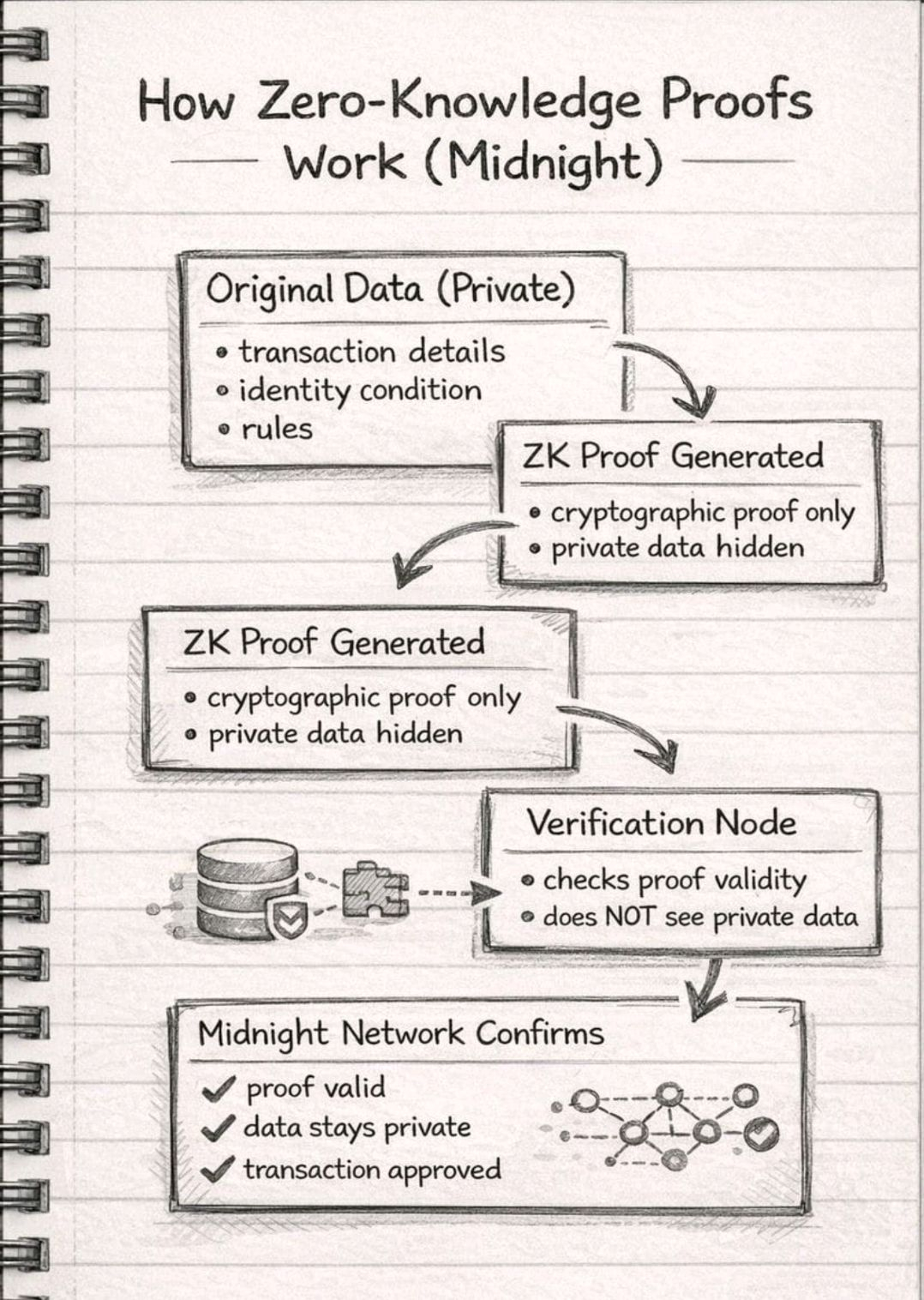
Instead of publishing sensitive information on-chain, the network uses zero-knowledge proofs to verify that a transaction or computation is valid without revealing the underlying data. In simple terms, it allows the system to confirm that something is true without showing why it is true. That single change dramatically alters the relationship between privacy and verification.
“Prove the outcome without revealing the details.”
This concept sits at the heart of Midnight’s architecture.
Another feature that stands out is the network’s dual-layer design, which separates private computation from public verification. Sensitive operations can happen in a protected environment while the blockchain itself only receives the proof that the process was executed correctly. This approach opens the door to use cases that traditional public blockchains struggle to support.
For example, companies could use Midnight to manage supply chains without revealing proprietary information. Financial institutions could verify compliance requirements without exposing their full transaction history. Even sectors like healthcare or education could share verified data between organizations while keeping personal information completely confidential.
That balance between privacy and verifiability is extremely powerful.
From a developer perspective, Midnight also introduces an operational model designed to make network usage more predictable. Many blockchains struggle with fluctuating transaction costs and resource competition, which can make building large-scale applications difficult. Midnight’s approach to resource management aims to create stable and predictable costs, making it easier for developers to deploy applications without worrying about sudden spikes in fees.
This kind of cost predictability could become especially important for enterprise applications. Businesses typically require stable infrastructure before committing to a new technology stack. If Midnight can maintain reliable performance while protecting sensitive data, it could unlock entirely new categories of blockchain adoption.
Security and governance are also central to the network’s philosophy. Midnight combines zero-knowledge cryptography with decentralized validation to ensure that both privacy and network integrity remain strong. Instead of sacrificing transparency for confidentiality, the system attempts to achieve both simultaneously.
That balance is rare in the blockchain space.
What excites me most about Midnight, however, is not just the technology itself, but the broader possibilities it creates. Blockchain discussions often revolve around trading, DeFi, or speculative markets. Midnight expands that conversation into new territory.
Imagine digital identity systems where users can prove their credentials without revealing personal information. Consider confidential collaboration platforms where organizations can work together without exposing proprietary data. Think about enterprise applications that can operate on-chain while maintaining strict privacy requirements.
These are the kinds of environments where Midnight could truly shine.
The $NIGHT token plays an important role in enabling this ecosystem. It supports governance, network participation, and the broader economic activity within the Midnight environment. As the network grows and more developers begin building privacy-focused applications, the role of $NIGHT could expand alongside the platform’s adoption.
Ultimately, Midnight represents a different vision for the future of Web3.
Instead of forcing users to choose between privacy and transparency, it attempts to combine both through advanced cryptography and thoughtful architecture. In doing so, it challenges one of the oldest assumptions in blockchain design: that trust requires complete visibility.
Perhaps the next generation of decentralized systems will prove something different.
Perhaps trust can be built not by exposing everything, but by proving exactly what needs to be proven and nothing more.
If that idea succeeds, @MidnightNetwork and $NIGHT could play a major role in shaping the next chapter of blockchain technology—a chapter where privacy, security, and decentralization finally coexist in balance.
#night $NIGHT 🌙