
Without further ado, let's get to the content!
GPT: Essentially, GPT is a massive large language model (LLM). Its architecture is a deep neural network, specifically a transformer, trained on astronomical amounts of text data. The workflow is simple: you provide text input (prompt), and GPT processes this context through its learned connections to predict and generate the most likely subsequent text, answers, or completions. It is essentially a sophisticated text engine that operates mainly within its training data and a text-based interface.
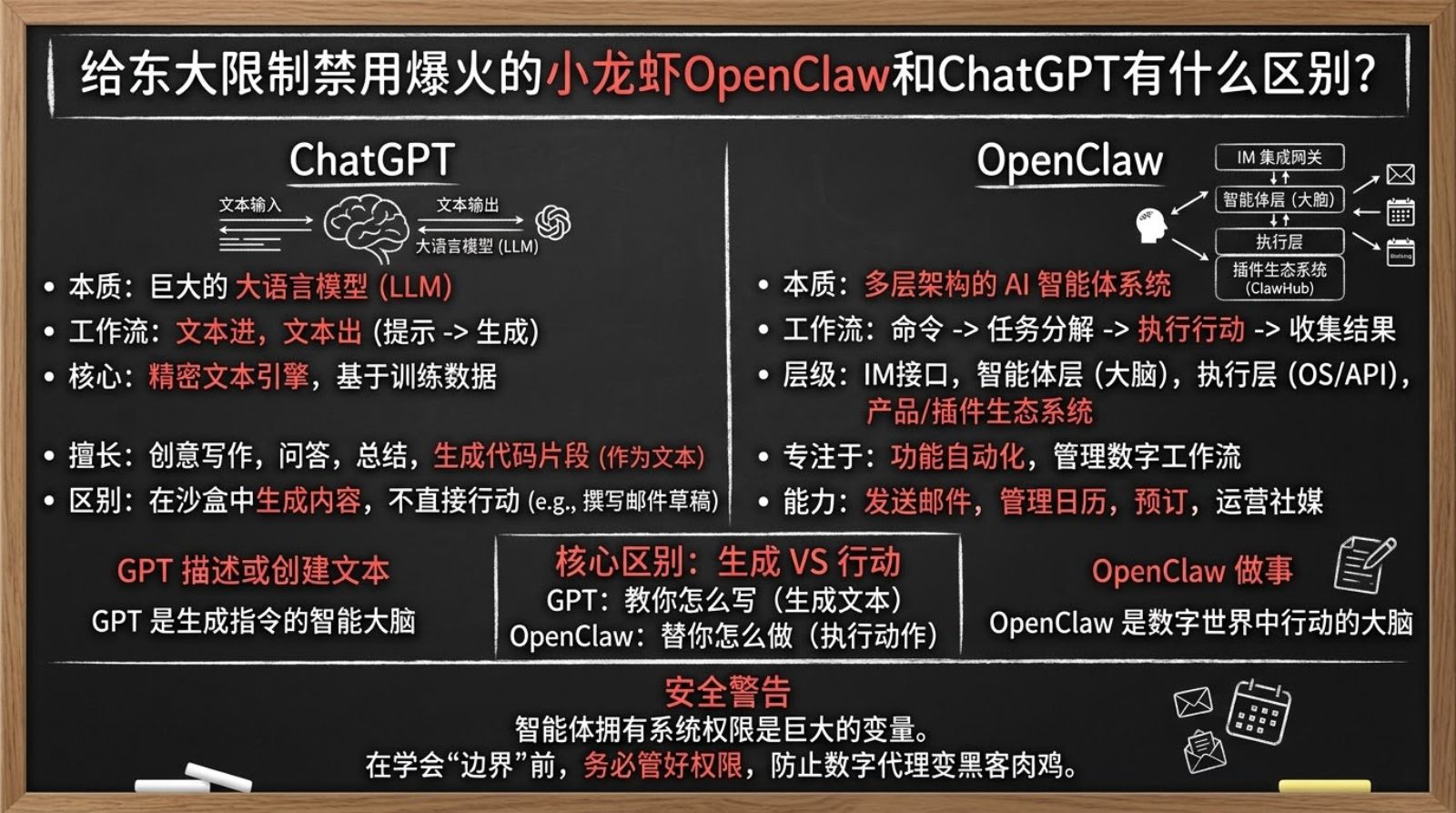
OpenClaw: In contrast, according to recent reports: (Chinese official warnings and Singapore's restrictions), OpenClaw is described as an AI agent system with a multi-layered architecture. It is not just composed of a single language model, although it may include one or interact with one for reasoning and command parsing. The mentioned layers include:
IM integration gateway: interfaces with instant messaging or communication platforms.
Agent layer: decomposes user commands/goals into actionable steps, planning and coordinating execution, the 'brain.'
Execution layer: the part that interacts directly with the operating system, file system, or external tools/API to perform actions.
Product/plugin ecosystem: a decentralized community builds a repository of skills and plugins (like in ClawHub), extending the agent's ability to interact with specific services (email clients, calendars, booking websites, etc.).
The workflow of GPT is text in, text out, while OpenClaw's workflow is closer to: text/command input -> agent decomposes into tasks -> acts using execution layer and plugins (sending emails, checking calendars, browsing websites) -> collects results/data -> potentially provides it as text feedback or takes further actions.
GPT is the intelligent brain for generating instructions, and OpenClaw is the brain for acting in the digital world.
Core difference: generation vs action
The most significant difference can be summarized as: GPT is primarily used for generating text, while OpenClaw is designed to perform actions.
GPT excels at creative writing, answering questions, summarizing information, generating code snippets (as text for you to use), translating languages, and engaging in conversation.
Although plugins are now integrated into GPT to extend certain capabilities, the basic model operates as a text generator in a sandbox environment. GPT drafts email messages; it does not send emails through your actual account without significant external packaging.
OpenClaw focuses on functional automation. It is described as 'truly functional AI.' It aims to go beyond text and manage digital workflows:
Sending/receiving actual emails (not just drafting text for one).
Managing calendar schedules (adding/removing/checking events).
Booking flights and travel (interacting with booking platforms).
Operating social media accounts (posting, monitoring, interacting).
This transition from pure generation to autonomous action is the core difference. GPT describes or creates text; OpenClaw does things.
In simple terms, GPT is teaching you how to write, while OpenClaw is doing things for you.
This leap from 'brain' to 'hands and feet' is indeed exciting, but don't forget that when an agent has the permission to operate your private keys and take over your system, it is no longer just a tool, but a huge variable.
Before you learn what 'boundaries' mean in code logic, be sure to manage your permissions well, and don't let your 'digital agent' become a hacker's 'remote bot.'