
In recent months, with the pullback of BTC and the entire crypto market, many 'wise' KOLs have started to shout that it's time to begin dollar-cost averaging into BTC.
Buffett once said: 'Ordinary people can simply dollar-cost average into the S&P 500 and outperform 99% of fund managers.'
In the crypto space, dollar-cost averaging (DCA) and Martingale are almost revered by all veterans as the 'retail investor's bible.' The operation is simple to the point of being mindless.
But... is it really flawless?
In today's article, I've thoroughly analyzed the underlying logic of dollar-cost averaging into BTC, while providing you with three sets of practical advanced strategies (the last one is what I'm currently using) to help you elevate your returns to the next level.
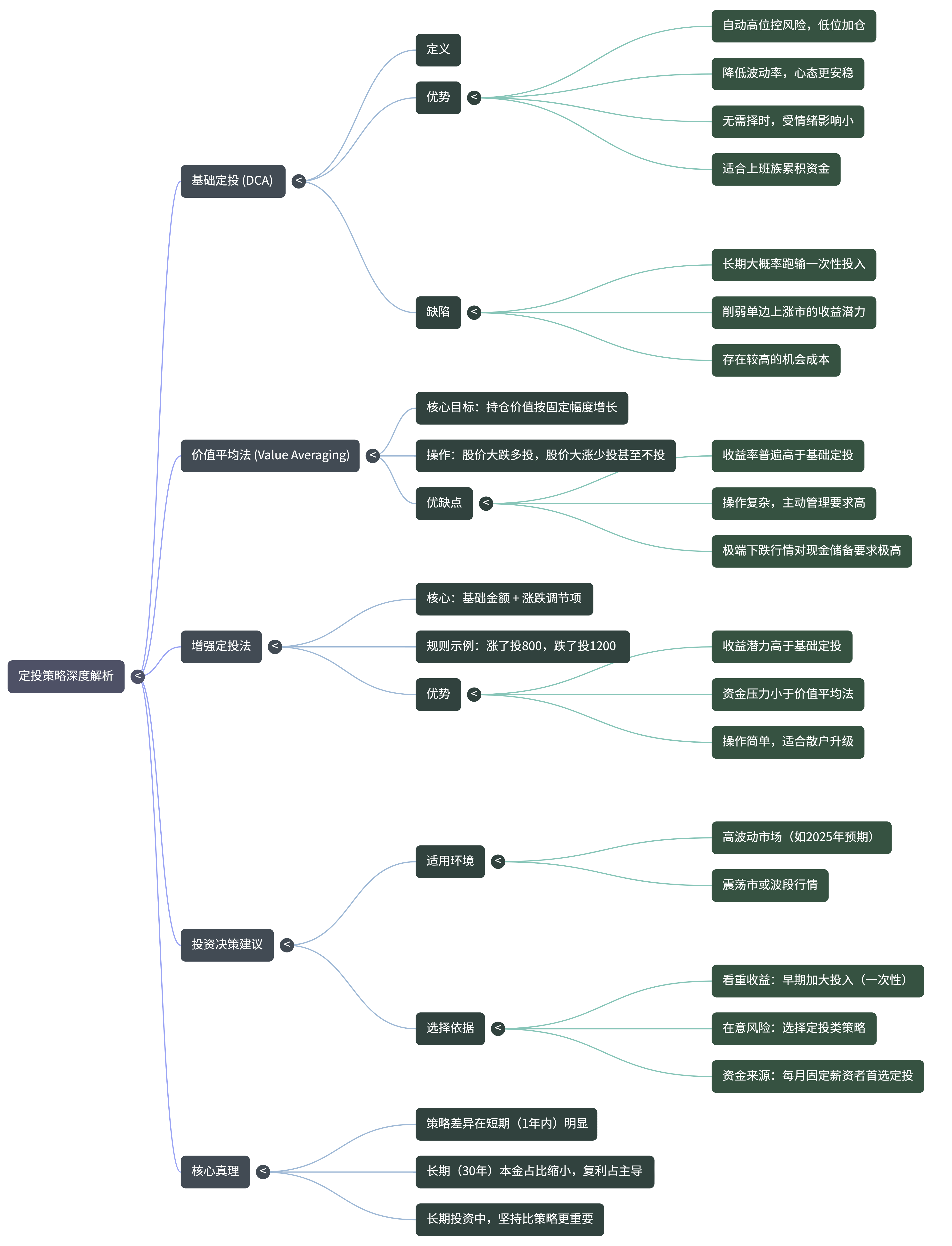
First, let’s look at the mind map:
Why is BTC dollar-cost averaging so popular?
BTC's volatility is 5-10 times that of stocks (daily fluctuations of 10-20% are common; in 2018 and 2022, it even halved by 80%). The best part of dollar-cost averaging is that it automatically helps you 'buy low and sell high' during such extreme volatility.
Fixed investment of 1000 each month:
During a market crash, 1000 can buy more BTC;
During a major rise, you buy less, and your risk exposure decreases.
This effectively incorporates a built-in discipline system of 'buy more on dips, buy less on highs'.
Real backtesting shows: in BTC's history (2011-2025), dollar-cost averaging during bear markets and periods of extreme volatility can significantly reduce maximum drawdowns, allowing you to sleep better, especially suitable for office workers for 'mindless operation'.
The 'BTC dollar-cost averaging trap' that others won’t tell you.
But one point that many KOLs love to avoid is: during a continuously rising bull market cycle, dollar-cost averaging will likely underperform a lump-sum investment!
Based on historical backtesting of BTC from 2011-2025 (multiple independent studies):
Starting from any 10-year/cycle point, the probability of dollar-cost averaging underperforming a lump sum investment is about 70-80%, and the lag is even greater in super bull markets (like 2020-2021, 2024-2025).
The reason is simple - BTC's rise often concentrates in a few explosive phases, and dollar-cost averaging spreads the investment over time, missing out on the early, most powerful upward wave, leading to a high opportunity cost.
How to upgrade BTC dollar-cost averaging? Here are three advanced strategies.

Basic dollar-cost averaging is stable but has a low return ceiling; how to break through? Here are three practical advanced strategies:
1. Value Averaging - highest returns, but also the toughest.
Core concept: it’s not about fixed investment amounts, but about fixed monthly growth in total portfolio value.
For example, if your goal is to increase your portfolio by 1000 USD each month:
When BTC crashes, and your holdings shrink, you just invest more to make up for it;
When BTC rises sharply, you can even invest less or not at all.
Advantages: in BTC, both bull and bear markets yield returns that are almost invariably higher than basic dollar-cost averaging (historical backtesting shows up to 5-10% more per year).
Fatal flaw: in a bear market, you have to continuously make large purchases (like in 2018 and 2022), which puts immense cash flow pressure; retail investors easily 'run out of bullets' and give up halfway.
2. Enhanced dollar-cost averaging (Enhanced DCA) - most suitable for ordinary people, a compromise of the best.
The rules are super simple: set a fixed adjustment value (like 200) on top of the basic 1000.
This month BTC rose → invest only 800 next month.
This month BTC fell → invest 1200 more next month.
Research shows: 85%-92% probability of outperforming basic dollar-cost averaging; the greater the adjustment, the more significant the improvement in returns.
Simple to operate, with controllable capital pressure, this is currently the most practical upgraded version for retail investors in BTC.
3. Trend-enhanced dollar-cost averaging (my personal practical version) - using the 200-day EMA for trend filtering.
This is a hybrid strategy I'm currently using: adding a layer of 200-day EMA trend filtering on top of enhanced dollar-cost averaging (the most classic trend indicator in the BTC circle).
The rules are extremely simple:
When BTC price is above the 200-day EMA → pause new investments (hold steady, don't invest).
When BTC price is below or equal to the 200-day EMA → activate the enhanced dollar-cost averaging method (the more it drops, the more you invest next month).
Advantages: extremely high capital efficiency, only heavily investing at low points (bear markets/correction periods), avoiding high-point dumping; psychologically comfortable, no chasing highs; further reduced volatility (especially suitable for those afraid of buying at the peak).
Disadvantages (must be made clear): the 200-day EMA has strong lagging characteristics, easily whipsawed in volatile markets; in a long bull market (BTC has spent over 70% of the past few years above the EMA), it will severely miss out, missing the main upward wave, significantly reducing total invested principal; compounding effects are diminished.
Suitable for: individuals with moderate risk tolerance, especially those who dislike buying at high prices.
The ultimate truth in the long-term dimension.
If you extend the time frame to more than 10 years, you will find:
Whether it's basic dollar-cost averaging, advanced dollar-cost averaging, value averaging, or my enhanced version, the final differences aren't that significant.
Once BTC's compounding starts rolling, wealth growth mainly relies on time + persistence + belief in Bitcoin's long-term narrative, rather than early clever tricks.
The true path is: find a strategy that allows you to sleep well long-term and won’t make you give up halfway.
If you value stability, use enhanced dollar-cost averaging; if you seek extreme returns, go for value averaging; if you want an extra layer of trend protection, try my enhanced trend version (provided your cash flow is strong enough).
Lastly, here’s a saying for you:
The highest realm of Bitcoin investment is not about choosing the right strategy, but about sticking to it throughout a complete bull-bear cycle.
Which BTC dollar-cost averaging method are you currently using? Are you planning to try the enhanced version or my trend version?
Share your holding strategy in the comments, and let’s discuss together~
