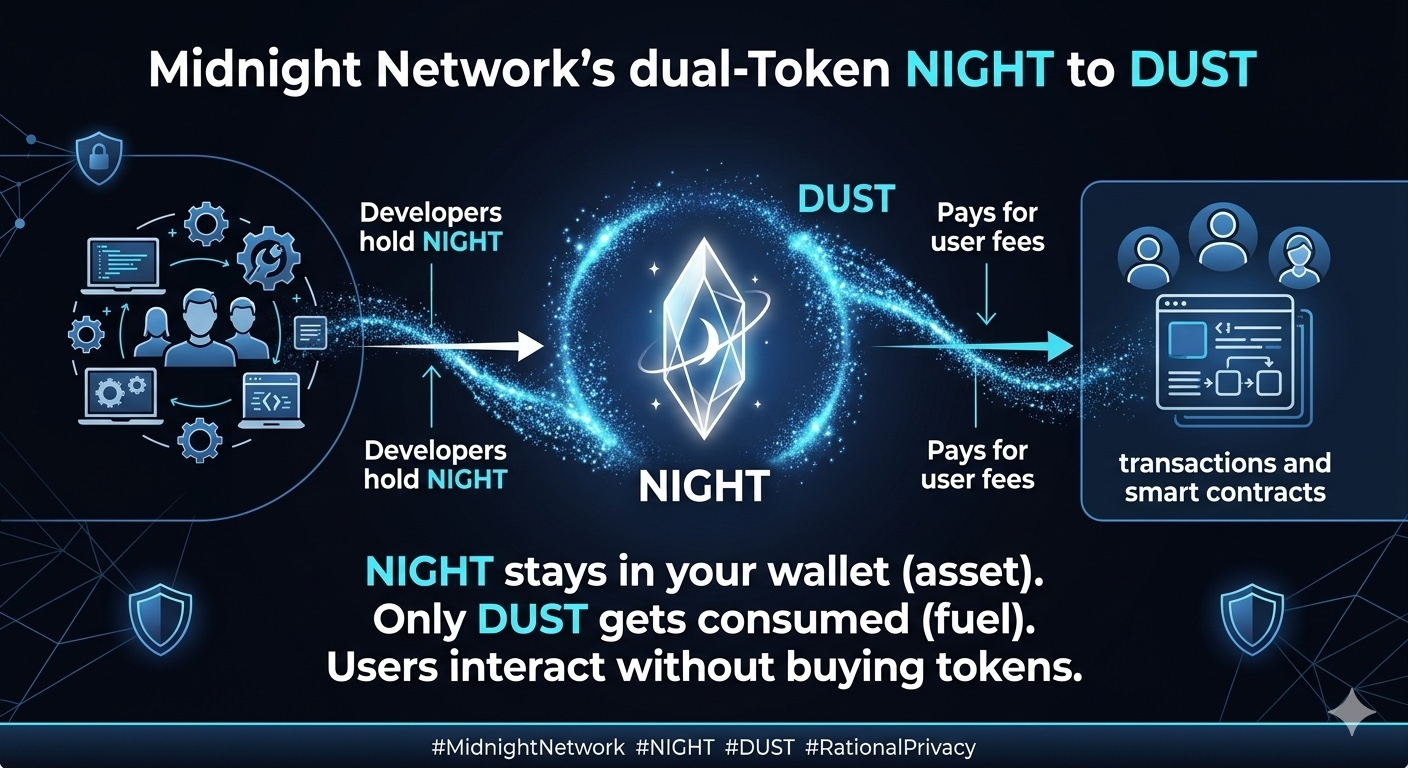
That’s actually the idea behind @MidnightNetwork and its NIGHT DUST model.
Most blockchains today work the same way:
You want to use the chain?
You must buy the native token first to pay gas.
Ethereum. Solana. Almost all of them.
When token price pumps, gas becomes expensive.
And suddenly normal users hesitate to use the app.
We’ve all seen it before:
“Wait until gas is cheaper.” 😅
Midnight is trying something different.
Instead of using one token for everything, they split the system into two parts:
NIGHT
• fixed supply (24B)
• the asset you hold
But when you hold NIGHT, it automatically generates DUST.
And DUST is what actually pays for transactions and smart contract execution.
Think of it like this:
NIGHT = the asset
DUST = the fuel
The interesting part?
You don’t burn NIGHT to pay fees.
Your NIGHT stays in your wallet.
Only DUST gets consumed.
And this creates a new possibility for Web3 apps.
Developers can hold NIGHT to generate DUST and sponsor fees for their users.
That means users could interact with dApps without needing to buy tokens first.
Closer to how Web2 apps work.
You just open the app and use it.
This is also why Midnight talks about “rational privacy.”
Not just hiding data with zero-knowledge proofs, but making privacy actually usable and scalable.
Of course, we still need to see how it plays out in reality:
• How fast does DUST generate?
• How strong is the decay rate?
• Will apps really sponsor user fees?
But the idea itself is pretty fresh.
If it works, it could remove one of the biggest frictions in Web3: having to buy tokens just to use an app.
Mainnet is getting closer, testnet is already live, and the Glacier Drop just happened.
So I’m curious what the ecosystem will look like.
What do you think?
Would the NIGHT → DUST model make you more interested in building or using apps on Midnight?