
I’ve been diving deep into the Midnight Devnet lately, and honestly, it’s refreshing to see a blockchain environment that isn’t just about testing, but acts more like a playground for real privacy development. Since it kicked off in 2023, the devnet has been designed so that whether you’re a seasoned blockchain pro or just starting out, you can actually give privacy-protecting smart contracts a proper test drive. What really caught my attention is how it opens the door for people with zero blockchain experience. You can basically test your business logic locally and then deploy it to a public blockchain once it's ready, making the whole process feel much less intimidating.
The tools they’ve built are surprisingly user-friendly, especially Compact, their smart-contract language. If you’ve ever touched TypeScript, you’ll feel right at home because they’ve modeled it to be very similar. In Compact, it’s incredibly clear what part of your contract is private and what stays public. They’ve intentionally dropped some of the more complex TypeScript features to simplify verification, so you don't need to be a deep cryptography expert to build something functional. Once the contract is written, you just assemble it and send it straight to the devnet, where you can play around with it using a browser wallet or even share the app with other testers to see how it performs.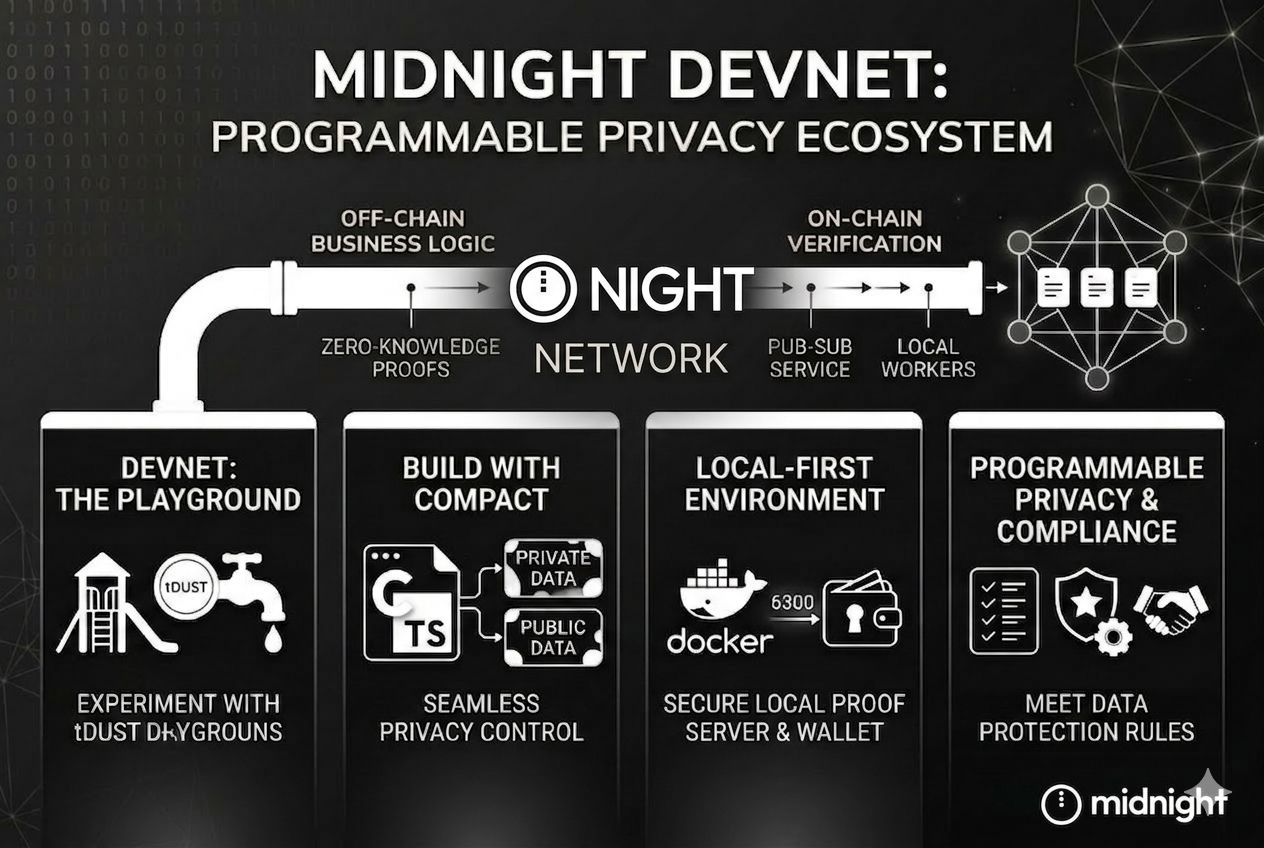
The entire atmosphere there really promotes experimentation. There’s a developer token called tDUST that exists only within the devnet, which you can get from a faucet to pay for transaction fees or transfer shielded assets. What I love most is that the design is "local-first"—tools like the proof server (usually a Docker container on port 6300) and the Lace wallet run directly on your own machine. This means sensitive data stays on your computer and never has to hit a remote server, which is a massive win for building apps that need to comply with strict data protection laws. You can prove you've passed compliance checks without ever putting personal or financial data on-chain.
After spending time on the devnet, I finally see why Midnight is pushing for "programmable privacy." They’ve managed to take something as technical and "heavy" as zero-knowledge proofs and make them practical for the everyday developer. To my (perhaps unpopular) taste, the most impressive part isn't just about hiding information—it’s about the power of choice. It gives us the ability to manage the flow of information, deciding exactly what needs to be disclosed and what should remain confidential. With tools like these, ZK-apps are no longer just a cool concept; they’re finally becoming a reality.