
I wonder if anyone finds this assumption common when discussing privacy in crypto? If blockchain wants to serve businesses or financial institutions, then simply adding Zero Knowledge Proof is enough, as transaction data is hidden, privacy is ensured, and the system can continue to operate as usual.
Initially, I thought quite simply like that.
But recently, when I delved deeper into @MidnightNetwork , especially seeing the latest share from Charles Hoskinson, I began to see that their approach to the issue seems broader than just "adding ZK to blockchain."
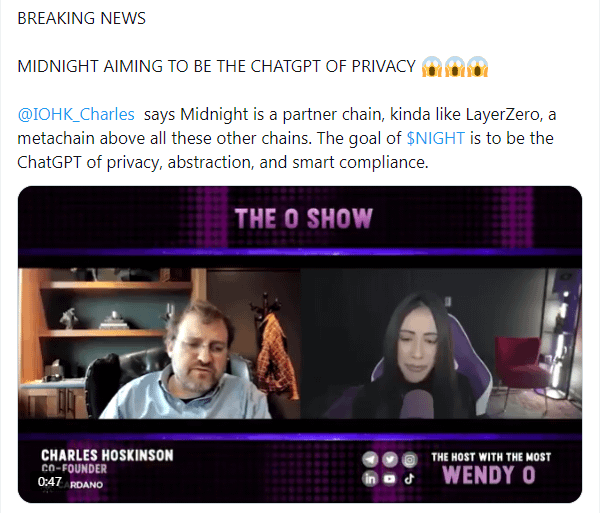
Hoskinson describes Midnight as a partner chain in the Cardano ecosystem, but the noteworthy point is that it is not designed solely to serve one chain. According to his explanation, Midnight resembles a type of metachain, a layer that can interact with various blockchains and act as an intermediary tier for privacy-related functions.
The comparison you made is also quite easy to visualize: the role of Midnight in the ecosystem is somewhat similar to how LayerZero acts as a connecting infrastructure between chains, where different networks can communicate with each other through an intermediary layer. But what caught my attention more was how you described the long-term goals of the project. Hoskinson once said that Midnight wants to become the "ChatGPT of privacy, abstraction, and smart compliance."
At first glance, this statement seems more metaphorical than technical description. However, if you think more deeply, it evokes a very clear view of the system's design.
In current crypto, privacy is often built directly into each blockchain. For example, Zcash uses ZK-SNARKs to hide transaction data in a shielded pool, creating a very strong level of privacy but also making integration with traditional financial systems more complex.
But with Midnight, I see they are trying a completely different direction.
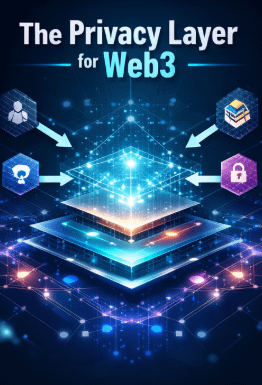
Instead of viewing privacy as a feature of each individual chain, they attempt to build a privacy abstraction layer, where blockchains or Web3 applications can use security tools as needed without having to implement the entire ZK proof infrastructure from scratch. In this model, Midnight is not just a single chain, but resembles a privacy service layer that other applications or blockchains can call upon when needed, while $NIGHT is used to operate the economic mechanisms surrounding this infrastructure layer, rather than merely serving as transaction fees like many traditional Layer 1s.
At this point, I find the comparison with ChatGPT starting to become interesting.
In simple terms, ChatGPT is not the only AI technology that exists. But it functions as a common interface where many applications can use AI without needing to build their own models. Meanwhile, Midnight creates an intermediary layer where smart contracts or Web3 applications can access functions like ZK proof, selective disclosure, or compliance-related logic.
The concept that the project often refers to is rational privacy, which I explained in the previous article. Instead of completely hiding all data, the system allows users to decide who can access which information and under what circumstances that data is disclosed.
In a business context, this approach is quite understandable. An investment fund can move tens of millions of USD on-chain, and if all transaction data were publicly available immediately, competitors could infer trading strategies simply by monitoring wallets. In traditional financial markets, such information typically resides within the internal systems of the fund or broker, not as data visible to the entire market in real-time.
On the contrary, that fund still needs to prove to the regulator that its transactions comply with regulations such as KYC or AML, and at this point, an absolute privacy system sometimes makes compliance harder to achieve.
Of course, this kind of design also raises a few questions.
If Midnight truly acts as a privacy layer for multiple blockchains, then it will have to handle a significant amount of ZK computation. Ecosystems like StarkNet or Polygon zkEVM have shown that scaling ZK-based systems often leads to quite complex prover infrastructure, and computational costs sometimes become a limiting factor for the overall network's performance.
Whether Midnight will encounter a similar problem as transaction volumes increase, I still haven't seen a clear answer in the current documentation. If the cost of creating proofs becomes a bottleneck, then balancing privacy and performance may be a much harder problem than the initial theoretical design.

After reading how Midnight describes the system, I started to think of a broader question.
If blockchains in the future are indeed used by banks, investment funds, and major financial institutions, where each transaction can be worth tens of millions of USD, should privacy be designed as a feature of each individual blockchain, or as a common infrastructure layer that the entire ecosystem can use?
