

The computer at home, equipped with a top-tier graphics card, basically sleeps most of the time except for a couple of games in the evening.
A few days ago, while paying the electricity bill, I looked at that constantly lit standby light and suddenly felt that this is simply a tremendous waste of resources.
The performance of current smart hardware is already seriously excessive, whether it's your high-end router at home or an old phone gathering dust.
If you add up the computing power of the chips inside them, it actually amounts to an extremely large number.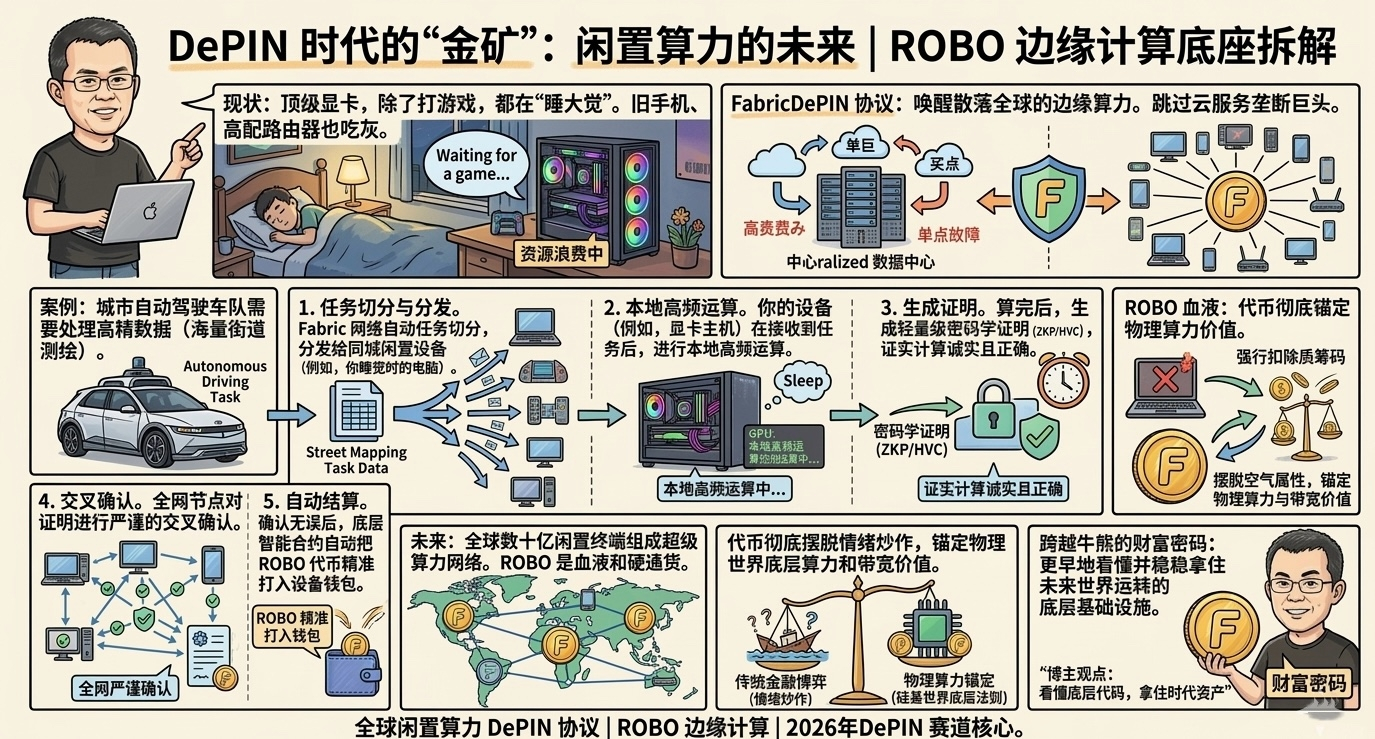
This corresponds exactly to a hidden mainline I saw in the @Fabric Foundation Fabric network, which is the underlying architecture of ROBO.
What they have spent a large part of their white paper on is actually how to completely awaken the scattered edge computing power around the globe.
In the past, whether it was technology companies or research institutions, running a complex data model could only be done by honestly renting large cloud servers from big factories.
However, centralized data centers of large companies are not only outrageously expensive but also have extremely fragile single-point failure risks.
The geek team at ROBO has attempted to directly bypass these cloud service monopolies in an extremely hardcore way.
The protocol they developed allows you to directly register your idle hardware as an independent computing node in the decentralized network.
Assuming there is an autonomous driving fleet in your city that needs to process massive amounts of high-precision street mapping data in real time.
This extremely large computing task will be automatically divided into countless small data packets by the Fabric network, prioritized for distribution to idle devices in the same city.
Your computer host might quietly accept one of these tasks and start performing local high-frequency computations while you are sleeping.
After computation, your device will use the underlying hardware verifiable computing technology to generate a lightweight cryptographic proof.
This proof can rigorously confirm across the entire network that your device has indeed completed this part of the computation and that the results are entirely correct.
Once the network nodes cross-confirm without error, the underlying smart contract will automatically and accurately deposit the #ROBO tokens into this host's digital wallet.
This is the true landing form of the perfect combination of edge computing and zero-knowledge proofs that they have been tirelessly researching.
In this extremely sophisticated system, there are no high-and-mighty intermediaries to profit from the price difference or take a cut.
Your idle hardware has directly transformed into a digital age worker capable of accepting orders, working independently, and settling accounts.
If everyone takes a moment to carefully deduce the business scale behind this grand narrative, they will definitely break out in a cold sweat.
There are billions of idle terminals with powerful data processing capabilities worldwide consuming basic electricity costs without cause.
If major hardware manufacturers in the future integrate this settlement standard directly into the underlying protocol at the factory to increase selling points.
The entire Earth will form a vast and extremely decentralized idle computing power network larger than any centralized supercomputer currently exists.
The only blood and absolute hard currency that maintains the normal operation of this super computing power network is$ROBO .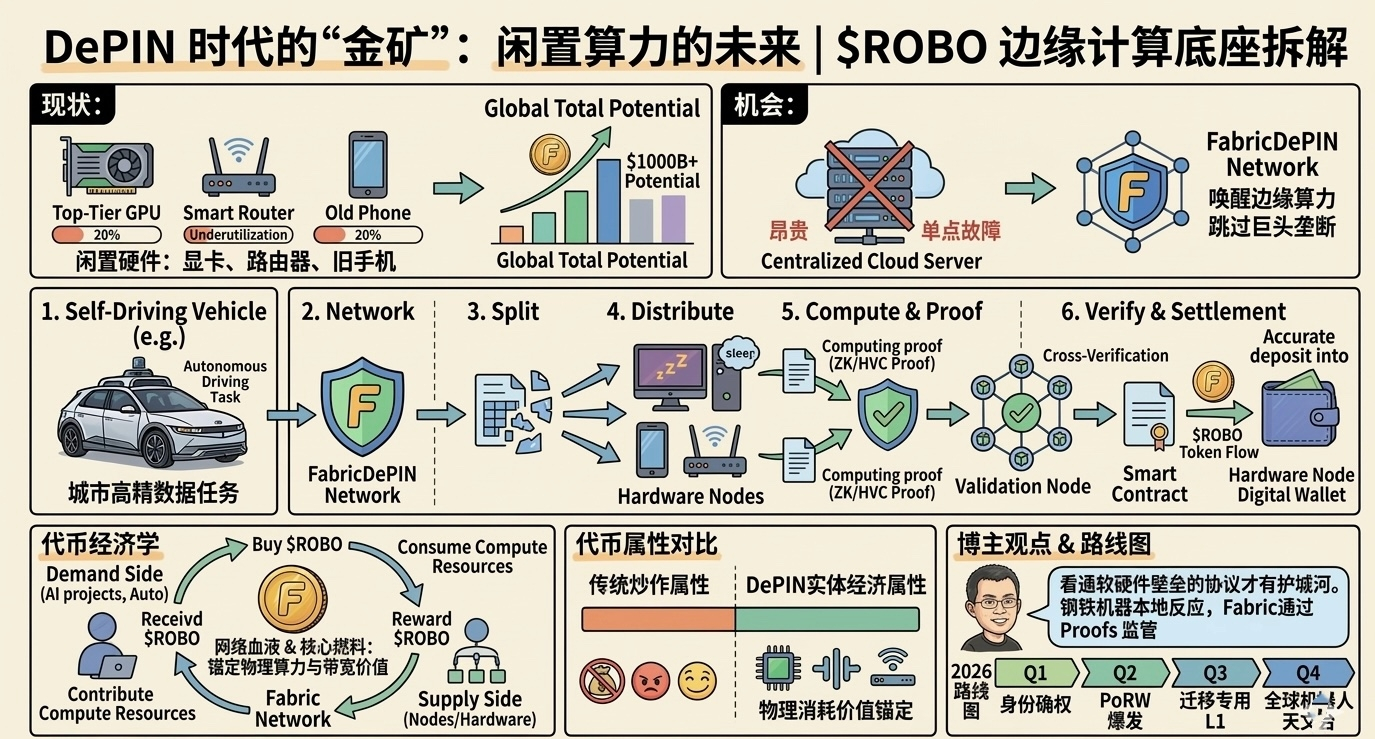
Data and task publishers must go to the market to purchase and consume a large amount of tokens with real money to publish genuine computing demands.
Hardware nodes providing computing power earn these tangible rewards by honestly contributing their processor resources.
Those malicious nodes that attempt to deceive the system with poor-quality code will be instantly expelled from the network and forcibly deducted their staked underlying chips.
In this tight physical economic model, tokens have completely shed the air attribute of purely relying on emotional speculation.
It has become a true hard metric that anchors the underlying computing power and bandwidth value of the physical world.
As long as human society's demand for computing power continues to grow exponentially, this physically-based buying pressure will never run dry.
Many times, we frequently get lost in the secondary market and are washed out because our thinking is still stuck in traditional financial games.
When you truly understand how these underlying codes reconstruct the computing power distribution laws of the future silicon-based world.
You will naturally understand what level of core asset of the era you are tightly holding onto.
The wealth code that crosses bull and bear markets has never been about staring at the market every day chasing those elusive red and green moving averages.
Rather, it is that you can see and firmly hold onto the underlying infrastructure that will operate in the future world earlier than most people.