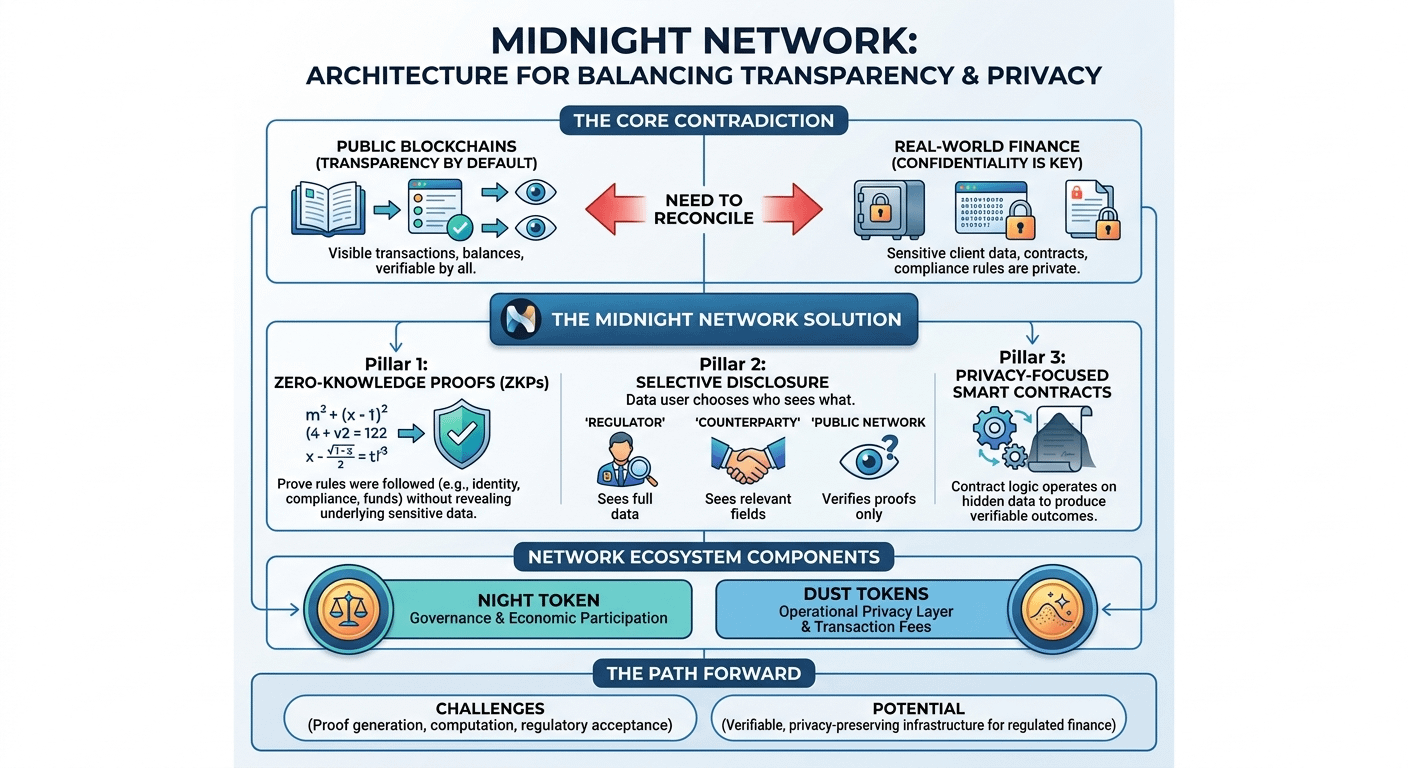
One of the quiet contradictions in blockchain design is that the technology was built for transparency, while many real-world financial systems rely on confidentiality.
Public blockchains make everything visible by default. Transactions, balances, contract interactions — they’re all there for anyone to inspect. From a systems perspective, that openness is part of what gives blockchains their credibility. You don’t need to trust an institution when the ledger itself can be verified.
But once you step outside the crypto-native environment, the situation starts to look less straightforward.
Banks, financial institutions, and regulated firms operate under a very different set of assumptions. Transactions often involve sensitive information: client identities, contract terms, collateral positions, internal risk exposure. Publishing those details to a fully transparent ledger isn’t just uncomfortable — in many cases it would violate regulatory obligations or competitive boundaries.
So the industry has spent years trying to reconcile those two worlds.
One common approach has been permissioned or private blockchains, where access to data is restricted to approved participants. Another approach stores sensitive data off-chain, with only cryptographic commitments placed on the ledger. There are also layered architectures where visibility depends on the role of the participant.
All of these ideas solve parts of the problem, but they often feel like workarounds rather than native solutions. In some designs, transparency disappears entirely. In others, the system becomes complicated enough that it starts to resemble traditional infrastructure with extra cryptography layered on top.
This is where Midnight Network becomes an interesting experiment.
Rather than trying to hide transactions entirely or restrict the network itself, Midnight focuses on something slightly different: proving that rules were followed without exposing the underlying information. The idea leans heavily on zero-knowledge proofs, which allow a system to verify that a statement is true without revealing the data used to prove it.
It’s one of those concepts that initially feels abstract. But the practical implication is simple enough. A transaction could prove that it meets regulatory requirements, satisfies collateral thresholds, or follows certain compliance rules — without revealing the full transaction details to the public network.
Alongside that, Midnight explores selective disclosure. Instead of everything being either public or private, participants can reveal specific information to specific parties. A regulator might see the full data set. A counterparty might see only the relevant transaction fields. The broader network simply verifies the proofs that the rules were satisfied.
In theory, this creates a more nuanced visibility model than the binary transparency most blockchains rely on.
Midnight also extends this concept into privacy-focused smart contracts, where contract logic can operate on hidden data while still producing verifiable outcomes. The network doesn’t need to know every input to confirm that the contract executed correctly.
The ecosystem itself includes a couple of structural components. The NIGHT token serves as the network’s core asset, supporting governance and economic participation. Meanwhile, DUST tokens function more operationally within the privacy layer, helping facilitate private transactions and contract interactions.
Those details might seem small, but privacy infrastructure often requires new mechanisms for handling computation costs and network incentives.
Still, it’s hard not to approach these designs with a bit of caution.
Zero-knowledge systems have improved significantly in recent years, but they’re still computationally heavy compared to standard transactions. Proof generation times, developer tooling, and network throughput all become practical constraints once systems move beyond small test environments.
There’s also the question of how regulators will interpret these models. Selective disclosure sounds reasonable in theory, but regulatory frameworks often depend on very explicit data access and reporting processes.
So Midnight feels less like a finished answer and more like an attempt to explore a different architecture.
What makes it interesting isn’t that it promises perfect privacy. It’s that it tries to address a problem that the industry hasn’t fully solved yet: how to keep blockchains verifiable without forcing every participant to operate in complete public view.
If systems like this work, they could make blockchain infrastructure more compatible with regulated finance. If they don’t, the industry will probably keep experimenting until it finds a model that does.
Either way, projects like Midnight are a reminder that the next phase of blockchain development may have less to do with transparency alone — and more to do with figuring out when transparency actually makes sense.
$NIGHT @MidnightNetwork #night