
In the Web3 industry, privacy protection has always been a key focus, but there are not many projects that can truly achieve a balance between "privacy and compliance." Many privacy chains either focus solely on privacy, neglecting regulatory compliance, which makes practical application difficult; or they emphasize compliance too much, losing the core meaning of privacy protection. The emergence of Midnight Network just addresses this pain point. As a fourth-generation blockchain, it proposes the concept of "rational privacy," which is neither extreme nor compromising, and this is why I have always paid attention to it.
Many people may still not be clear about what Midnight Network actually does. Simply put, it is a platform specifically designed to solve the problem of excessive transparency in Web3 data, with the core being zero-knowledge proof (ZKPs) technology. Unlike some projects that complicate zero-knowledge proofs, Midnight's technology is more practical — we can complete all operations on the blockchain, such as trading and verifying information, without exposing our personal information or business secrets, thus ensuring privacy without affecting the normal process of transactions and verifications. This aspect is particularly useful for both enterprises and ordinary users. For example, in scenarios like compliance audits and identity management, DApps built with it can achieve data usability without visibility.
One more point that really impresses me is that Midnight Network does not engage in zero-sum competition. Many blockchain projects nowadays are focused on competing with other public chains for market share and users, but Midnight is different. As a partner chain of Cardano, it resembles a 'universal privacy layer' that can empower major public chains like Cardano, Bitcoin, Ethereum, and Solana by adding privacy protection capabilities. This cooperative and win-win approach actually aligns better with the trend of multi-chain integration in Web3, as its success is also dependent on the prosperity of other public chain ecosystems. This impartial positioning gives it even greater long-term development potential.
Let's talk about the $NIGHT token that everyone is most concerned about. It, along with DUST, forms a dual-token model with very clear roles. $NIGHT is the core of the entire network, responsible for governance and staking, and it can also generate DUST; while DUST is mainly used to pay for privacy transaction fees, and it is renewable, so there's no need to worry about running out. This design is quite reasonable, ensuring the value of $NIGHT while also making users' transaction costs more manageable. Additionally, the distribution of $NIGHT is also very fair, with no VC involvement or team reservations; most of it is distributed to the community through methods like Glacier Drop and scavenger mining, and now many people are participating, with over 8 million wallets having engaged in related activities.
Currently, Midnight is still in the Hilo phase, relying on Cardano's security system to establish the liquidity and governance mechanism for $NIGHT, and the mainnet is about to launch at the end of March, entering the Kūkolu phase, at which point the first batch of privacy DApps will also go live. Plus, its node partners are quite strong, with major companies like Google Cloud and Blockdaemon participating, so the ecological development speed is still very fast.
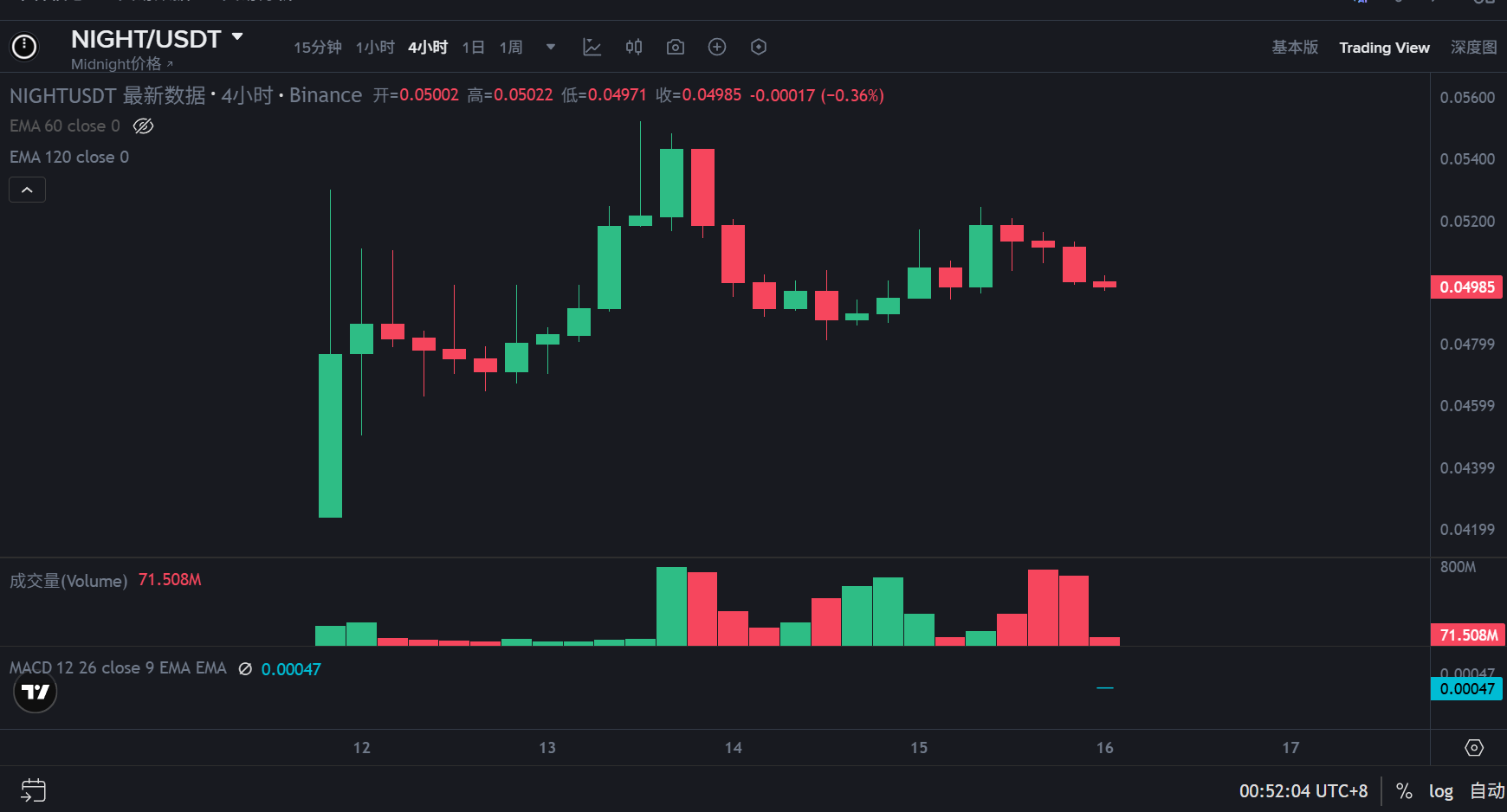
Personally, I feel that the price of $NIGHT is still at a low level, around $0.05, which is clearly undervalued compared to its technical strength and ecological potential. The privacy sector is a necessity, and as global data compliance becomes increasingly strict, projects like Midnight that can balance privacy and compliance will only become more popular. When the next bull market arrives, along with the mainnet launch and ecological improvement, $NIGHT is highly likely to experience a strong breakout, making it worth everyone's long-term attention and investment.