

In the past few days, the market has been fluctuating, and the most lively place in the square is undoubtedly the project of $ROBO and @Fabric Foundation . I took a look around, and the debate between bulls and bears is particularly intense. The bulls are hyping up Fabric, talking about AI + DePIN, and how it will dominate the world tomorrow; the bears have their arguments too, believing it's just a speculative concept that's too difficult to implement. I have a habit of not following the crowd. No matter how heated the discussions are, I still need to calm down and research on my own. Just like when we buy things, we can't just listen to the salesperson's hype; we need to look at the material and details ourselves. I'm not a professional analyst, just an ordinary player who has been in the crypto space for several years, experiencing both gains and losses, and I've encountered my fair share of pitfalls. So now I've developed a habit of analyzing any project from the most practical and straightforward perspective, thinking about whether this thing can actually succeed. Today, I happen to take advantage of this excitement to share my views on Fabric and $ROBO, just to throw out some ideas.
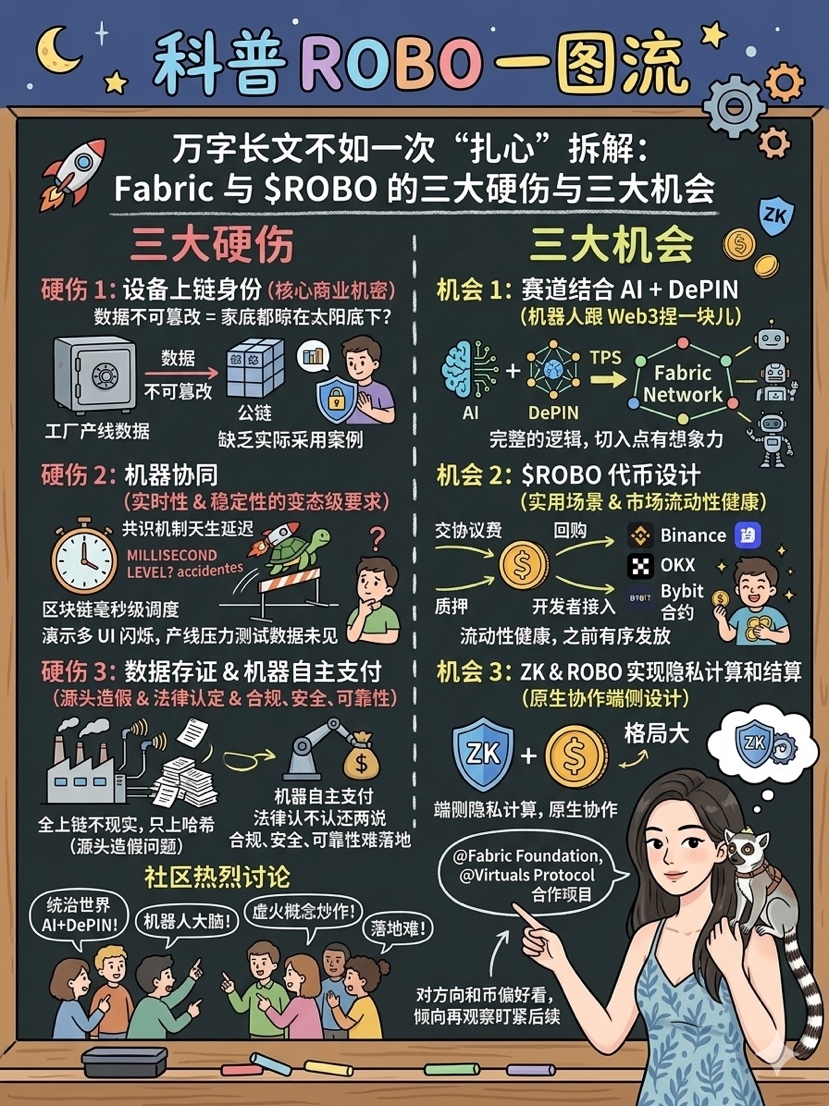
First, let's talk about the direction. I think this track has indeed chosen something worthwhile.
In the past two years, everyone has been talking about AI and DePIN, but Fabric combines these two aspects, aiming to merge robots with Web3. What it discusses regarding on-chain device identity, cross-device collaboration, data notarization, and autonomous machine payments sounds quite complete, unlike those projects that just throw out a concept to raise money. It's clear that the team has seriously pondered how to integrate blockchain technology into physical hardware and industrial scenarios. The future robot market will definitely be a big cake, and right now those giants are all working on their own closed systems. Fabric aims to take an open path, providing machines with a decentralized 'trust layer' and 'economic identity.' This approach indeed has imagination.
Now let's talk about the token $ROBO . It is the native token of this network, designed with plenty of practical scenarios, such as paying protocol fees, buybacks, staking, and developer access. On the market side, as a collaborative project of Virtuals Protocol, it first launched on Uniswap, then gradually appeared on major exchanges like Binance, OKX, and Bybit, and now it also has contracts. I looked at the current data, and both the market cap and trading volume are decent; liquidity appears healthy, and the previous public sales and distributions were orderly.
However, brothers, let's take off the filter and talk about something heartfelt. Any project that seems perfect, when put into reality, reveals all the issues. From my research, I feel there are several hurdles, and if Fabric can't get past them, it will truly be an illusion.
First, regarding device on-chain identity. The project team wants the robot's operational data to be on-chain and immutable, which sounds great. But we have to think about it: in reality, those factories treat their production line data as core business secrets! Why would they expose such sensitive data to be put on-chain? If your blockchain is immutable, it's like hanging your entire fortune out in the sun. You tell me that privacy computing and zero-knowledge proofs can be used; technically, that's feasible, but what about the details of implementation? Are there actual adoption cases? I really haven't seen much in the current materials. Without big manufacturers pouring real money into it, this concept will just float.
Second, regarding machine collaboration. Different brands' devices are decentralized through blockchain scheduling, and this vision does seem very futuristic. But the requirements for real-time performance and stability in industrial scenarios are extraordinarily high; a delay of a few milliseconds could lead to incidents. We all know that blockchain's consensus mechanism inherently has delays. Asking it to perform millisecond-level scheduling in a factory is like making Liu Xiang run hurdles in high heels, isn't it? Most of the demos we've seen so far are just UI interfaces flashing; I haven't seen real production line pressure test data.
Third, data notarization and autonomous machine payments. The amount of data generated by robots in a second is massive; putting everything on-chain isn't realistic. Just hashing requires solving the issue of source fraud, and whether the law recognizes it is still debatable. As for payments, the scenarios described sound great, like machines paying for electricity and maintenance by themselves. But right now, robots are far from being able to make truly autonomous decisions. The compliance, safety, and reliability issues involved in this payment process are too difficult to implement in the short term.
Of course, I must also say a fair word. Fabric hasn't taken the shortcut of using shell APIs but aims to achieve native collaboration at the edge with ZK and ROBO for privacy computing and settlement. This pattern can indeed work. However, challenges such as memory bottlenecks, network latency, L1 public chain performance, AI reliability, and privacy regulation are all present. Moreover, the 'Seed Tag' label that Binance has attached to it reminds us that this thing will be very volatile.
So, to summarize my thoughts.
Regarding this direction of Fabric and the ROBO token, I'm currently leaning towards watching, but I prefer to observe further. I will add it to my watchlist and keep an eye on its subsequent dynamics. When can we see a few heavyweight partners really landing? When can we see authoritative third-party test reports proving that its technology can indeed run on real production lines? Once these substantive developments gradually emerge and certainty increases, I will seriously consider whether to get on board. Opportunities in the crypto circle are always there; the key is to manage your positions well and not be swayed by market emotions. We have plenty of time ahead; let's keep an eye on it together. I hope Fabric can take steady steps to turn its ideas into reality, and I hope we can all remain stable during this cycle. #ROBO This play, let’s watch it slowly.