
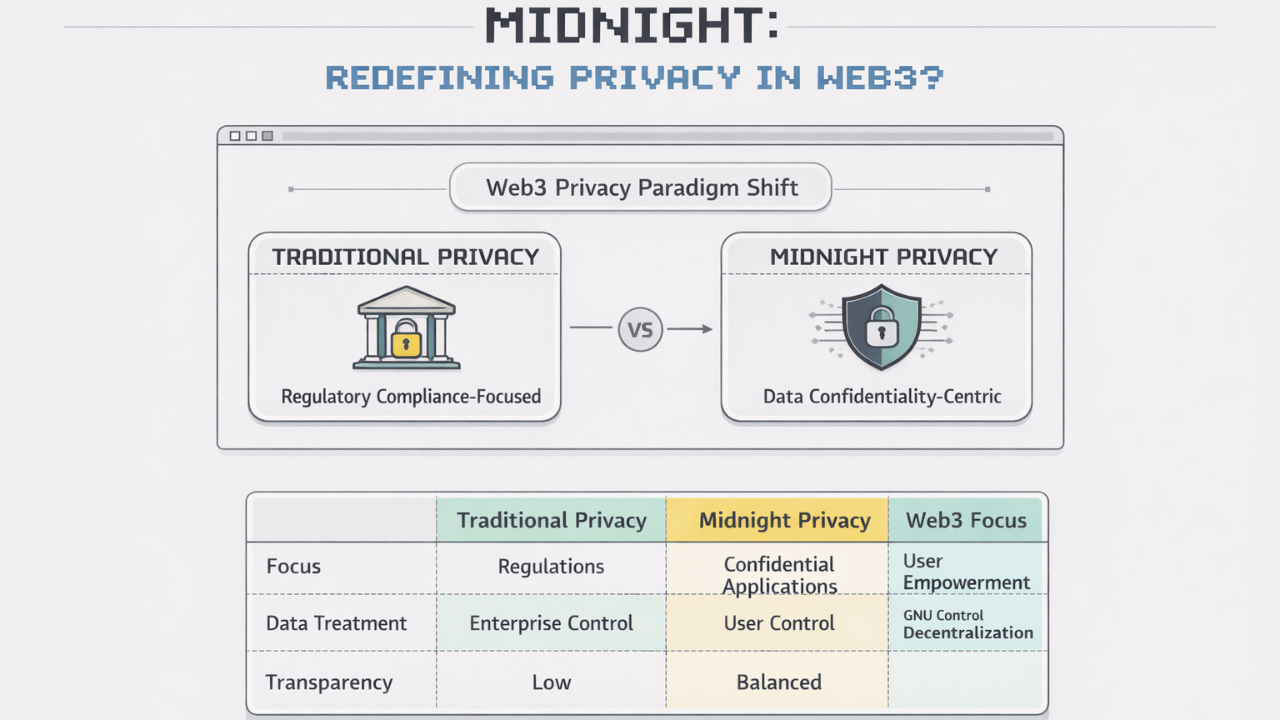
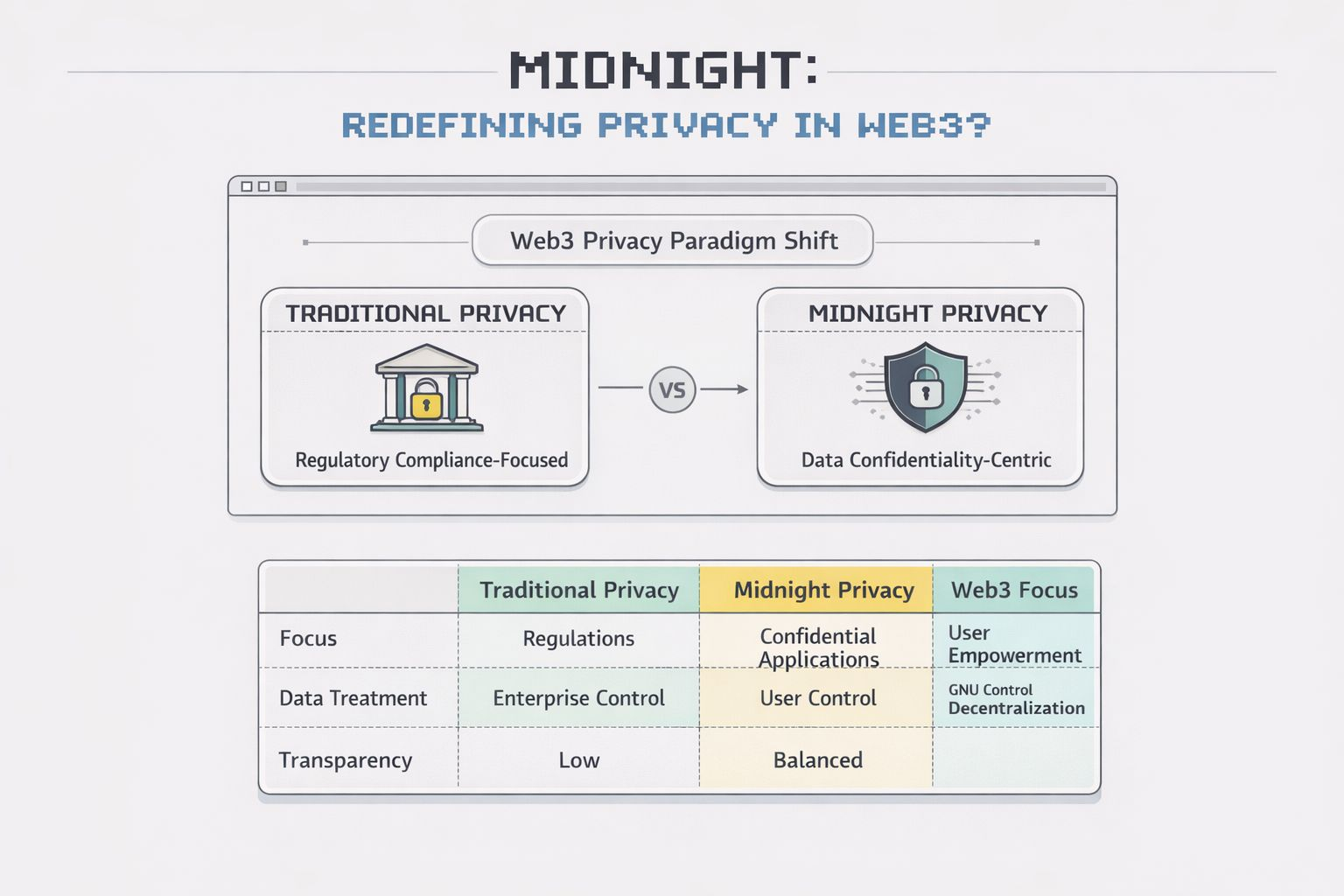
I think Midnight can make the market reconsider the definition of privacy in Web3 not because they are hiding stronger than the old privacy chains but because they are trying to completely change the original question.
From my perspective, the crypto market has usually viewed privacy through a rather crude logic. Either everything is public like most current blockchains, or everything is deeply hidden like the old-style privacy coins.
Having become accustomed to those two extremes, many people unconsciously understand privacy as a state. The harder it is to see, the better. @MidnightNetwork is pushing the market towards a much different understanding.
They do not describe privacy as hiding everything but as the ability to control what is disclosed, what is kept confidential, and in what context it is revealed.
For me, this is a very significant difference at the definitional level.
Because if privacy only means hiding everything, the market will forever view it as a story leaning towards anonymity.
If privacy is understood as a tool to prevent sensitive data from being unnecessarily exposed while the system can still prove its correctness when needed, then privacy starts to look more like infrastructure than an ideological stance. Midnight is trying to steer the market in that direction.
I think this is why Midnight is much more worth discussing than the familiar privacy narrative.
Privacy in crypto has often been portrayed as something to combat surveillance or to protect personal privacy in a narrow sense. Midnight is trying to push this further.
They view privacy as a condition for practical applications to exist on the blockchain. When they emphasize selective disclosure, the ability to verify shielded execution, and compliance by design, they are telling the market that privacy is not just for those seeking absolute anonymity.
It is also intended for businesses, identity, healthcare, finance, and governance. That is, for environments where sensitive data and the obligation to prove must go hand in hand.
From my perspective, this is where the market may be forced to reevaluate.
Because Midnight is directly challenging the old understanding that the stronger privacy is, the more it must be absolutely concealed.
But in the real world, privacy is most valuable not when it blocks all visibility but when it allows the system to disclose enough to operate without revealing more than necessary. This is a mindset much closer to real life.
In reality, most systems do not require absolute secrecy. They need to share appropriately. A business may need to demonstrate compliance without wanting to open all customer data.
An identity application may need to prove that a person is qualified to participate without wanting to store the entire sensitive record.
Midnight is trying to turn those kinds of needs into the default logic of the infrastructure.
One reason I find this thesis more compelling is that they are not just speaking with slogans.
Midnight is integrating this new definition of privacy into network architecture, tooling for developers, and even tokenomics.
In terms of architecture, they follow the approach of having public state and private state coexist, allowing applications to have verifiable parts while sensitive data does not have to be public by default.
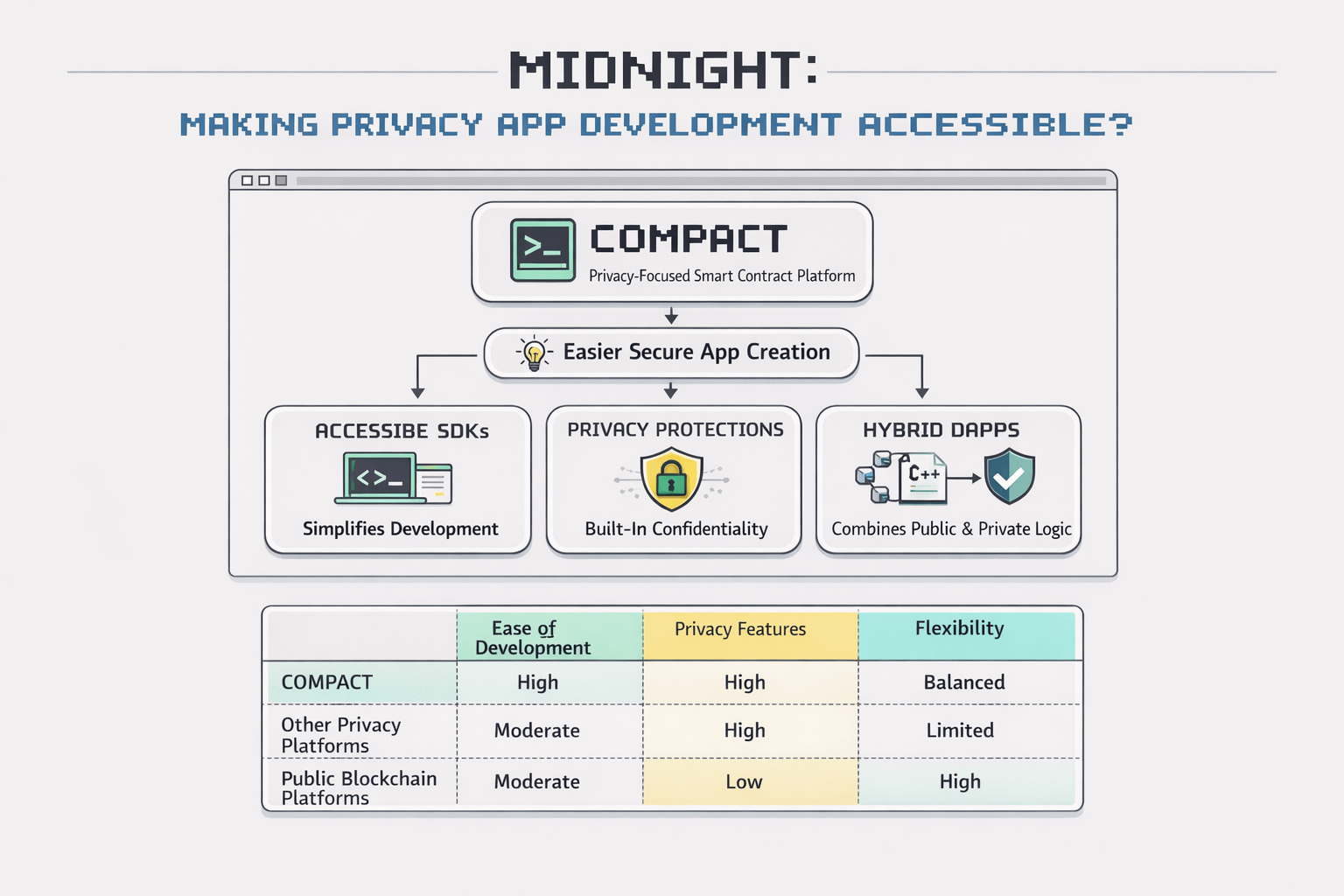
Regarding developer experience, they emphasize Compact and familiar toolkits so that developers can build privacy-preserving apps without having to piece together deep technical layers from scratch.
In network economics, they separate NIGHT and DUST to create an operational model where the app can bear the costs for the user and reduce onboarding friction. When these three parts are combined, privacy is no longer a discrete feature.
It becomes a design layer that runs through from the protocol to the product.
I think this is a place where many people are missing the point.
The market often likes easy-to-tell stories. Privacy tokens. Hidden transactions. Hard-to-trace wallets. And that’s it. Midnight is trying to say that the real story is much more interesting.
If blockchain wants to delve into environments with sensitive data, privacy must mature.
It has to move away from a role that opposes compliance and shift to a role that allows compliance to happen without compromising privacy. It also has to move away from being a separate niche for a special group of users to becoming a layer of infrastructure for use cases where full disclosure is too blunt.
But I also don’t think that just telling that story will automatically convince the market.
A new definition only has life if it attracts real applications. If selective disclosure only exists in the docs, if programmable privacy is only appealing on stage, if compliance by design does not attract any real builders and organizations to use it, then the market will revert to old understandings.
Privacy is a niche, not infrastructure. In the end, the market does not score based on nice definitions. The market scores based on real app usage and real problems solved.
So if you ask me whether Midnight can make the market reconsider the definition of privacy in Web3, the answer is yes.
Not because they are telling privacy in a novel way for fun, but because they are trying to transform privacy from a polar opposite of transparency into a layer of contextual disclosure control.
If they can bring real app builders and real usage to that model, the market will find it hard to continue viewing privacy as merely hiding everything. At that point, privacy in Web3 will be understood closer to what Midnight is trying to build: a tool for protecting sensitive data while still being verifiable enough for real-world use.
For me, if that happens, it will be a much bigger change than just having another privacy chain.
@MidnightNetwork #night $NIGHT