
Brothers, today this gossip gives me chills down my back. The situation in the Middle East just added another fierce fire.
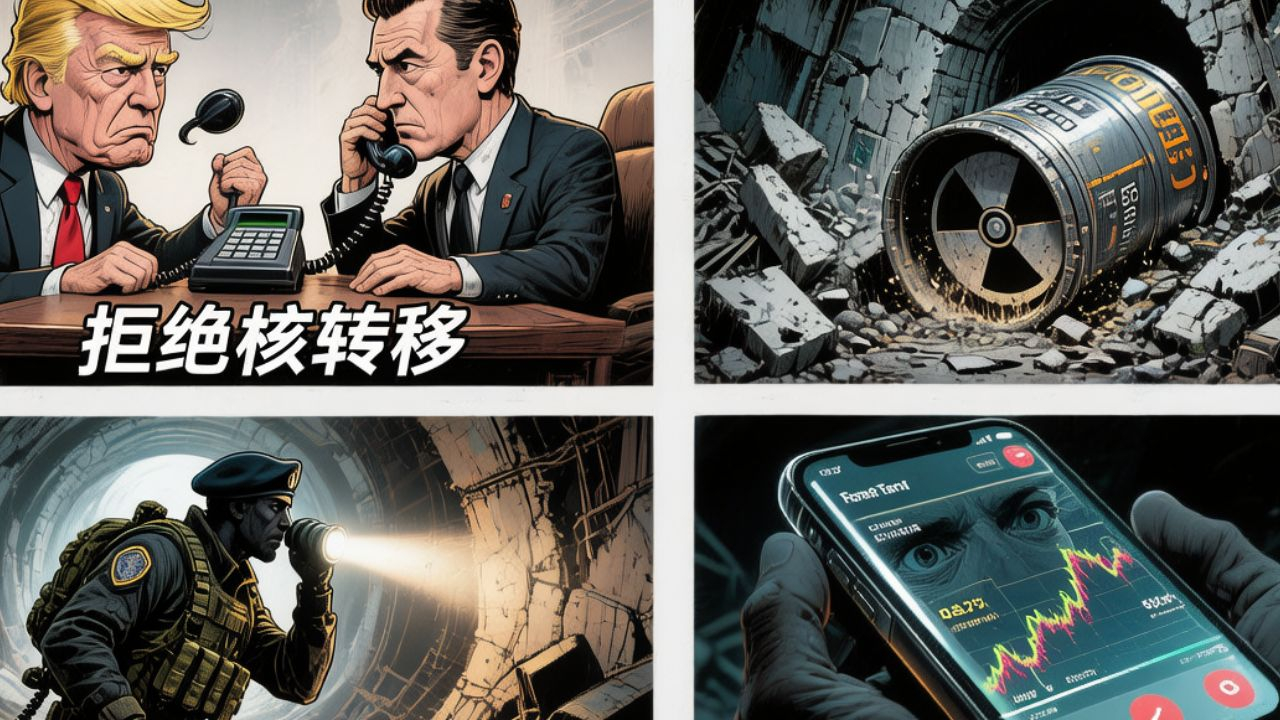
Simply put: Putin called Trump and said, "Buddy, that batch of deadly enriched uranium from Iran (about 440 kilograms, enough to make more than 10 nuclear bombs), let me store it in Russia for you, so the war can end sooner." Trump responded directly with, "No need, thanks."
Yes, it's that hardcore. Washington's stance is very clear: this batch of uranium must be completely secured and neutralized, rather than moved from one dangerous backyard to another opponent's backyard. This is not a technical issue at all; it's a matter of trust and the life-and-death line of geopolitical games.
What’s more exciting is that Trump has effectively broken the glass, publicly acknowledging for the first time that Russia has stabbed Iran in the back in this conflict. Now, Putin's image as the "peace mediator" might not hold up.
Now the most critical issue is: uranium is buried beneath the ruins of Iran's nuclear facilities or hidden in tunnels hundreds of meters deep. If diplomacy fails, what about military action? The U.S. has already declared that it does not rule out any possibilities, even the deployment of special forces to "retrieve it." This powder keg is just waiting for a spark.
As an old investor who stares at candlestick charts all day, what I sense is not the smell of gunpowder, but the scent of money and immense uncertainty.
Many people believe that when war breaks out, Bitcoin should rise because it is "digital gold." But reality has slapped them in the face. At the end of February this year, when Israel bombed Iran, gold surged, but Bitcoin plummeted alongside U.S. stocks, dropping nearly 7% in one day. What does this indicate? In the eyes of traditional large investors, cryptocurrencies are still high-risk assets. When panic strikes, the first reaction is to sell off and convert to cash, rather than rushing in for safe haven.
But there is another side to the story. For ordinary Iranians, cryptocurrencies are not a speculative tool. As soon as the bombing news broke, the outflow of funds from Iran's largest exchange surged 700% in an instant. In an extreme environment where the banking system may collapse and the local currency could become worthless, cryptocurrencies have become their only lifeline for transferring and preserving wealth. This scene is reminiscent of the past Russia-Ukraine conflict.
Therefore, Trump's rejection of Putin, in my view, has pushed the Middle East situation in a more unpredictable direction.
Short-term bearish, increased volatility: Any signs of escalation in military actions will scare away risk-averse funds. Market liquidity may tighten, and high-leverage contracts are more likely to face a series of liquidations, repeating the "down-turn-liquidation-down" death spiral. If your position is heavy, especially with high leverage, I advise you to wake up and think tonight.
Long-term narrative, quietly strengthening: Every geopolitical crisis, especially those involving financial sanctions and capital controls, demonstrates to the world how fragile centralized financial systems are. The "borderless" and "censorship-resistant" properties of cryptocurrencies shine particularly bright in such times. This may not immediately reflect in prices but will plant a seed in more people's minds.
The sword of regulation hangs high above: The U.S. can easily confiscate large amounts of crypto assets, reminding us that "decentralization" is not a lawless land. The intervention capability of sovereign nations far exceeds our imagination. The first principle of investing is safety; don’t just think about getting rich, first consider whether your asset custody is truly reliable.
My personal view is very straightforward:
Don't expect to get rich from trading coins based on just one or two war news. Geopolitics is an amplifier, not an engine. It amplifies the market's fear and greed but does not change the long-term logic of the assets themselves.
For ordinary investors, what you need to do now is not to gamble on direction, but to:
Control your hands, reduce leverage: When the black swan comes, surviving is more important than anything.
Focus on on-chain reality: Check the fund flows of exchanges in regions like Iran and Russia; it's more useful than any analyst’s wild guesses.
Stick to regular investments in quality assets: In times of panic, overcoming emotions with discipline and slowly accumulating core assets like Bitcoin and Ethereum might be the most prudent strategy for ordinary people.
Trump's rejection could close one diplomatic door, but it opens up a world that is more fragmented and uncertain. In such a world, the role of cryptocurrencies is accelerating from "marginal speculative goods" to "strategic financial hedging tools."
The greater the storm, the more expensive the fish, but the premise is that your boat must be sturdy enough. Buckle up, everyone; the market in 2026 is destined to be turbulent.
Follow Rao Ge's crypto diary to understand more first-hand information and insights about the crypto world, becoming your navigation in the crypto space; learning is your greatest wealth!#AI交易指南 #比特币升回7万 $ETH
