
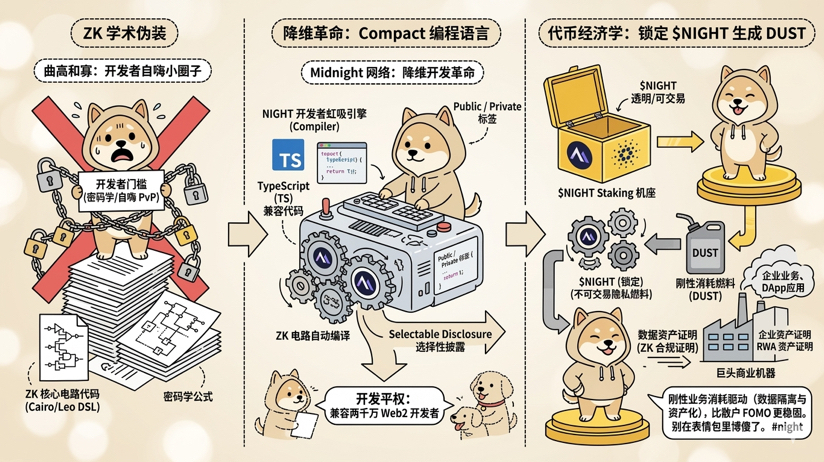
The cryptocurrency world has always had a very disgusting trend of 'academic PUA'. As soon as privacy public chains and ZK (zero-knowledge proofs) are mentioned, project parties like to fill their white papers with incomprehensible cryptographic formulas. It seems that the higher the entrance threshold, the more valuable the project becomes. However, peeling away these profound technical disguises, the current ZK track is actually facing a fatal underlying deadlock: very few people can write this kind of code.
Take a look at those mainstream ZK star projects on the market. An ordinary programmer who wants to write a smart contract that protects commercial privacy must first tackle Cairo, Leo, or extremely rigid domain-specific languages (DSL). Writing a ZK circuit, developers not only need to understand business logic but also must constantly guard against bugs in the underlying polynomial constraints being exploited by hackers.
This has led to the current privacy track becoming a “self-entertaining small circle” participated by only a few top cryptography geeks. Without a massive number of developers, there will be no massive number of real applications, and the ecosystem is naturally stagnant.
This is precisely the core reason why I am currently placing all observation weight on the Midnight ($NIGHT) project itself. The network incubated by the Cardano team (IOG) has a terrifying killer feature that is not some mysterious zero-knowledge proof algorithm, but it has completed an extremely shrewd **“dimensionality reduction development revolution.”**
The Midnight team has directly encapsulated the extremely complex underlying mathematical logic of ZK into a set of tools that are extremely friendly to Web2 developers—Compact programming language. The most amazing part is that this language is highly compatible with TypeScript (TS).
Those who have been in the tech circle know what this means. There are over twenty million traditional internet engineers proficient in TypeScript globally. Previously, they looked at ZK code as if it were written in a foreign language; now Midnight is like handing them a “point-and-shoot camera.”
Developers do not need to further their studies in cryptography, nor do they need to manually arrange complex ZK circuits. They only need to label data in their code as “Public” or “Private” just like writing regular Web front-end and back-end logic. All the dirty work—including how to compile these logics into impeccable zero-knowledge proofs—is automatically completed by Midnight’s underlying compiler.
This **“development equity”** is the true moat that can be established by public chains, deep and unfathomable. It directly steps on the development threshold of ZK applications, allowing large traditional tech companies and IT teams to seamlessly and frictionlessly migrate their business secrets into Web3.
When we shift our perspective back to the token economics of $NIGHT, the logic becomes exceptionally clear.
In this network, the massive influx of developers and enterprise-level DApps requires consuming the network's exclusive privacy fuel (DUST) for every contract deployment and every privacy data state change. This kind of fuel cannot be purchased on the secondary market; the only way for enterprises and developers to obtain it is to buy $NIGHT on the market and lock it tightly at the protocol level.
The cliff-like reduction of developer barriers will inevitably bring about an explosion of on-chain business activities; and the explosion of business activities will ruthlessly drain the circulation of $NIGHT.
While people in the market are still staring at a few K line charts guessing market sentiment, this set of “developer siphon engine” directly aimed at tens of millions of productivity has begun to operate silently. True infrastructure that can transcend cycles never relies on shout-outs; it only relies on monopolizing productivity tools.