
I often think about the strange paradox that has always lived inside blockchain technology. On one hand, blockchains promised transparency, trust, and decentralization. On the other hand, that same transparency sometimes forced users to reveal more than they were comfortable sharing. Every transaction, every wallet interaction, and sometimes entire financial histories could be traced on a public ledger. The system that was meant to empower individuals occasionally exposed them in ways traditional systems never did. This contradiction is exactly where zero-knowledge proof technology begins to change the story.
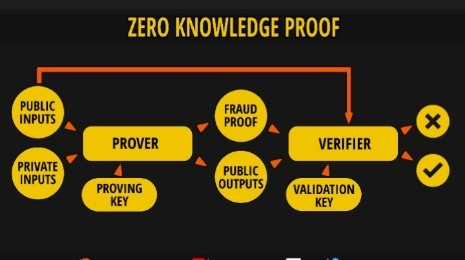
When I first encountered the concept of zero-knowledge proofs, the idea felt almost philosophical. The notion that someone could prove something is true without revealing the underlying information sounds like a riddle rather than a piece of mathematics. Yet this is precisely what cryptographers discovered decades ago. A zero-knowledge proof allows one party to demonstrate knowledge of a fact without exposing the fact itself. When I look at how this concept fits into blockchain infrastructure, I see something more than a technical upgrade. I see the beginning of a new model for digital trust.
Traditional blockchains operate like transparent accounting books. Anyone can verify transactions, which ensures integrity but sacrifices privacy. Zero-knowledge blockchains approach verification differently. Instead of revealing the entire transaction, the network only verifies a cryptographic proof confirming that the rules were followed. I find this approach fascinating because it allows the system to maintain trust without demanding full visibility.
In practice, this idea is already reshaping parts of the crypto ecosystem. Networks using zk-SNARKs and zk-STARKs can compress thousands of transactions into a single proof that the blockchain verifies quickly. From a scalability perspective, this is powerful. Rather than every node reprocessing the same data, the network simply checks a mathematical proof. I see this as one of the most promising solutions to blockchain scalability challenges.
But what excites me even more is how this technology could change the relationship between users and their data. Today, digital platforms collect enormous amounts of personal information because verification requires access to raw data. Zero-knowledge systems challenge that assumption. If I can prove something without exposing the underlying information, then control over data begins to shift back toward the individual.
I imagine a future where I can prove my identity online without revealing my full identity. I could confirm that I meet financial requirements without exposing my bank balance, or verify credentials without sharing private records. These possibilities might sound futuristic, but experiments in digital identity, privacy-preserving finance, and secure data sharing are already happening.
Of course, I also recognize the complexities that come with this technology. Generating cryptographic proofs still requires significant computational resources, and the infrastructure surrounding zero-knowledge systems is far from simple. Developers are still learning how to build efficient applications around these proofs. At the same time, regulators are trying to understand how privacy-preserving systems can coexist with financial oversight.
What I find particularly interesting is the deeper philosophical shift happening beneath the surface. Early blockchain narratives often celebrated radical transparency. But the real world does not operate entirely in the open. Businesses protect trade secrets, individuals guard their financial privacy, and institutions operate under confidentiality rules. Zero-knowledge blockchains acknowledge this reality while still maintaining verifiable trust.
When I step back and look at the broader picture, I see zero-knowledge technology as more than a feature. I see it as a new layer of digital infrastructure that could redefine how trust works online. Instead of relying solely on institutions or complete transparency, systems could rely on cryptographic certainty.
The most compelling question for me is not whether zero-knowledge blockchains will succeed technically, but how they will reshape power structures in the digital economy. If verification no longer requires exposure, the massive data monopolies that dominate the internet today may begin to lose their advantage. Control over information could gradually return to individuals rather than centralized platforms.
#night $NIGHT @MidnightNetwork
