
Introduction: The Silent Revolution
Cryptocurrencies have traveled an extraordinary path in just over a decade. What began as an experimental idea with Bitcoin is now evolving into something much broader: a new global financial infrastructure based on blockchain technology.
If in 2017 initial speculation prevailed and in 2021 the cultural phenomenon of NFTs, recent years have marked a deeper transformation: the integration between blockchain, artificial intelligence, and real-world assets.
Today the crypto ecosystem no longer revolves solely around trading. A digital architecture is being developed that connects investments, technological infrastructure, and new forms of economic coordination.
Tokenization of Assets: When the Real Economy Enters Blockchain
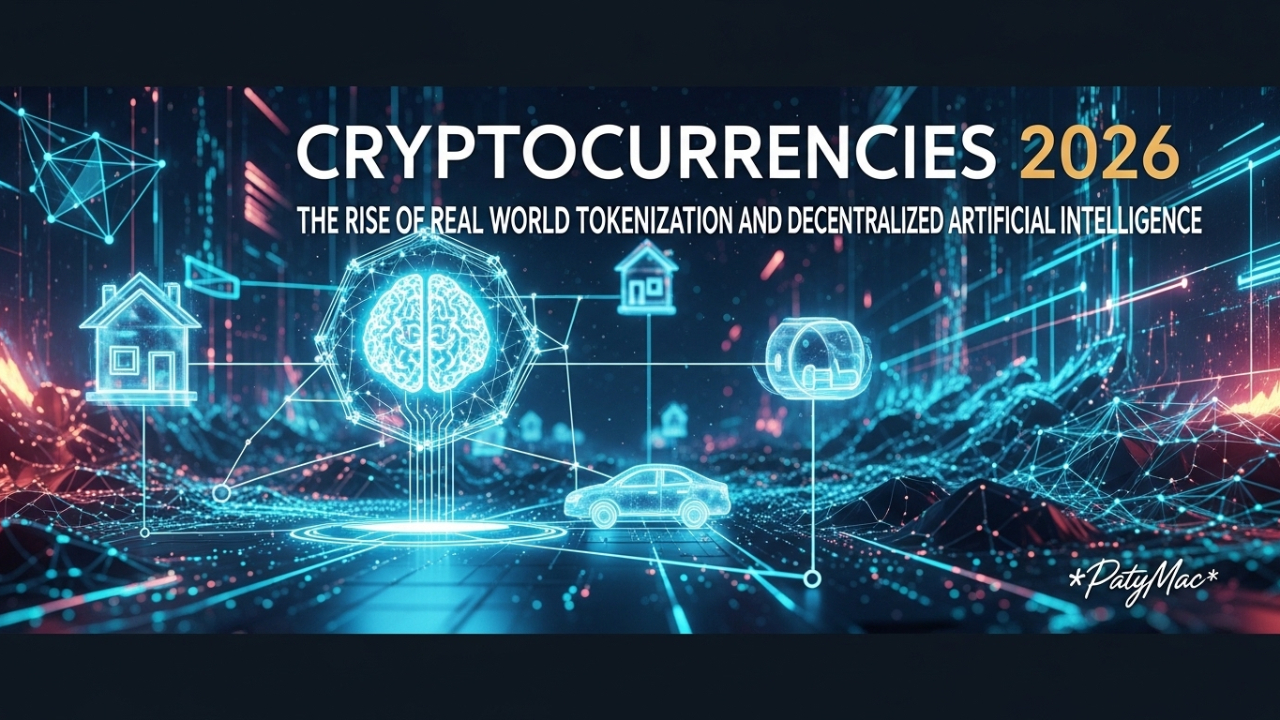
One of the most important trends in the current ecosystem is the tokenization of real-world assets (RWA).
The concept consists of representing physical assets —such as properties, bonds, or commodities— through digital tokens recorded on the blockchain.
This has several important implications:
Global access to investments
A high-value asset can be divided into thousands of tokens, allowing investors with limited capital to participate in markets that were previously reserved for large institutions.
Greater liquidity
Traditional assets often require lengthy processes for their purchase or sale. In contrast, tokens can be exchanged in digital markets practically in real time.
Transparency
Blockchains record each operation publicly and immutably, reducing intermediaries and increasing trust in processes.
For this reason, many analysts believe that tokenization could become one of the most important changes in financial markets over the next decade.
DePIN: Infrastructure Built by Communities
Another concept that is gaining relevance is DePIN (Decentralized Physical Infrastructure Networks).
This model proposes building physical infrastructure —such as telecommunications networks, data storage, or mapping systems— using economic incentives based on cryptocurrencies.
Instead of relying solely on large tech corporations, thousands of users can contribute resources and receive tokens in return.
Some decentralized networks are already exploring this model in areas such as:
wireless connectivity.
distributed storage.
geospatial data capture.
If this trend consolidates, it could change the way digital services are built on a global scale.
Artificial Intelligence and Blockchain
Artificial intelligence has become one of the most influential technologies of our era. However, much of its development is concentrated in a few tech companies.
In the face of this scenario, some blockchain projects are exploring decentralized artificial intelligence models.
These networks seek to allow developers from around the world to contribute to the training of models and share computing resources in a distributed manner.
Although it is still an early stage, this convergence between AI and blockchain raises important questions about the future of data control and technological innovation.
Layer 2: The Path to Scalability
One of the historical challenges of blockchain has been scalability.
Layer 2s emerged as solutions that allow transactions to be processed more quickly and economically without compromising the security of the main networks.
Thanks to these technologies, it is now possible to conduct operations with very low costs and much shorter confirmation times.
This brings the user experience of blockchain applications closer to that of traditional digital services.
Meme Coins: The Cultural Factor of the Ecosystem
Although they are often considered simple internet jokes, meme coins reflect an important aspect of the crypto ecosystem: the ability of digital communities to coordinate and create value.
These coins often function as social and cultural phenomena, where the identity of the community plays as important a role as the technology.
Although they are highly volatile assets, they have also served as a gateway for millions of new users into the crypto world.
The Challenges of the Ecosystem
Despite the advances, the sector faces several significant challenges:
Regulation
Governments are continuing to develop regulatory frameworks for digital assets, seeking to balance innovation and investor protection.
Security
Vulnerabilities in smart contracts and attacks on bridges between blockchains remain relevant risks.
Centralization
Some projects still depend on relatively concentrated structures, raising debates about the true degree of decentralization.
Conclusion: A New Chapter for the Digital Economy
The development of cryptocurrencies is no longer limited to price movements in the markets.
Today we are observing the construction of a new technological layer for the global economy.
Tokenization of assets, decentralized infrastructure, open artificial intelligence, and new forms of digital organization are part of this transformation.
The ecosystem continues to evolve, and its real impact will likely become clearer in the coming years.
But one thing seems clear: cryptocurrencies have ceased to be an experiment.
They are gradually becoming a structural piece of the digital economy of the future.


