
Most people think Midnight is about privacy.
It is.
But that’s not the most interesting part.
The real shift is how it handles cost.
One Token, Too Many Jobs
On most blockchains, one token does everything.
It’s governance.
It’s speculation.
It’s fees.
It’s execution cost.
Sounds efficient.
But it creates a hidden problem.
When that token’s price moves, everything moves with it — including the cost of actually using the network.
So execution becomes unpredictable.
Not because the system failed…
But because the pricing layer was unstable from the start.
Midnight Breaks That Link
Midnight takes a different route.
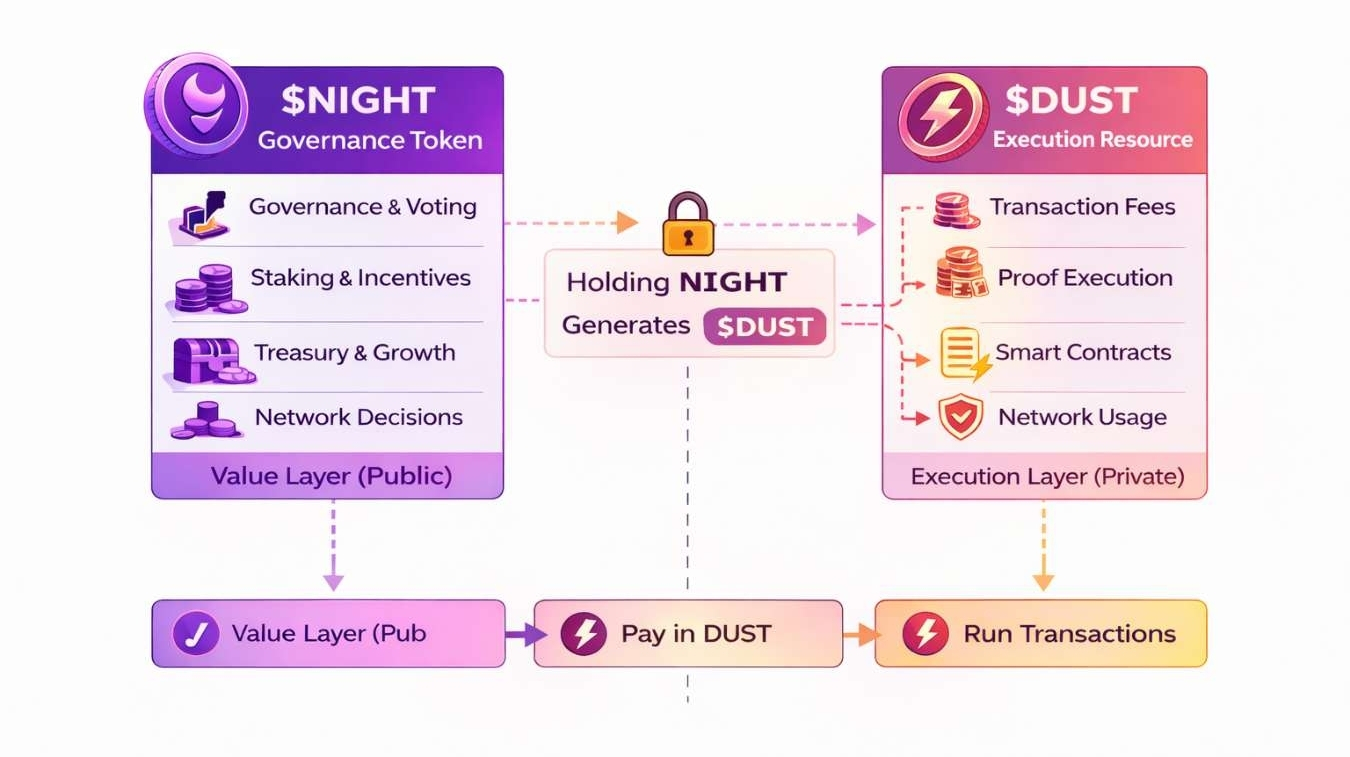
It separates the system into two layers:
NIGHT → governance, incentives, visible value
DUST → execution, fees, private computation
You don’t directly “pay” for each action like on traditional chains.
Instead, holding NIGHT generates DUST — a resource used to run transactions.
And here’s the twist:
DUST is not transferable.
It decays over time.
It behaves more like energy, not money.
Why This Actually Matters
Privacy isn’t free.
Every private computation requires proofs.
And proofs require computation.
And computation has a cost.
If that cost is tied to a volatile token…
Then privacy itself becomes unstable.
Apps start adjusting:
Fewer checks
Delayed execution
Reduced precision
Not because they want to…
But because the cost layer becomes noisy.
Making Cost Boring Again
Midnight’s goal is simple:
Make execution cost predictable.
Not exciting.
Not speculative.
Just stable.
By separating DUST from NIGHT, the network ensures that:
Governance volatility doesn’t affect execution
Developers can plan long-term usage
Private apps don’t break under market pressure
It’s not flashy.
But it’s necessary.
The Trade-Off No One Talks About
There’s a catch.
When users stop paying directly per transaction…
The cost doesn’t disappear.
It just becomes less visible.
For users, everything feels smooth.
For builders, things get more complex:
How much DUST will we need?
What happens when usage spikes?
How do we manage decay and replenishment?
The system becomes easier to use…
But harder to reason about.
The Real Question
Midnight didn’t just redesign privacy.
It redesigned how cost is experienced.
And that leads to a bigger question:
When users stop “feeling” the cost of execution…
Does the system become better?
Or do we just hide the complexity somewhere deeper?
Because in Midnight, cost didn’t disappear.
It just moved.