You might not believe this when I say it.
Last month, I went out for drinks with a friend who works as a doctor in Ankara. He complained about the Turkish healthcare system, which was quite lively — 30 million medical records are scattered across various hospitals; if a patient transfers to another hospital, they have to run all over town with their CT scans, not to mention getting prescriptions across hospitals. They initiated a blockchain pilot to connect the data, but the legal department slammed the table: Who takes responsibility for patient privacy? Putting medical records on the chain is equivalent to publicly displaying them; who would dare?
I was still stubbornly saying that there are plenty of privacy chains now, and Zcash and Monero are doing just fine. My friend sneered: Those things? When regulation comes to check, what do you use to prove compliance? Either hide it tightly like an underground party or stand naked on the street; is this really a choice?
That's heartbreaking.
When I got back, I was flipping through Midnight's white paper, and suddenly I realized something — our group of old-timers in the crypto world has been arguing for ten years about 'privacy vs compliance', but for them, it's not even a choice.
You see, why is Western Union willing to play with Midnight? They are the second largest remittance giant in the world, with over 400,000 outlets in more than 200 countries. Their CTO, Luke Tuttle, said, 'Ensuring privacy, compliance, and reliability has been built in from day one.' What does that mean? Big institutions don't want to eliminate privacy; they want the kind of 'privacy that can be shown to others' — just like when you stay in a hotel, the staff knows you're in that room but doesn't know what you're doing inside.
This is the @MidnightNetwork outrageous operation of that dual public-private ledger.
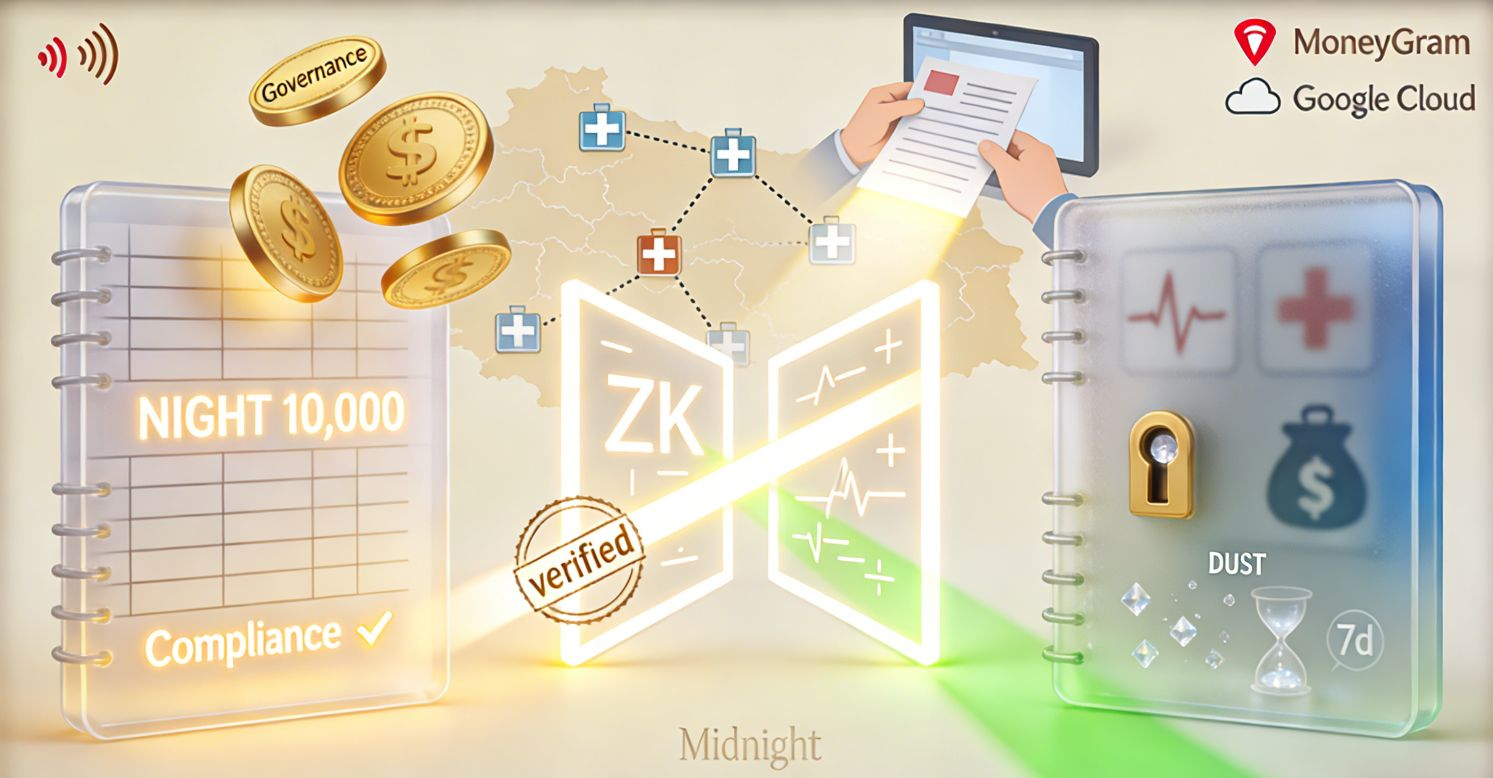
What is recorded in a public ledger? Records of NIGHT transfers, governance votes, and compliance proofs. Everyone can see it, and no one can play tricks. What is stored in a private state? Transaction amounts, identity information, medical data. Only those you authorize can take a peek. Two tracks run on the same chain, using ZK as the gatekeeper — the validator just needs to say 'this person is qualified'; they don’t need to know how many zeros are in this person's bank account.
What's even more extreme is that dual token model.
I used to wonder why ETH turned itself into gas — when the price goes up, gas prices skyrocket; when the price goes down, no one cares about network security. Isn't that contradictory? Midnight directly dismantled this issue: $NIGHT is the land you hold, used for governance and generating income; DUST is the grain that grows in the field, specifically for paying fuel costs, and if not consumed within seven days, it rots in the ground, cannot be transferred, and cannot be hoarded.
Separating speculative assets from consumables; that's what proper economics is all about. Have you ever seen anyone use their company's stock to buy cigarettes downstairs?
A couple of days ago, I saw the news that Vodafone has also entered the scene, bringing their IoT to create a 'ubiquitous economy'. Then there's AlphaTON, which aims to provide privacy AI agents for a billion users on Telegram. The logic behind these big companies rushing in is actually very simple: Midnight gave them a step — they can leverage the credibility of blockchain without having to reveal their entire assets.
The Turkish healthcare project my friend mentioned is now also discussing proof of concept with Midnight. The 30 million medical records are still not on the chain, but in the future, when getting prescriptions across hospitals, a local ZK proof will be generated on the patient's phone, and the doctor will verify, 'This person indeed has this condition and should take this medication.' That's it. The medical records remain in the patient's hands, and even when regulators come, they can present compliance proofs.
Do you call this privacy?
I call this basic decency in the digital age.
We've been educated by public chains for the past ten years, always thinking that transparency equals justice, and code is law. But the real world isn't a geek paradise; businesses need to make a living, regulators need to meet obligations, and users want convenience without being stripped bare. Midnight's slogan of 'rational privacy' sounds vague, but when you look at it in practice — let those who should see it see it, let those who shouldn't keep quiet, and the rest is up to you to decide.
This isn't technology; it's political wisdom.
In our conversation, I need to send my friend a WeChat message: The Turkish project can proceed now. #night