I remember the first time I really thought about what ownership means in the digital world. Not the kind of ownership like having a wallet or money in it. The kind where you have something that means something to you and it exists in a space that you can't see or touch but you know its yours. That's what Sign.net seems to be asking.
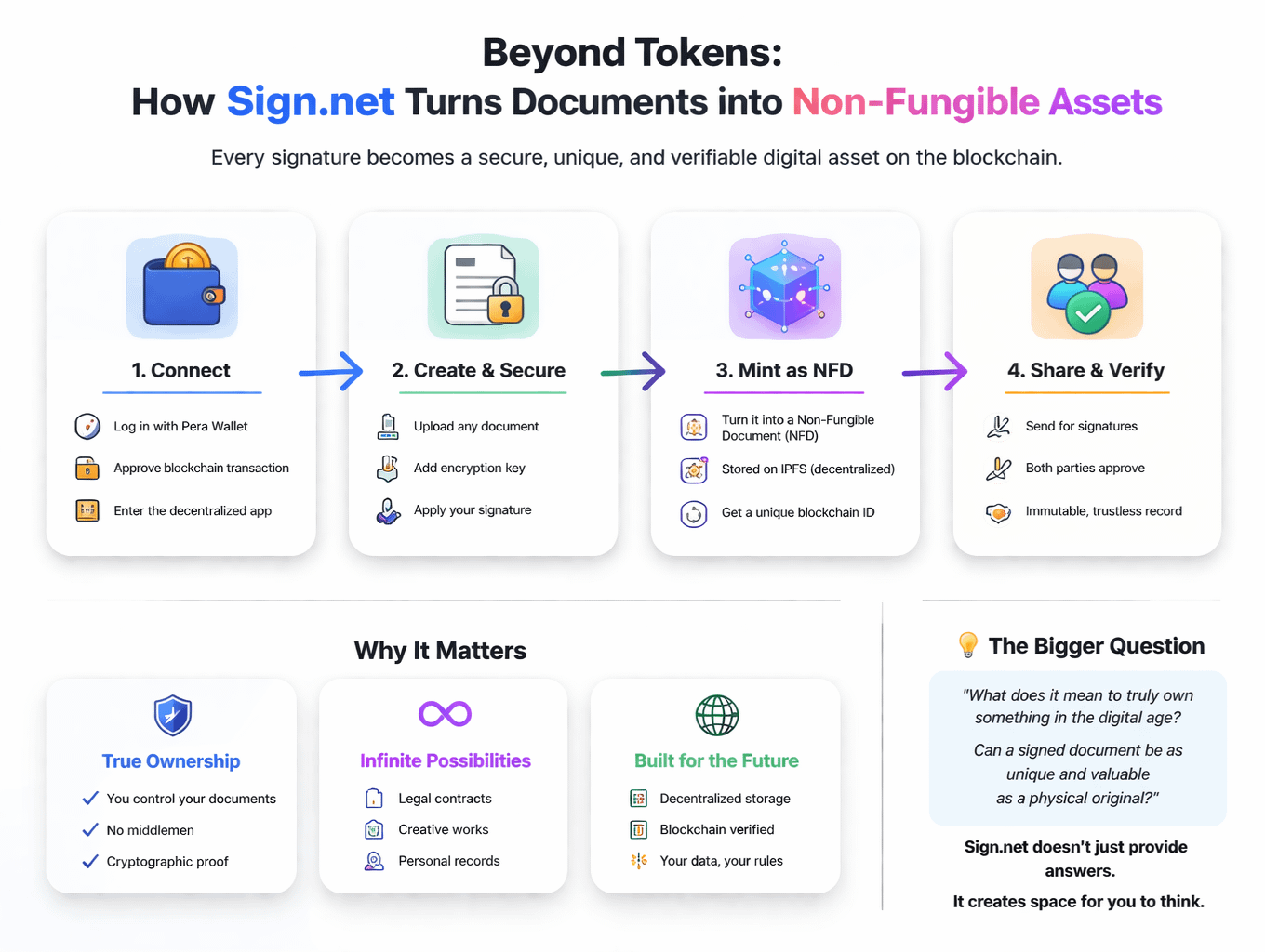
On a surface level Sign.net is a decentralized app for signing documents. You log in with your Pera Wallet approve a transaction and you're in. What happens next is more interesting than a signature. Every document you interact with can be turned into a -Fungible Document or NFD. A unique record that exists on the blockchain. If you want these documents can be. Stored on IPFS, a decentralized storage system. Suddenly signing a contract or agreeing to terms isn't a normal thing. Its creating a digital thing that you control.
I had to ask myself: is this really useful or is it just another way to make normal things sound cool with crypto words? To answer that I started testing it. I started with something a personal rental agreement I made for a friend. I uploaded the document generated a key for encryption added my signature and sent it over. Watching my friend approve the transaction and see the document turned into an NFD felt real. This wasn't a PDF floating in Google Drive; it was a secure object that we both could trust without needing someone in the middle. The process made me think: why haven't we been doing this for years? Why do we still trust entities for something as simple as a signed document?
Then I tried something fun: I wrote a short poem and turned it into an NFD. There was no consequence, no money involved just a small piece of personal expression. Making it have a unique digital identity. Like an NFT artwork. Made it feel important. It raised questions for me: what does it mean to own something digital? Can digital ownership, enforced by cryptography carry the weight as physical ownership?
Sign.net doesn't give easy answers. It doesn't need to. The app makes you think about ownership, privacy and permanence. It leaves the judgment to you. You need to hold a minimum of SIGN tokens to turn documents into NFDs or have ALGOs for gas fees. That reminds you that this is still an ecosystem with rules and limitations. That friction is also a form of discipline; it makes you think. Every document you encrypt every NFD you make asks for a decision.
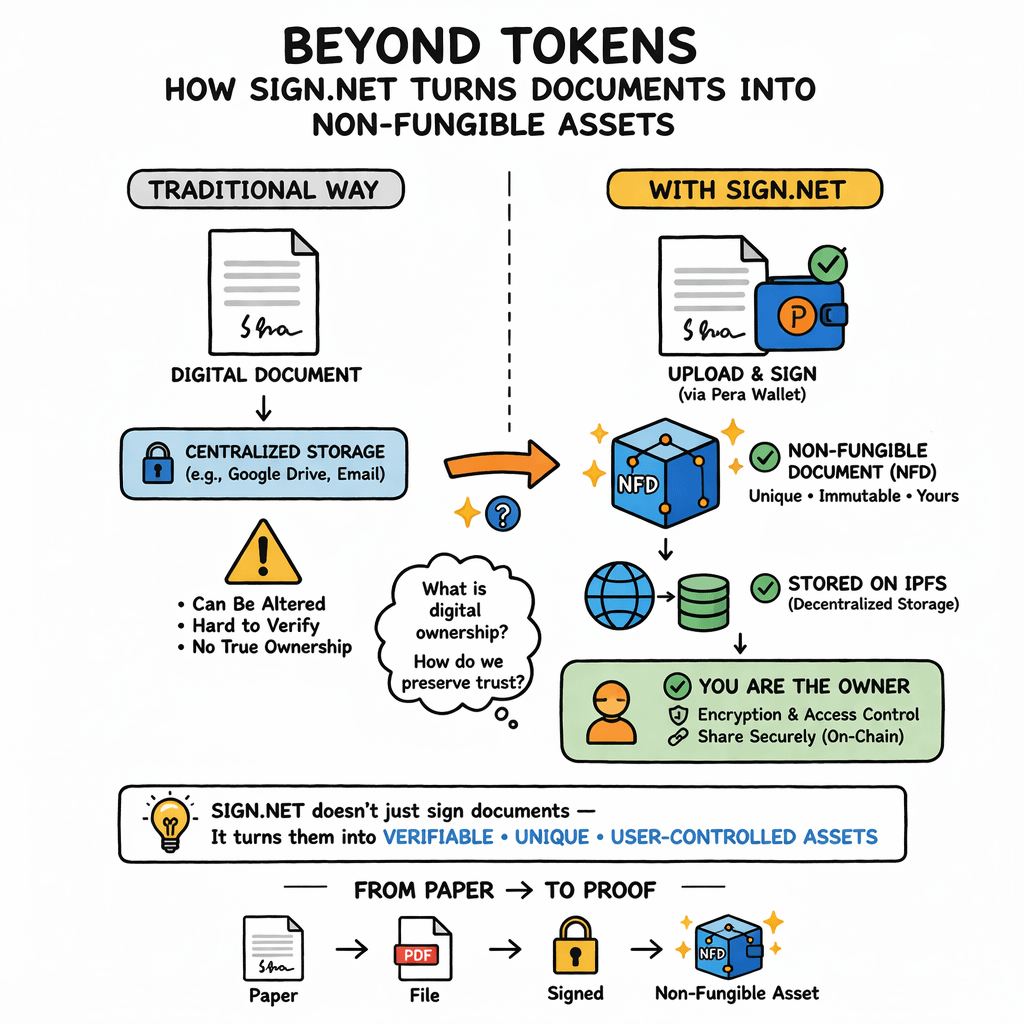
Watching Sign.net work I feel a little optimistic. I've seen blockchain projects promise things and deliver nothing; I've also seen real utility hidden beneath hype. Sign.net doesn't fit either category. Its asking a question than shouting a solution. How do we keep trust digitally? How do we keep control in an era where most data lives elsewhere?. Can something as ordinary as a signed document become special just by being non-fungible?
By the end of my exploration I realized that the value of Sign.net isn't just in the technology. It's in the space it creates. It asks us to think, to question and maybe even to feel a little more careful, about what ownership and authenticity mean in our lives. It doesn't demand belief. It does encourage thought.