

I don’t buy it.
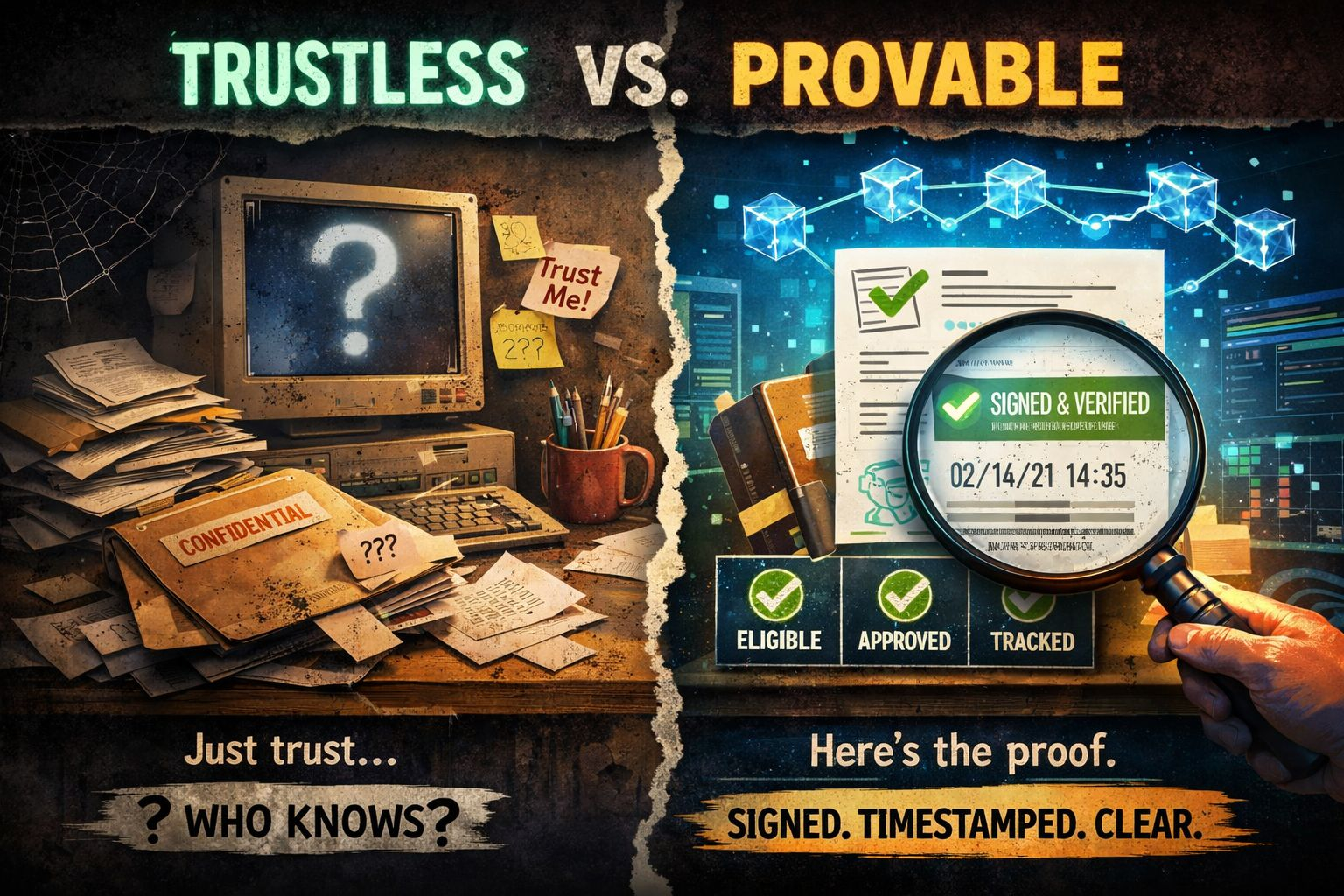
Look at how the real world actually runs—governments, banks, public programs. None of that works without trust. Zero chance. The problem isn’t trust… it’s that trust is usually a black box. You’re just told things are legit.
And that’s where things start to fall apart.
Because when something breaks—and it always does—you’re suddenly digging through systems that feel like the digital version of DMV paperwork mixed with “find that one email from 3 years ago.” Good luck.
Here’s the thing most crypto infra still gets wrong.
It’s obsessed with transactions.
Who sent what.
Where it went.
When it landed.
Nice. Clean. Almost too clean.
But real systems? They don’t run on transactions.
They run on claims.
“This person qualifies.”
“This payment followed policy.”
“This was approved.”
And right now those claims are held together with…
internal dashboards
random approval chains
and a whole lot of “trust the process”
Which is basically code for: we hope this holds up later.
Spoiler: it usually doesn’t.
This is where I had a bit of a lightbulb moment looking at S.I.G.N.
Not because of some flashy feature. No insane TPS flex. No shiny UX demo.
It was the boring part.
Their attestation layer.
Yeah… sounds dry. It’s not.
Think about it like this—an attestation is basically a signed receipt for reality.
Not just “something happened”… but:
who said it happened
under what rules
at what time
and can you prove it later
That “later” part is everything.
Quick scenario.
Government launches a financial aid program.
Today’s flow?
Applications go in → systems check stuff → money goes out.
Months later… audit hits.
Now everyone’s scrambling:
Who approved this?
Was this person actually eligible?
What rules were active back then?
And now you’ve got five systems, three departments, zero shared context. A complete mess.
Now imagine the same flow, but every step leaves an on-chain paper trail.
Eligibility check → recorded as an attestation
Approval → signed by an authority
Funds → linked to the exact rule set used
Identity → verifiable, not just stored somewhere
So instead of chaos, you get a clean chain of evidence.
No guesswork. No missing pieces. No “trust me bro.”
Just proof.
Here’s the kicker.
Nobody’s hyping this.
Because it’s not sexy.
It doesn’t pump your token. It doesn’t make for viral screenshots.
But this is the kind of infra that decides whether crypto ever leaves its sandbox phase.
Because once you step into real systems—public money, regulation, compliance—the question changes fast.
It’s not “does it work?”
It’s “can you prove what happened… under scrutiny?”
Big difference.
And honestly, this is where most projects quietly fail.
They build systems that execute.
Very few build systems that can explain themselves.
That’s what S.I.G.N. is leaning into.
And yeah, it took me a second to see it—but once it clicks, it’s hard to unsee.
Big picture?
If crypto actually plugs into things like CBDCs, national ID systems, public funding rails…
this “evidence layer” stuff isn’t optional infra.
It becomes the backbone.
Because at scale, nobody cares about your TPS.
They care about the paper trail.
And the projects that figure that out early?
They’re not just building apps.
They’re quietly writing the rulebook.