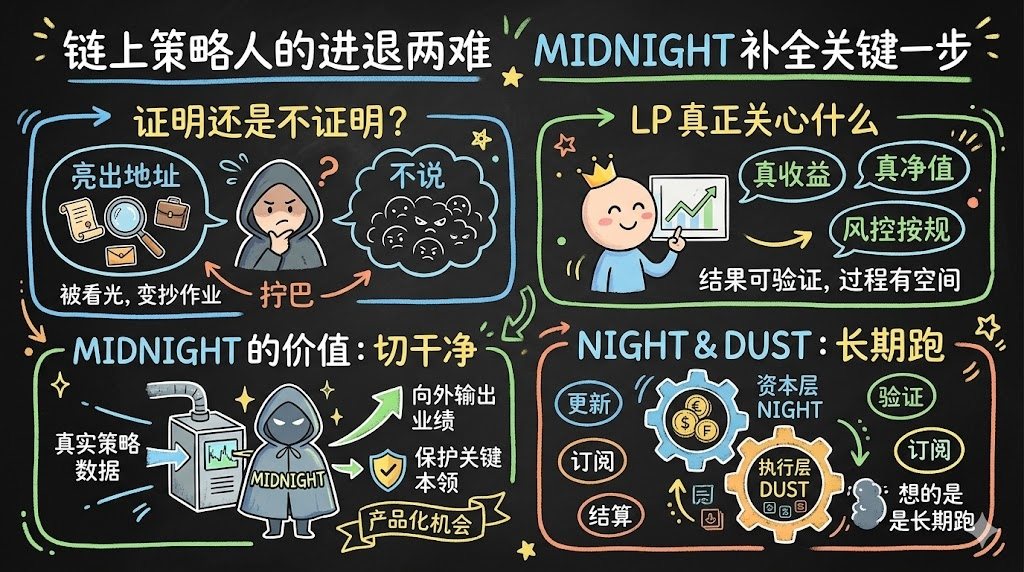
What those who make strategies on-chain fear most is actually not losing money, but being unable to explain after making money.
When you say you do well, the first reaction of others is, where's the address? Show it to me.
But once the address lights up, many things will follow suit. The positions can be seen, the adjustment rhythm can be seen, the style can be seen, even how you do research and find opportunities can be figured out over time.
This matter is very twisted.
Without proof, no one believes you.
It's a real proof, and it's easy to hand over your most valuable things.
So there has always been a strange phenomenon on-chain.
Many people would rather post profit screenshots in groups than turn their strategies into public products. It's not that they don't want to grow; it's just that once it's laid bare, it easily turns into others copying your address to do homework, making it increasingly difficult for you to operate.
@MidnightNetwork This kind of thing is very smooth when placed here.
Its most valuable aspect is not burying the data all at once but rather cutting out the things that need to be handed over.
For example, you can prove that the net value is real, that the earnings are real, that the drawdowns are not falsely recorded, and that risk control indeed follows the rules. But you don't have to show when you bought, when you sold, how you allocated your positions, or the paths you took.
This difference is actually quite significant.
Because what LP really cares about is often not which coins you bought yesterday.
What he cares about is whether your system can actually run, whether the performance you present can stand up, and whether you are speaking with results.
If the results can be verified and the process can leave some room, then many on-chain strategies that were originally afraid to come out have a chance to slowly become products.
I think this is where projects like Midnight truly excel.
It's not just about saying privacy is important; it's that it has begun to encounter the most realistic layer on-chain.
Many people are not unwilling to disclose; they are unwilling to hand over their skills for the sake of disclosure.
Going further, $NIGHT and the DUST set have significance here.
Making a strategy is not just about posting a net value screenshot once; there are updates, verifications, settlements, and subscriptions that follow. If the system is to run long-term, the underlying resources must be stable. NIGHT is placed at the capital layer, and DUST is responsible for trading and contract execution. This kind of separation at least shows one thing: it's not just about a brief excitement, but how these things can run long-term.
Ultimately, what is most lacking on-chain is never the people who can make strategies.
What’s lacking is whether these people are willing to put themselves on the table.
Either don't speak, or if you do, you get exposed; this kind of environment cannot retain people.
If one day, on-chain asset management, strategy subscriptions, and copy trading really start to look like an industry, rather than just everyone copying a few addresses back and forth, then a crucial step in between is that someone has to fill this gap first.
What Midnight is facing now is this step.
@MidnightNetwork $NIGHT #night