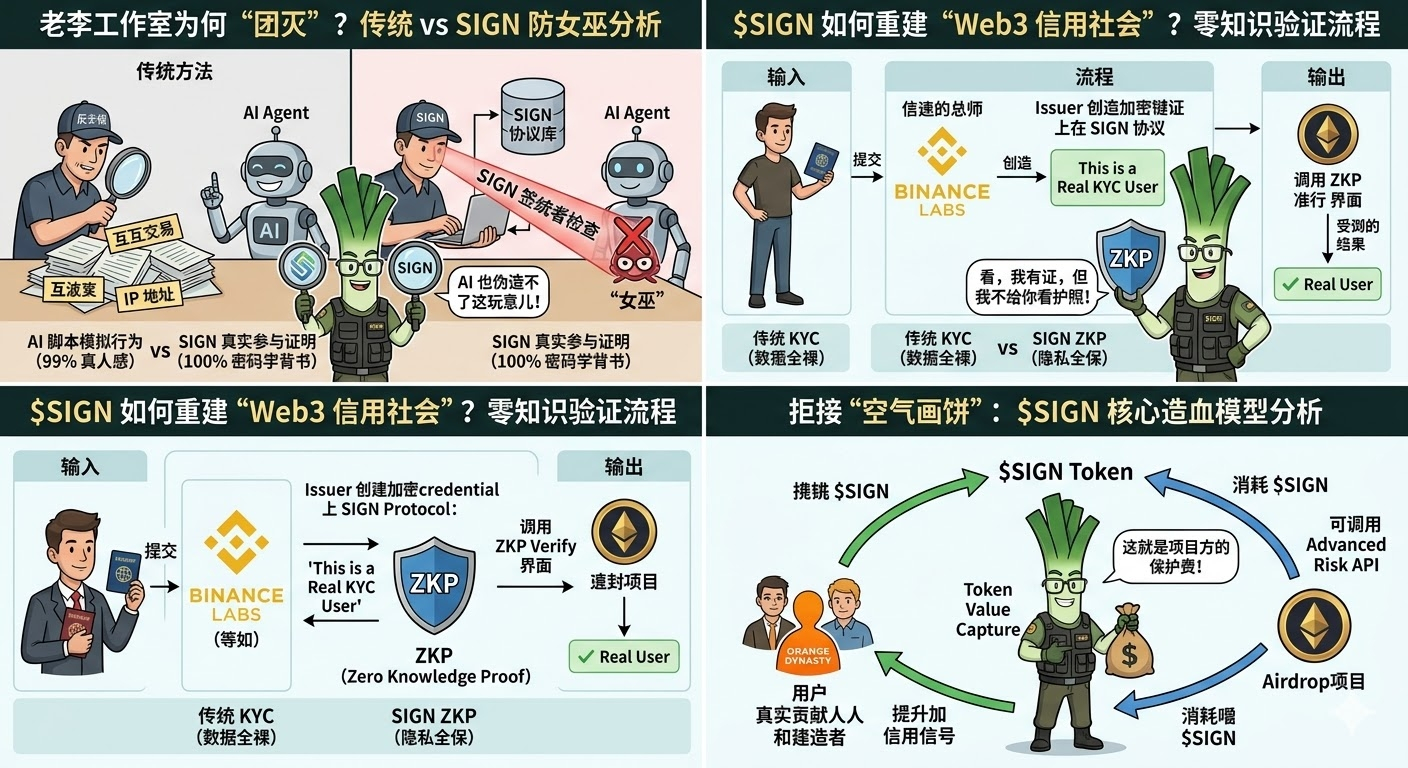
I. The Cyber Tragedy of Old Li Next Door: When AI Scripts Meet "Dimensional Reduction Attack"
The night before last, my good buddy Lao Li, who runs a "fur-grooming studio" in Huizhou, dragged me out for a night of drinking alone.
Old Li has upgraded his equipment significantly in the past two years. He used to hire a few college students to manually click the mouse, but now he's completely replaced by AI agents for automated interaction. He has 1000 accounts, tweets with emotional content, random on-chain interaction times, and even the slippage of the cross-chain bridge is set to resemble a real person's slip-up. He thought he could easily get $500,000 in this top-tier Layer 2 airdrop.
When I checked my share the day before yesterday, all 1,000 accounts had been wiped out, leaving me with 0 tokens.
After investigating for a long time, Lao Li discovered that the project team did not use "number of interactions" and "IP address" to investigate the witch (the fake accounts), but instead directly connected to the "on-chain reputation proof" system based on Sign Protocol ($SIGN).
System requirements: As long as you can provide a “proof of real participation” issued by a designated organization (such as an offline hackathon or a well-known DAO organization) on Sign Protocol, you can directly receive the basic living allowance; without this proof, even 100 interactions will be treated as bots.
Old Li's loss was not unjustified. He used AI to simulate all human behaviors, but he could not use AI to forge a "proof of social relationship" endorsed by a cryptographic signature.
This incident sent chills down my spine: the era of savage exploitation by scripts and bots is over, and the "credit society" of Web3 is being forcibly established by protocols like Sign.
II. Why is KYC only a temporary solution, while Sign is the killer app?
Many people might argue: "Isn't it simple to check real users? The project team can just implement KYC (Know Your Customer) verification and upload their ID card, right?"
Dude, we're here in the crypto world to surf the waves, not to run around naked. If you send your passport to some unknown, unknown project team today, your information can be sold for 50 cents on the dark web tomorrow.
At this point, the "full-chain proof protocol" of Sign Protocol ($SIGN ) demonstrates its irresistible charm.
Its logic is not to expose your privacy, but to "decouple".
Issuing proof: For example, Binance (as a trusted proof person) issues you a proof on Sign: "This person is a real Binance KYC user and has been registered for more than 2 years."
Generate credentials: This credential is packaged into a piece of immutable data and stored in a decentralized network.
Zero-Knowledge Verification (ZKP): When you go to claim the airdrop that Lao Li has been dreaming of, you only need to show this Sign certificate. The project team sees it, oh, a real person stamped by Binance, let's send the money! But the project team never knows your real name, nationality, or ID number.
What do you call this? You call earning money while maintaining your privacy. In 2026, with increasingly stringent data privacy regulations, Sign's approach has become an essential infrastructure for major public blockchains and projects to perform "user filtering."
III. Orange Dynasty: A "protective shield" for retail investors, and a "truth serum" for institutional investors.
Since we're going to talk about something in depth, we have to mention the killer app that the Sign team is pushing for in 2026: Orange Dynasty.
When Lao Li was drinking, he cursed this app as the culprit that cut off his source of income, but I think it's a powerful weapon for the "leek monster" to protect himself in the future.
In Orange Dynasty, you no longer possess a cold, impersonal 0x address, but a three-dimensional identity filled with "attestations".
Have you participated in any on-chain voting? Please provide proof.
Have you ever submitted code to open-source projects on GitHub? Please provide proof.
You even attended a Web3 summit offline? Scan the QR code to send proof.
When enough of these proofs are accumulated, they constitute your "on-chain Sesame Credit".
In the future, truly good projects that issue airdrops and create whitelists won't need to look at how many meaningless transactions you've made (that kind of gas-wasting behavior is simply inhumane). They will only need to call Sign's SDK to filter out real users whose "reputation score" is greater than a certain value.
Those zombie accounts generated in batches using AI cannot even be detected by SIGN.
IV. The Leek Monster's Calculation: Does Sign Capture Value?
Now that we've had our fill of the story, let's get back to the trading and token aspects. After all, no matter how amazing the protocol is, if the tokens don't empower it, it's just "air charity."
I carefully reviewed the white paper, and currently Sign has two very direct value capture logics:
ToB Protection Fees: Like the large project team Lao Li encountered, if they wanted to use Sign's protocol to filter millions of addresses and block airdrop hunters, it would consume resources and API calls. Many advanced functions require consuming or staking Sign's services. To save millions of dollars in airdrops from being drained by bots, the Sign team is definitely willing to spend a small amount of money to buy Sign's services.
ToC Reputation Staking: To gain higher weight and unlock higher-level identity templates in Orange Dynasty, users also need to stake $SIGN . The more you stake and the longer you stake, the stronger your "signal" becomes.
However! As usual, I, the leek monster, must pour some cold water on this. Never forget the regular unlock at the end of each month (around the 28th).
If you are optimistic about this "on-chain identity infrastructure," don't try to catch a falling knife before it unlocks at the end of the month.
🔪 Conclusion: Don't treat weapons like toys.
From EthSign's electronic signatures to TokenTable's token management, and now to on-chain identity verification, the underlying principle is the same: to establish a cryptographic-based spirit of contract in a dark forest of mutual distrust.
Old Li's 1,000 accounts died miserably, but this also marks Web3's final step towards an era of "real user-driven" computing. In the future, your "attempt" might be more valuable than the balance in your wallet.
Guys, have you ever been subjected to mindless, repetitive interaction-based PUA tactics? Do you think Sign's anti-cyberbullying mechanism, which uses "reputation verification" instead of "mindless interaction-brushing," can completely eliminate these bot farms? Share your painful experiences in the comments! 👇