

Look. Big name. Sounds like something a government committee argued about for six months and then slapped onto a slide deck.
Here’s the thing. It’s not that deep.We’re basically talking about a system that says, “yeah, this person checks out,” without forcing you to upload your passport, your degree, your entire life story, and your childhood report card to some server that probably hasn’t been updated since 2016.
And honestly? That alone would be an upgrade.Right now, proving anything is a mess. You send documents. PDFs. Screenshots. Half the time it’s just vibes and hope. Some underpaid guy or worse, an automated script that breaks if your name has an extra space is sitting there deciding if you’re real.
I know what you’re thinking. “So… blockchain fixes this?” Yeah. That’s the pitch. Of course it is.
But ignore the buzzwords for a second.
What they’re trying to do is give you a way to carry proof. Not the raw data. Just the proof. Like walking into a place and instead of handing over your entire wallet, you just flash something that says, “I’m allowed in,” and nobody asks for your blood type, your address, and your last three transactions.
Simple idea. Weirdly hard to dNow add tokens into the mix. Because of course there are tokens.These aren’t just coins you trade and forget about. Think of them more like little access passes. Or those cheap plastic wristbands at events the ones that say you’re allowed backstage, except here it’s digital, reusable, and way easier to fake if the system is garbage… which, let’s be honest, half of them are.
So the goal—on paper—is clean: verify once, reuse everywhere, stop repeating yourself like an idiot filling out the same form 12 times.But then reality walks in.
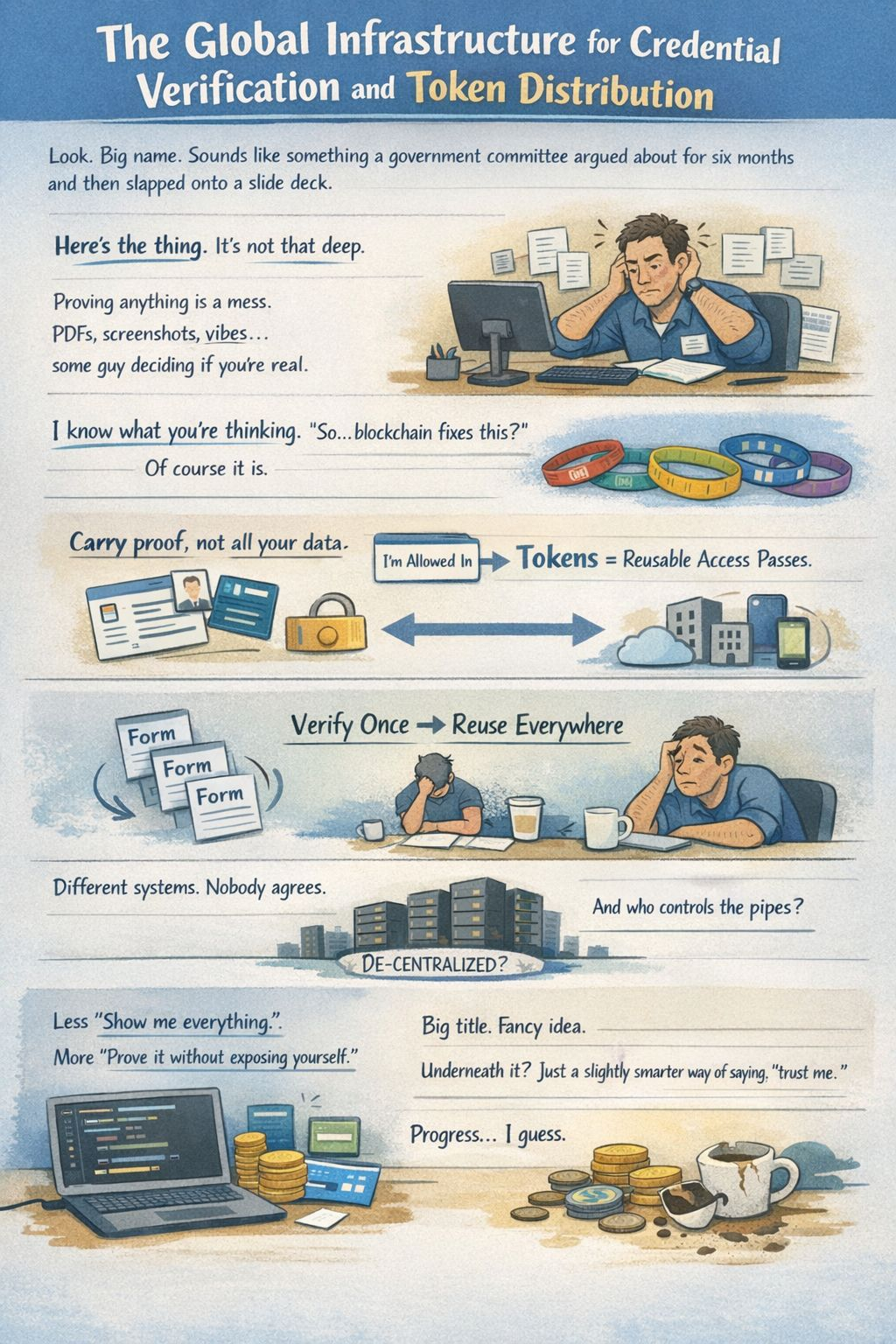 Different systems. Different standards. Nobody agrees on anything. One platform says you’re verified, another one goes, “nah, do it again.” And now you’re back to uploading documents at 2 AM, wondering why this still sucks in 2026.
And don’t even get me started on who controls the pipes.
Because yeah, “decentralized” sounds nice, until you realize there’s always someone running the servers, someone setting the rules, someone quietly deciding what counts as “valid.” It’s never as neutral as the whitepaper says, and if you’ve been around long enough, you already know that.
Honestly, the interesting part isn’t the tech. It’s the shift.
Less “show me everything.” More “prove it without exposing yourself.” Which sounds great, right up until someone figures out how to turn that into another gatekeeping system with better branding and nicer dashboards.
So yeah. Big title. Fancy idea.Underneath it? Just a slightly smarter way of saying, “trust me”except now there’s math involved, a few tokens floating around, and a bunch of engineers arguing in Slack about edge cases nobody thought about until production broke at 3 AM@SignOfficial #SignDigitalSovereignInfra $SIGN
