
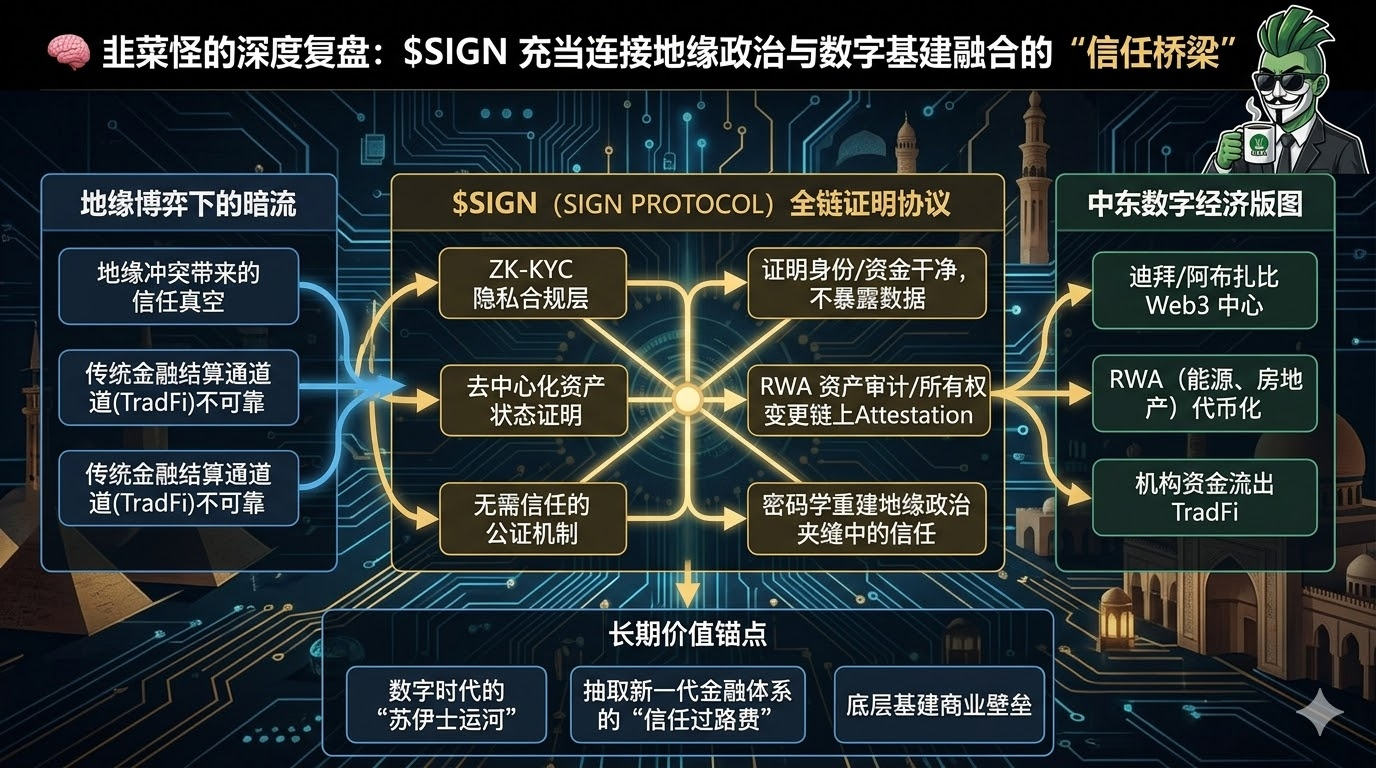
Brothers, the leek monster blames me for not watching the market last night, but instead spent the whole night reviewing the recent regulatory dynamics of VARA and ADGM in the UAE and the flow of sovereign funds. Today, let's completely open up the pattern, jump out of the short-term ups and downs of K-line, and directly put $SIGN (Sign Protocol) into the grand perspective of 'geopolitical and digital infrastructure integration' to discuss how much future growth space it really has in the Middle East.
The current Middle East can be said to be the 'eye of the storm' in global geopolitics. The old money holds a vast amount of funds, but they actually have profound anxiety. Why? Because traditional global financial settlement channels (like SWIFT) are essentially controlled by others. A disagreement can lead to restrictions; this feeling of handing over the core lifeline is unacceptable for top capital.
Therefore, the Middle East is crazily embracing Web3, investing heavily in building compliance centers in Dubai and Abu Dhabi. This is not to cater to speculation, but to play a bigger game: to create a decentralized financial alternative channel that is not subject to the coercion of a single strong power.
But for this digital channel to really operate, it faces an extremely tricky 'deadlock.'
Sovereign fund money needs to go on-chain, to facilitate large cross-border transfers, or to tokenize national-level quality assets (like energy, real estate) into RWA, facing extremely stringent compliance reviews from local regulators. At the same time, these national-level capitals absolutely do not want to hand over their core privacy data and business cards to any centralized third-party institution for certification.
Regulation needs to be transparent and compliant, while capital requires absolute privacy and data sovereignty. How to resolve this contradiction?
This is the time for Sign's fundamental 'full-chain proof protocol' to demonstrate its technical dominance. In the future digital economic landscape of the Middle East, it plays the role of a 'geopolitical level decentralized notary office.'
Imagine a real business scenario: a large energy tokenization project in the Middle East wants to issue globally. How can we ensure that funds from different countries, which do not trust each other, believe that this asset truly exists? How to prove to regulators that the funds involved are clean?
If relying on traditional financial institutions for endorsement, then it circles back to the old path. The only solution is to rely on the Sign protocol network.
Through Sign's zero-knowledge proof (ZK) technology, capital can generate an immutable 'state proof' and 'compliance proof' on the chain. It can declare to network nodes around the world: 'This asset has been audited by the highest local authority, and the participating funds fully comply with AML (anti-money laundering) standards.' The core disruption lies in the fact that this proof process does not require exposing specific identity information and funding scale behind it.
It uses cryptography and code to establish a 'trust infrastructure' that is unrelated to borders or political positions in the full of suspicion geopolitical cracks.
This is the future value space of Sign. It is not a DApp floating on the surface; it is an underground fiber optic cable, the 'Suez Canal' of the digital age.
In the future, when every major cross-border on-chain settlement in the Middle East and every top RWA project that lands must call this 'trustless proof mechanism' to meet compliance requirements, Sign will be collecting the 'trust toll' of the entire new generation of decentralized financial system. Once this underlying infrastructure's commercial barrier is built, its ecological moat will be extremely profound.
In the future, those who can survive and grow into towering trees in this hellish arena must be hard-core technological foundations that can solve macro pain points in the real world. Keep an eye on those protocols that can undertake grand strategies and integrate real-world scenarios; this is the long-term value that we should deeply study.
👇 Brothers, let's open our minds in the comments section for some hardcore discussions:
If the Middle East really puts core assets (like energy revenue rights) on-chain on a large scale in the future, what other Web3 infrastructure (like what type of oracle or cross-chain communication) do you think is needed to cooperate besides the Sign Protocol? Let's talk about your logic!