
Most blockchains were introduced to the world with a certain kind of pride. They wanted to be seen. Every transaction visible, every movement traceable, every action recorded in a way that felt almost permanent. In the beginning, that openness was often treated like a virtue on its own. The more transparent a system looked, the more trustworthy it was supposed to feel.
But the more I think about it, the more I feel that this idea was incomplete from the start.
do not think people truly want to systems that make them visible by default. I think they want systems they can trust without feeling exposed by them. There is a big difference between verification and surveillance, yet early blockchain culture often blurred that line. It acted as if the only way to prove something was to reveal too much of it.
That is why the idea behind a blockchain using zero knowledge proof technology feels important to me. Not because it sounds advanced, and not because it adds another technical layer people can debate online, but because it quietly changes the attitude of the system itself. It says something simple but powerful. Proof does not always need exposure. Trust does not always require disclosure. Utility does not have to come at the cost of privacy.
When I think about @midnightnetwork, I do not think about noise. I think about correction.
It feels like a response to one of the deepest design mistakes in the earlier blockchain era. For too long, users were expected to accept a strange trade. If you want ownership, be visible. If you want participation, become legible. If you want utility, surrender some part of your privacy. That trade was normalized so often that many people stopped questioning it. But it was never a healthy foundation.
Ownership should feel personal. Not performative. Not exposed. Personal.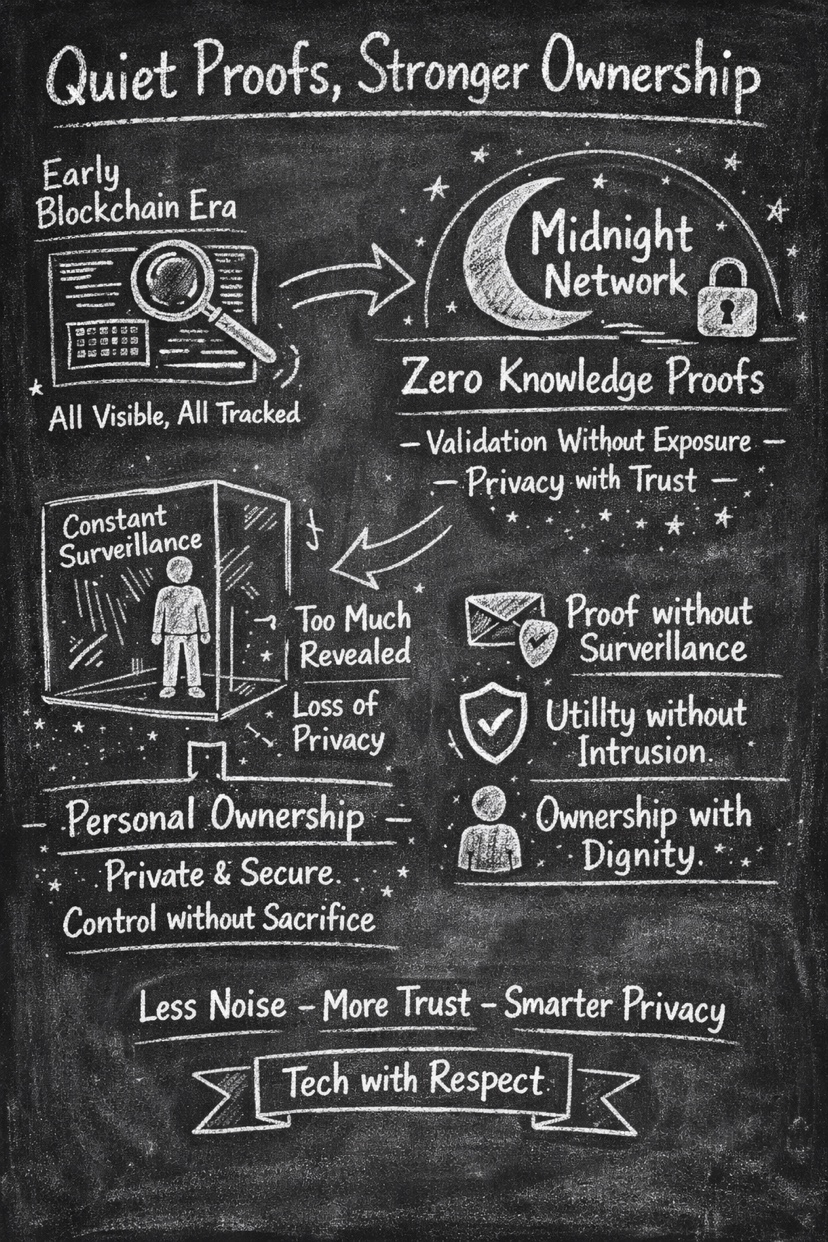
That is where ZK technology becomes more than a feature. It starts to feel like a philosophy. A blockchain can still confirm what matters, still support coordination, still enable real use cases, while protecting the parts of a person’s activity that do not need to be public. To me, that is a much more mature direction for this space. It does not weaken trust. It sharpens it. It makes the system more precise. Instead of showing everything, it proves what is necessary.
That shift matters more than many people realize.
A lot of projects still talk as if transparency itself is the destination. I do not see it that way anymore. Transparency is useful in some places, but it should not become a blanket rule for every user, every action, and every context. Real systems need nuance. They need boundaries. They need the ability to distinguish between what must be verified and what should remain protected. Without that distinction, utility becomes uncomfortable, and trust becomes something people tolerate rather than embrace.
What interests me about privacy in blockchain is not the romantic version of secrecy. It is the practical version of dignity.
A person should be able to interact with digital infrastructure without feeling like they are standing in glass. A network should not ask users to reveal more than the purpose of the interaction actually requires. If the system only needs proof, then proof should be enough. That is the beauty of zero knowledge in my eyes. It introduces discipline into design. It limits unnecessary exposure. It respects the idea that data protection is not an obstacle to utility, but part of what makes utility worth having in the first place.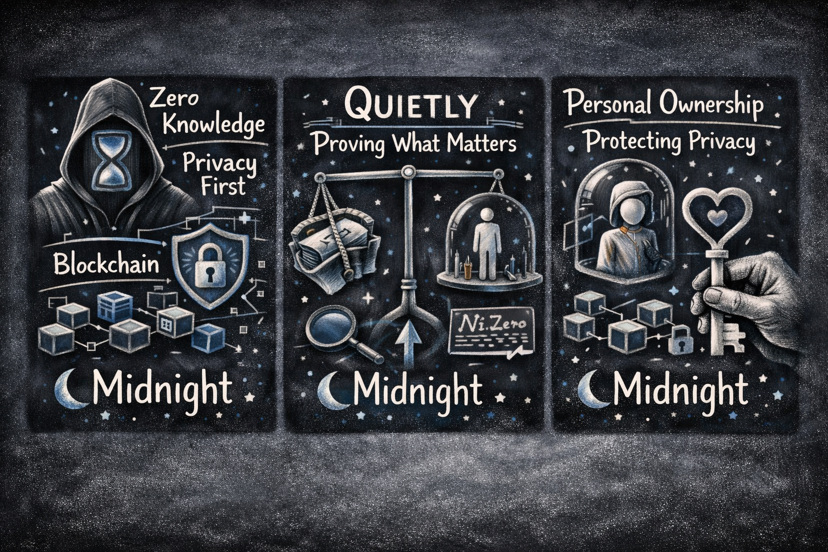
think this is why @undefined stands out to me in a different way. It feels less obsessed with spectacle and more focused on architecture. Less about showing everything, more about building something people can actually live with. That difference may sound subtle, but in the long term it changes everything. Loud systems attract attention quickly. Thoughtful systems earn trust slowly. And the systems that last are usually the ones that understand the difference.
The future of blockchain will not be shaped only by speed, scale, or visibility. It will also be shaped by restraint. By deciding what not to expose. By understanding that protection is not weakness. By designing systems that do not confuse openness with wisdom.
That is why this approach feels meaningful to me.
I do not think the strongest infrastructure will be the one that reveals the most. I think it will be the one that reveals the least while still proving enough. The one that gives people confidence without turning them into public records. The one that treats privacy not as an optional extra, but as part of the integrity of the system itself.
In that sense, zero knowledge is not just a technical method. It feels like a more respectful model of participation.
And maybe that is the deeper story here.
The next chapter of blockchain should not be about forcing people to choose between usefulness and control. It should be about building networks mature enough to hold both. Systems where ownership remains personal, verification remains reliable, and participation does not demand unnecessary exposure.
That is the direction that feels right to me.
Not louder.Not more visible. Just smarter, calmer, and more human.