
Yesterday, I watched another trader try to price $NIGHT like it was just another gas token. He ran the usual checklist: supply, unlocks, sell wall, bounce, fade. Then he stalled. Midnight does not treat NIGHT like a disposable fuel chip. It splits the economic roles in two.
NIGHT is the unshielded native and governance token. DUST is the shielded, non-transferable execution resource. Users do not burn NIGHT each time they transact. Instead, holding NIGHT generates DUST over time, like a rechargeable battery rather than a prepaid scratch card. That single architectural decision breaks the lazy habit of pricing every L1 token as a pure pay-fees-and-dump asset.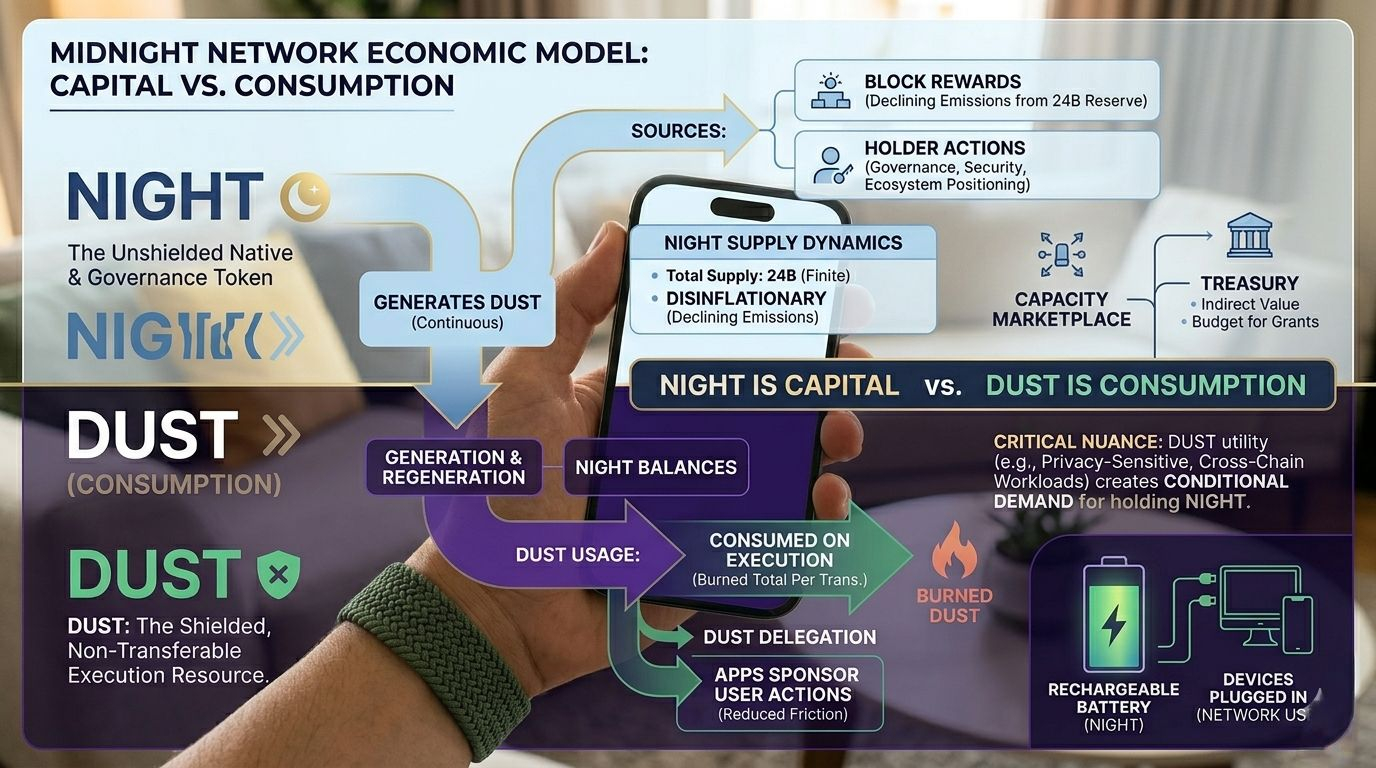
The important distinction is this: NIGHT is capital. DUST is consumption.
DUST is consumed when used. It is burned on execution. But it regenerates from NIGHT balances and decays if the balance falls or the link is severed. That creates a softer cost surface for builders. Apps do not have to constantly liquidate core holdings to keep paying fees. They hold capital and generate operating capacity from it.
Midnight also introduces DUST delegation. Applications can sponsor user actions by allocating DUST, reducing onboarding friction. That matters for privacy networks, where complexity is already a barrier. Instead of pushing cost anxiety onto every new user, apps can abstract it away.
Now to the messy part: burn versus emission.
If someone asks, Is NIGHT deflationary because fees are burned?” the honest answer is no not in the conventional token sense. The asset being burned in ordinary network activity is DUST, not NIGHT. NIGHT itself is non-expendable in transactions.
Meanwhile, circulating NIGHT increases through block rewards drawn from a pre-minted 24 billion supply Reserve. There is no infinite minting beyond that fixed pool, but distribution from the Reserve still introduces new circulating supply. Midnight calls the model disinflationary because the emission rate declines over time as the Reserve shrinks, eventually approaching full circulation.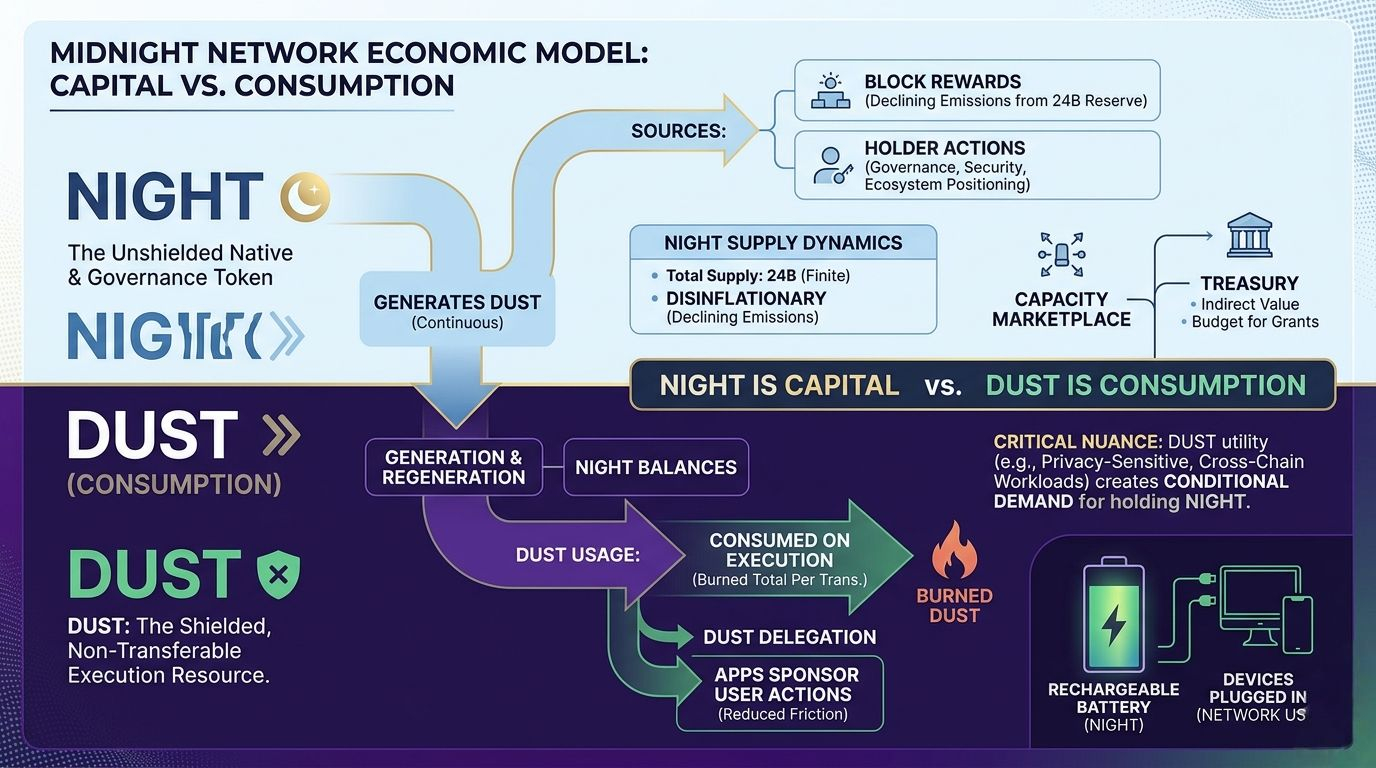
So the clean framing is:
NIGHT burn from usage: near zero
DUST burn from usage: effectively total per transaction
NIGHT emission: finite, declining over time
The critical nuance: DUST burn does not automatically equal value capture for NIGHT holders. DUST is not tradeable. It is a resource abstraction layer. The economic bridge between DUST utility and NIGHT demand depends on one thing — people choosing to hold NIGHT to generate DUST.
That is not trivial. It is conditional demand.
The fee model itself combines a base fee, congestion multiplier, and transaction weight. None are paid in NIGHT. Block rewards come from the Reserve and split between producers and the Treasury based on block fullness. At launch, subsidy heavily favors producers (around 95%), even for lightly filled blocks. Governance may later shift this closer to 50% to better reward fuller blocks.
There is also a proposed capacity marketplace, where leasing network capacity through non-NIGHT assets could route value toward the Treasury. That expands potential fee capture beyond simple transaction flow.
But Treasury value is indirect. It is budget, not dividend. It can fund grants, ecosystem growth, and potentially long-term token support. It does not create automatic per-token cash flow. Confusing those two is where speculative narratives usually go wrong.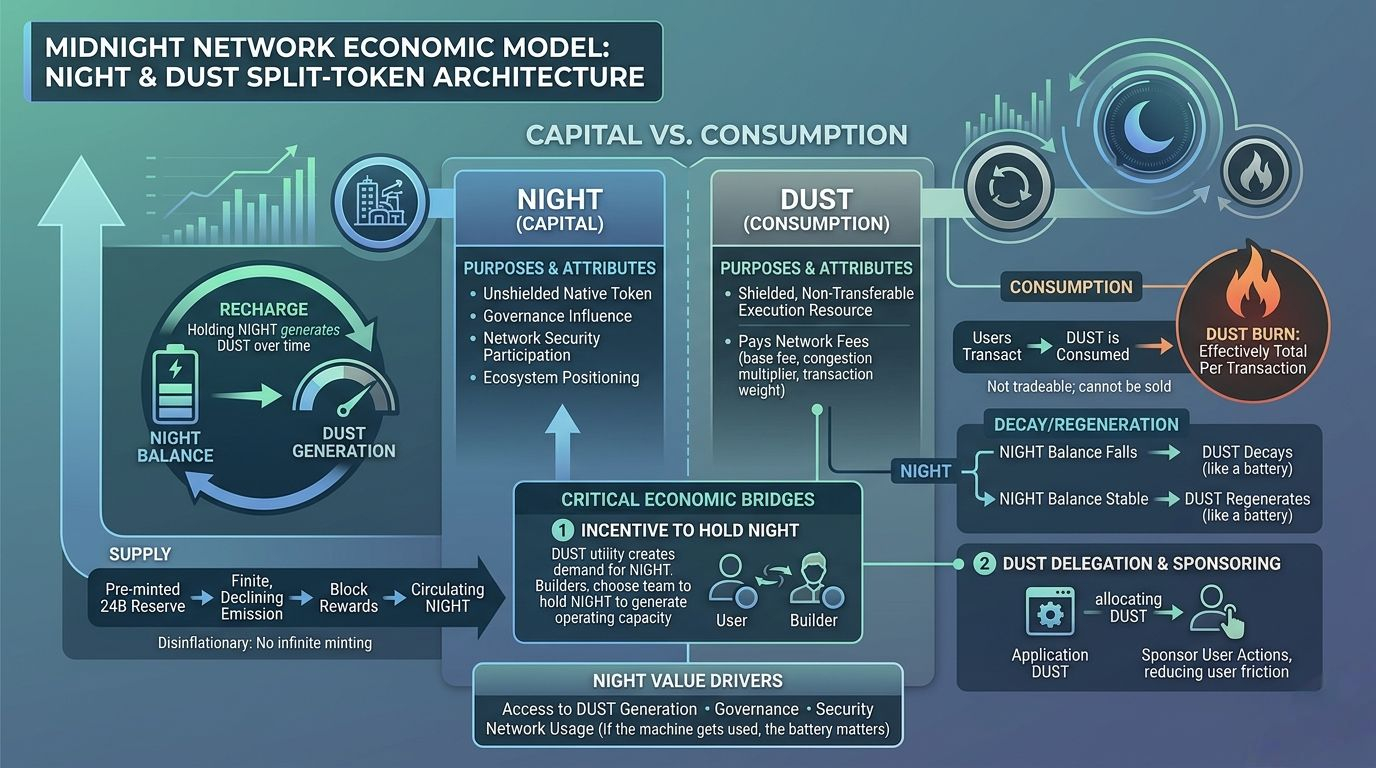
On the supply side, pre-minted does not mean pressure-free. Rewards distributed from the Reserve can still be sold. Treasury allocations can still become future overhang. The whitepaper examples showing ~3% first-year circulating inflation under certain Reserve/Treasury splits are illustrative, not promises. Traders who treat sample math as guaranteed outcome will eventually be surprised.
So what actually drives NIGHT?
Not fee burning. Not daily transactional demand.
It is:
Access to DUST generation
Governance influence
Network security participation
Ecosystem positioning in private computation
Potential cross-chain capacity demand
The open question is structural:
Does DUST utility create sustained incentive to hold NIGHT, or does it simply delay sell pressure?
If Midnight scales meaningful app traffic especially privacy-sensitive or cross-chain workloads then NIGHT becomes productive capital in an operating network. If usage remains thin, NIGHT risks feeling like stored energy in a battery with too few devices plugged in.
The split-token model is intellectually cleaner than the traditional gas loop. It separates capital from consumption. It reduces direct fee friction. It attempts to stabilize builder costs.
But design elegance does not guarantee demand.
In the end, NIGHT is not a moon token thesis. It is an infrastructure bet. The real metric is not burn rate hype or unlock panic. It is whether the machine gets used.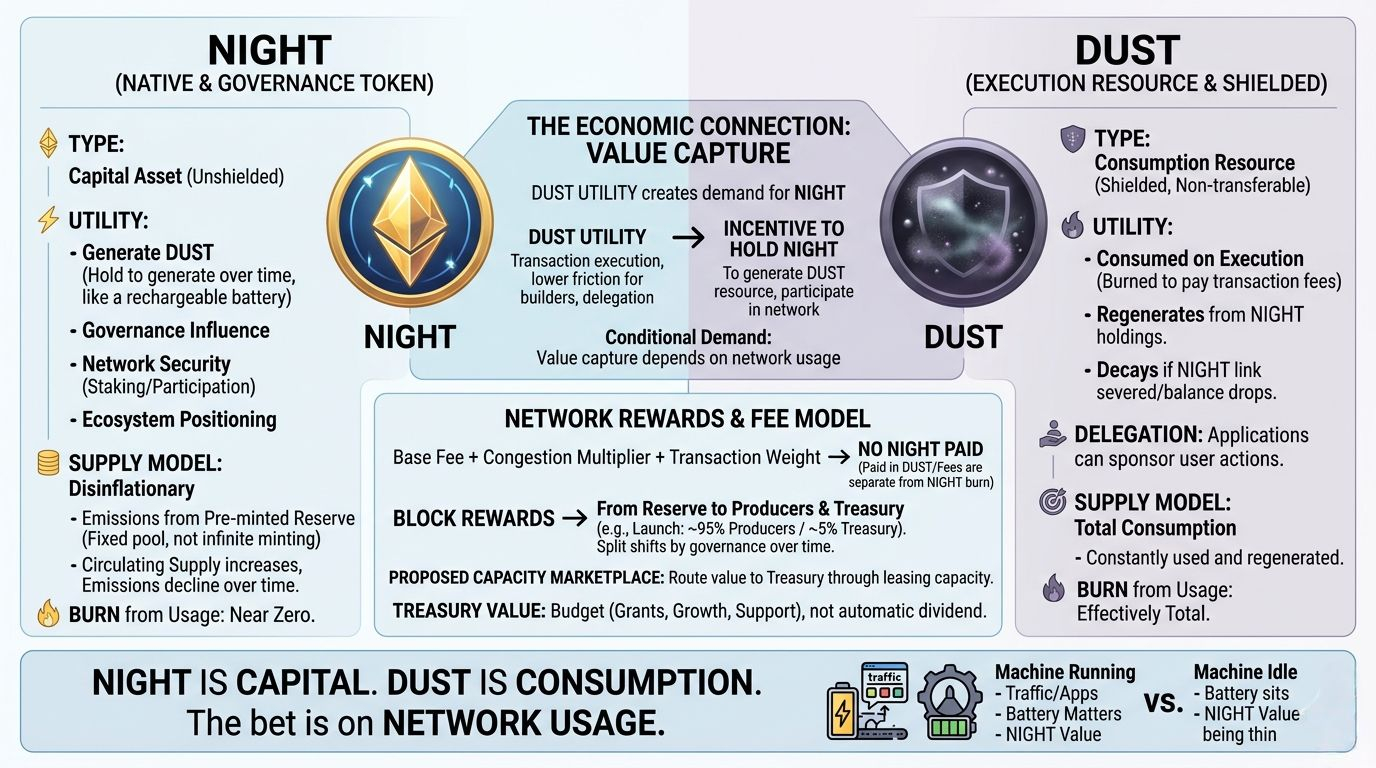
Because if the machine runs, the battery matters.
If it does not, the battery just sits there.
That is the bet.
@MidnightNetwork #night $NIGHT
