
Somewhere between a factory gate and a port crane, global trade turns into fragments—scans, batch codes, customs files, invoices, inspection logs. Every party needs proof. No one wants to reveal everything. That tension is where @MidnightNetwork tries to operate.
Trade is not about public transparency. It is about controlled disclosure.
A buyer may need proof a batch came from an approved plant. A bank may require shipment confirmation before releasing capital. Customs wants origin validation, not supplier margins. Traditional systems force companies to over-share or rely on siloed databases. Midnight proposes something cleaner: prove the fact without exposing the file.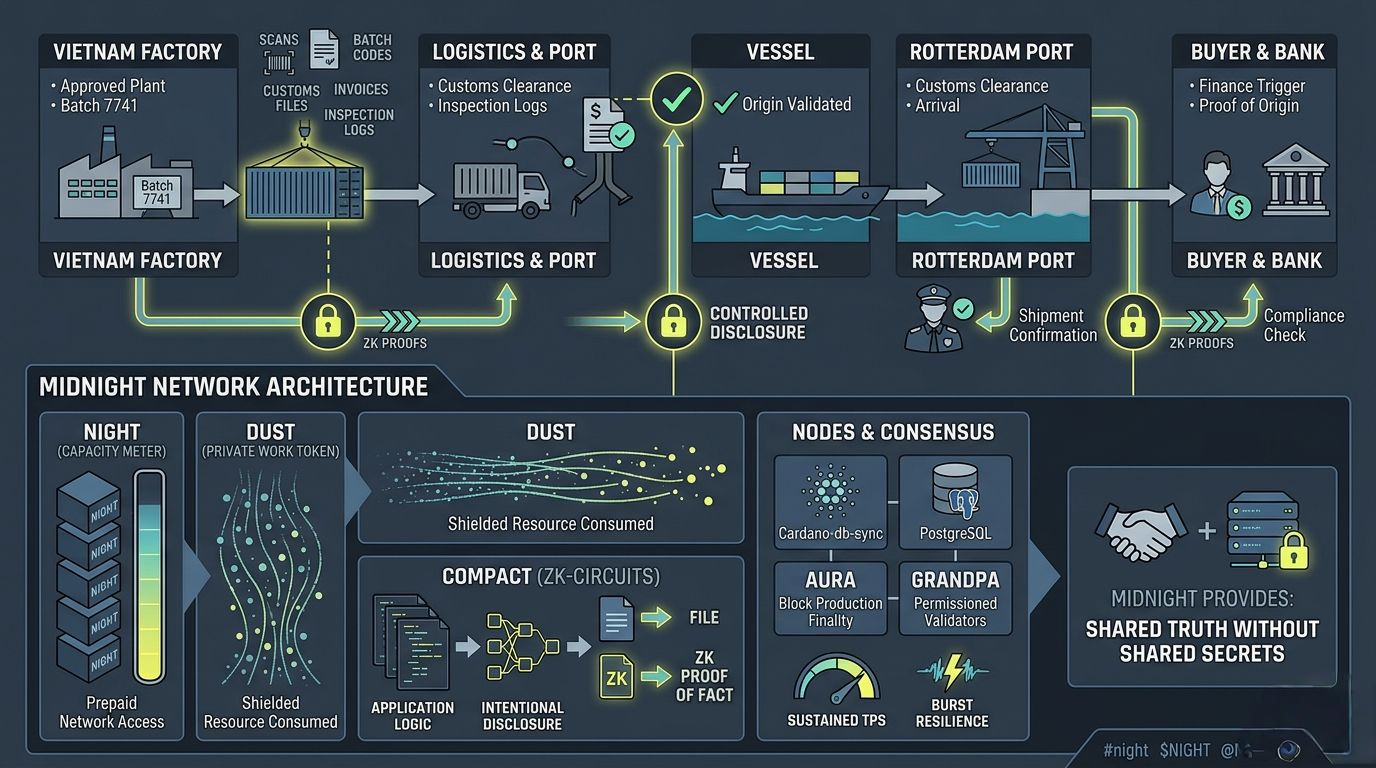
That is where zero-knowledge proofs stop being theory and start becoming infrastructure.
Midnight’s structure is practical if you strip away the crypto noise.
NIGHT functions like a prepaid capacity meter.
DUST is the shielded resource consumed to perform private network work.
Compact compiles application logic into zero-knowledge circuits so disclosure happens intentionally, not accidentally.
This is not vague “privacy.” It is programmable disclosure.
And the need is measurable.
Roughly 80% of global goods trade by volume moves by sea. Around 250 million containers move annually. Even if only eight lifecycle events per container were recorded—booking, packing, gate-in, customs clearance, vessel loading, arrival, release, finance trigger—that alone implies sustained throughput in the tens of transactions per second on average. Real systems spike during port congestion and financial settlement windows.
Average TPS is easy. Burst resilience is the real test.
But infrastructure is more than throughput. Midnight’s architecture acknowledges operational friction. Proof generation requires either a local or controlled proof server connection. The node stack integrates Cardano-db-sync and PostgreSQL. Consensus uses AURA for block production and GRANDPA for finality, with the possibility of permissioned validators.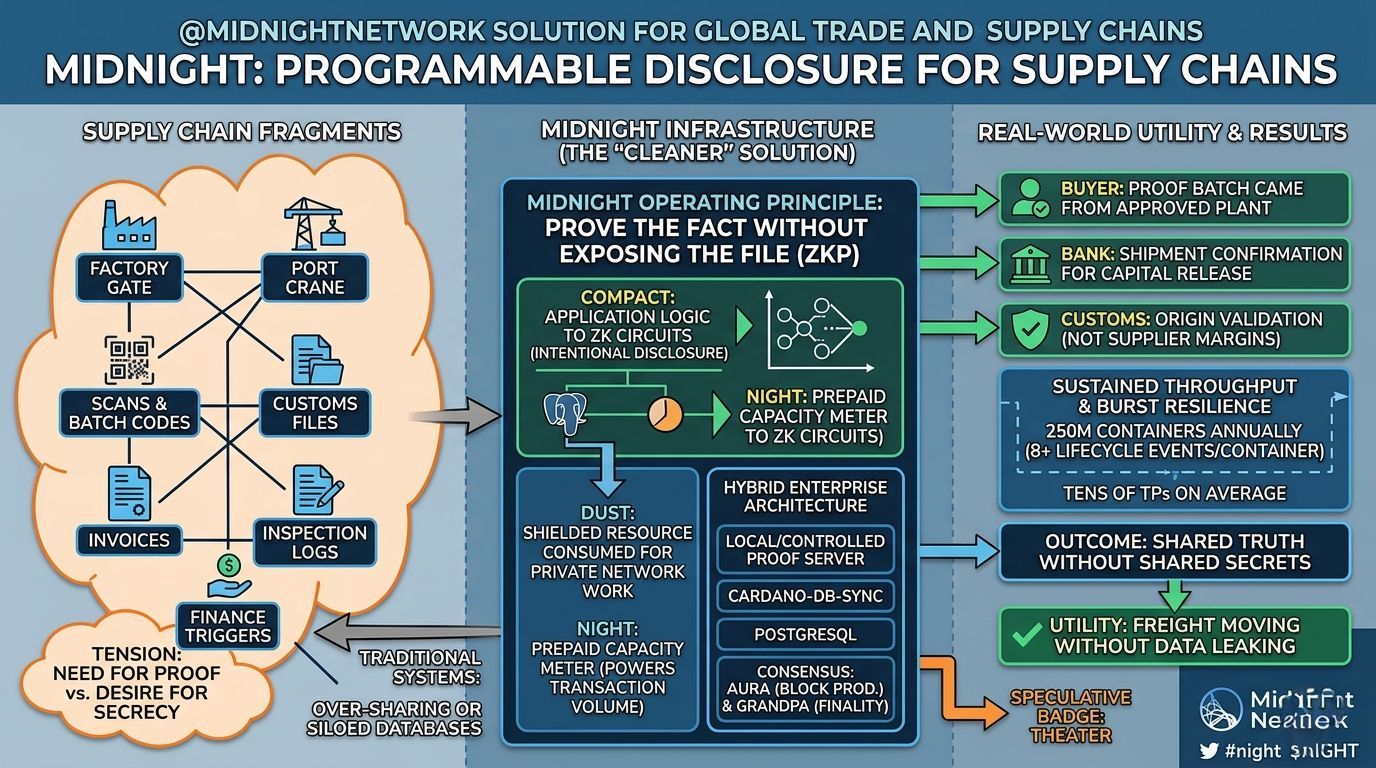
That design may suit hybrid enterprise systems. It also introduces complexity. And complexity slows adoption.
Which is why the real question is not elegance.
The real test is a boring Tuesday in freight.
A plant in Vietnam.
A buyer in Rotterdam.
A stressed port terminal.
A bank that wants one last compliance check before unlocking cash.
If Midnight works there—quietly generating proofs, protecting supplier lists, validating temperature compliance without leaking sensor logs—then it has substance.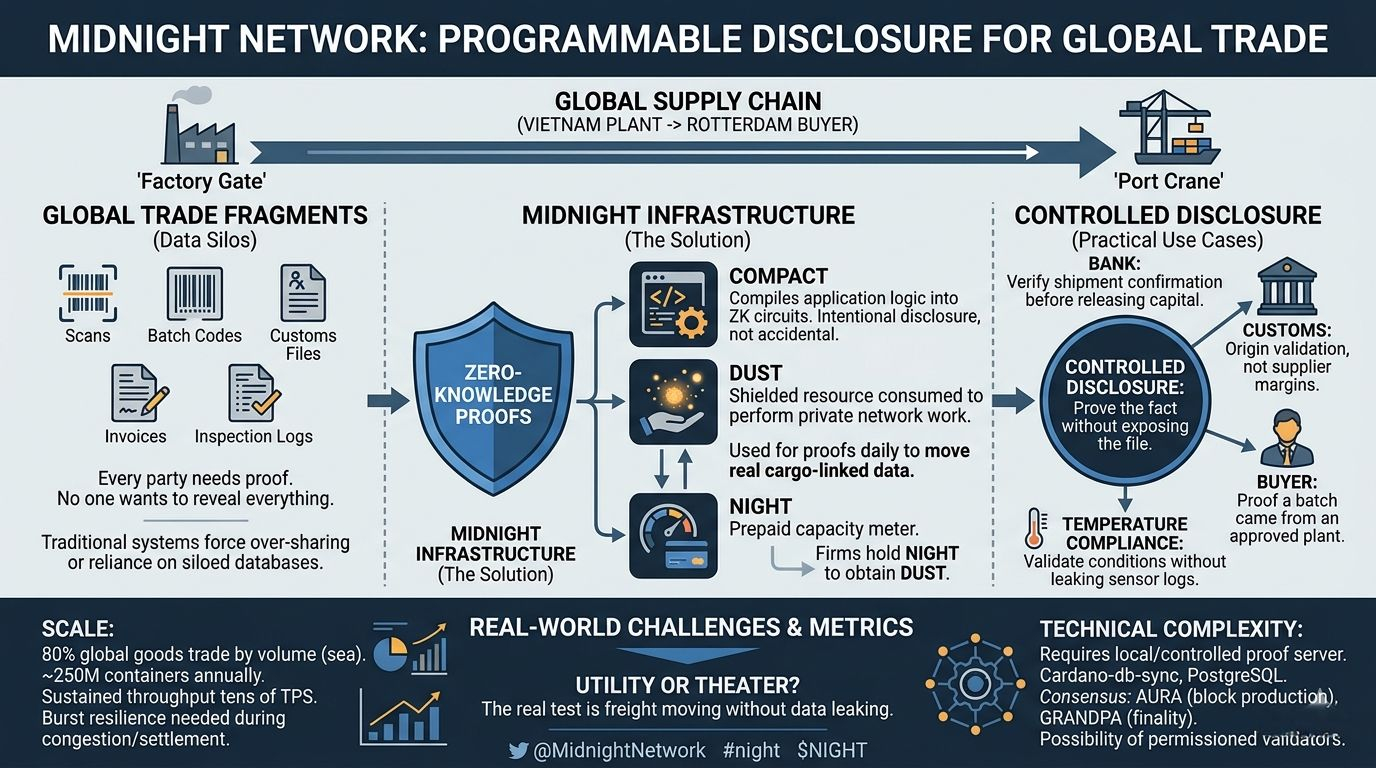
If NIGHT becomes something firms hold because DUST is required daily to move real cargo-linked proofs, that is utility.
If it becomes a speculative badge, it is theater.
Midnight’s strongest case is simple: companies need shared truth without shared secrets. That pain point is real. The solution is technically coherent.
What remains unproven is execution under load, proof latency, developer experience, validator trust design, and whether enterprises will migrate from entrenched legacy systems.
Utility is possible.
Adoption is conditional.
Proof will not come from narratives.
It will come from freight moving without data leaking.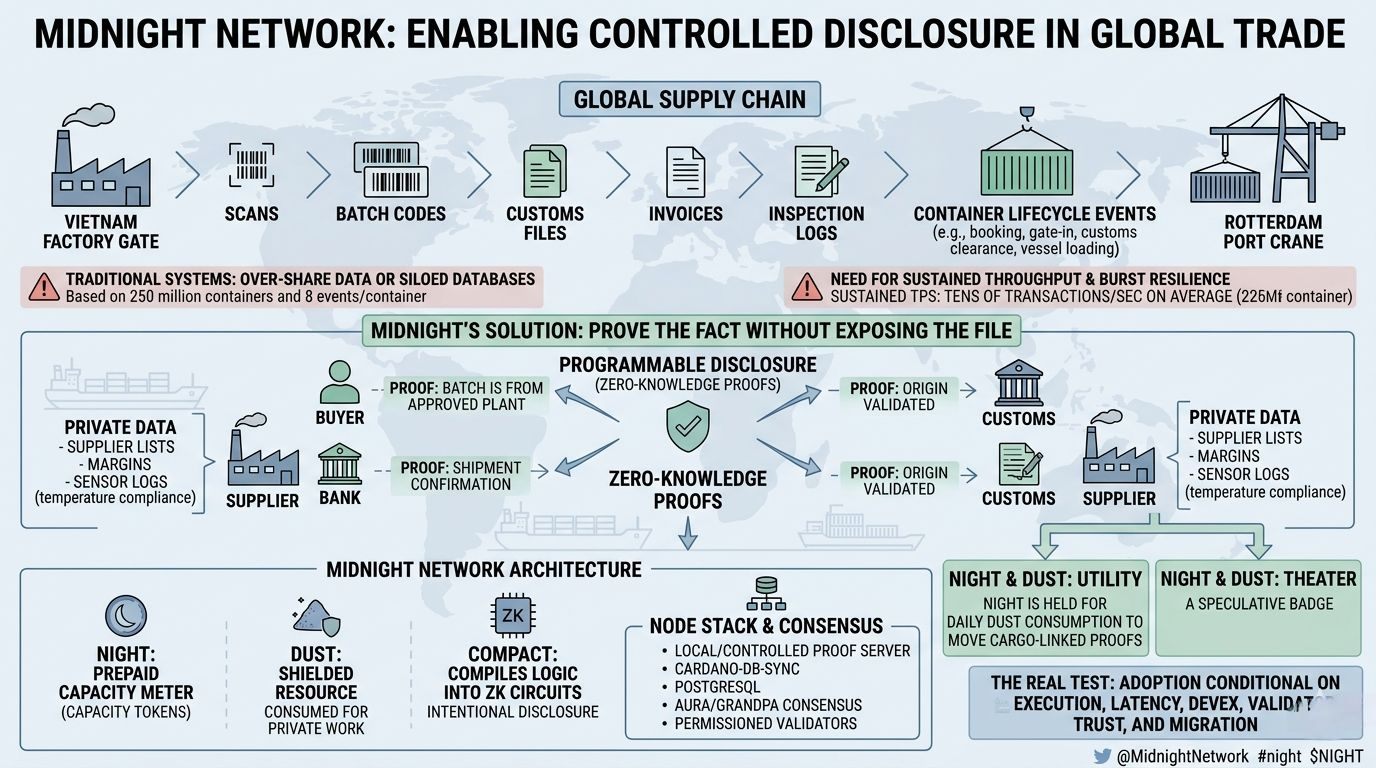
@MidnightNetwork #night $NIGHT
