
Imagine a scenario: you bought an NFT claiming to be an "apartment on Fifth Avenue, New York" on the blockchain, with an annual return of 10%, looking pretty sweet. As a result, six months later, you find out that the building doesn’t exist at all, or the landlord has long since mortgaged it to three banks. You seek to defend your rights, and the code tells you that "the transaction is immutable," but the real world tells you, "this is just a picture."
This is the heartbreaking truth about RWA (Real World Assets) right now: putting assets on the blockchain is easy, but putting the "truth on the blockchain" is as difficult as climbing to the sky.
If there is no @SignOfficial ($SIGN ), this kind of underlying verification protocol, the so-called RWA is just a blockchain shell wrapped around the traditional "pump and dump" schemes.
1. Don't be fooled by APY; what you lack is that 'official seal'.
The essence of RWA is not Tokenization, but Verification.
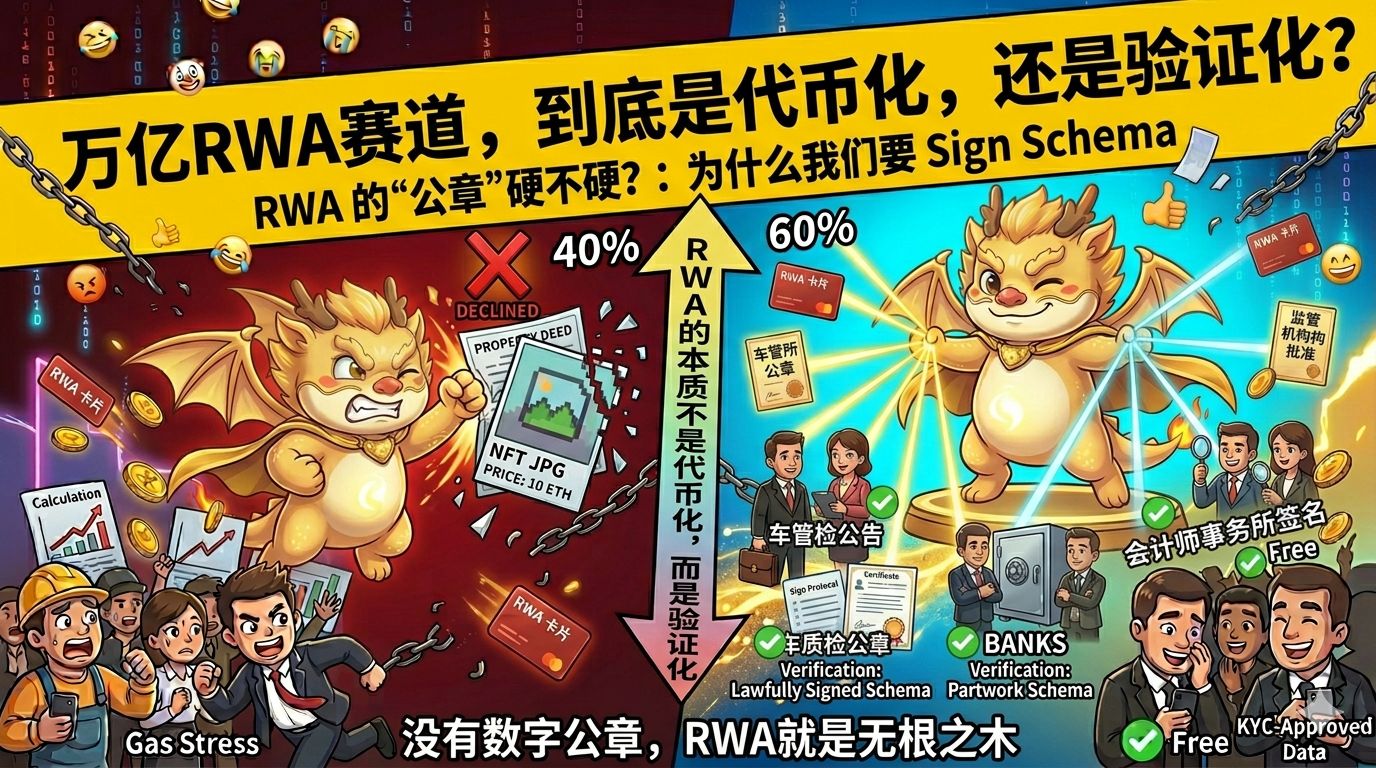
In traditional finance, you dare to buy a house because there are housing authorities and lawyers; but in Web3, what makes you trust a token issued by an anonymous wallet?
What Sign Protocol does is serve as the all-chain covenant center of Web3.
Schema (Universal Template): It defines what 'compliant proof' is. It is no longer a vague PDF screenshot, but rather structured data issued by licensed institutions that is traceable on-chain.
Digital Endorsement: Only when accounting firms, lawyers, and regulatory bodies have 'signed off' on the Sign Protocol does an asset possess true credit.
It transforms 'human speech' into 'code speech'. Without this digital official seal, the asset mapping of RWA is like a tree without roots.
2. Hooks: Equip your assets with a '24-hour electronic ankle bracelet'.
Human nature is greedy and changeable; the status of off-chain assets can change at any time.
The most hardcore Hooks in the Sign Protocol architecture are specifically designed to deal with the 'dark side of human nature'.
It can set mandatory logic:
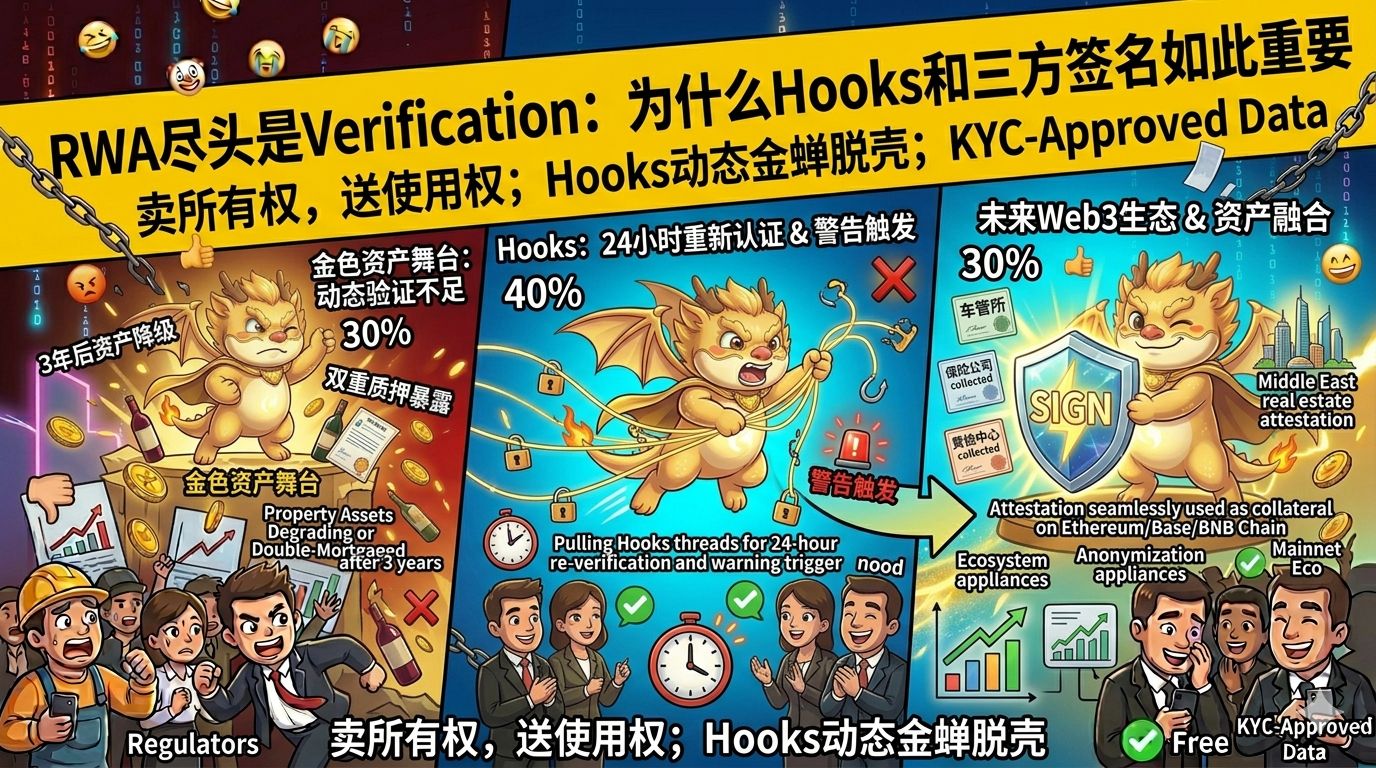
Automatically verify the asset status every 24 hours. If off-chain assets are found to be locked or re-mortgaged, the Hook will immediately lock the liquidity of the on-chain tokens and trigger a warning.
This 'logical monitoring' ensures that assets are no longer out of control once they are on-chain. It gives RWA the ability for 'real-time anti-counterfeiting' for the first time. This is not just a technological upgrade; it is buying insurance for investors' capital safety.
3. Full Chain Interoperability: Breaking the 'Trust Islands'
Why is the Sign Protocol a prerequisite for large-scale on-chain integration?
Because large funds (like BlackRock and Fidelity) fear trouble the most. If their asset certification on Ethereum is not recognized on Base or BNB Chain, then this game cannot be played.
The Omnichain architecture created by Sign Protocol turns trust into a universal currency. A real estate certificate issued in the Middle East can seamlessly serve as collateral in DeFi protocols across the entire chain. This 'liquidity of trust' is the foundation that supports the trillion-dollar RWA market.
Pixiu Summary
Don't just look at who has high returns; look at who has a strong 'foundation'.
The end of RWA is not issuing tokens, but the industrialization of credit. What Sign Protocol does is the hardest, least flashy, but most indispensable tough work.
It forces a set of anti-counterfeiting lines between the reality filled with lies and the rigorous on-chain code through Schema + Nodes + Hooks.
Simply put, if RWA is the vast ocean of Web3, then the Sign Protocol is the only lighthouse that can guide the big ship to avoid the reefs. Without it, everyone is just running naked in a so-called 'decentralized' open sea.