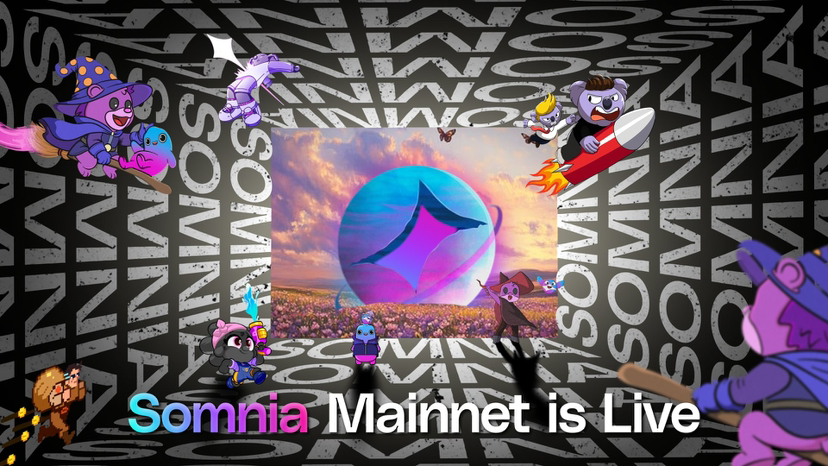
In today's virtual world witnessing explosive growth, @Somnia Official has redefined the economic incentive model of the metaverse protocol through its native token $SOMI . $SOMI is not only a governance token but also a value carrier supporting the entire virtual economic system, encompassing multiple functions such as node incentives, protocol governance, virtual asset minting, and cross-chain interactions. With the full launch of #Somnia mainnet, the utility of $SOMI is expanding from underlying protocol services to a virtual economic ecosystem valued in the trillions of dollars.
As of the fourth quarter of 2025, $SOMI token has a fixed total supply of 1 billion tokens, with a circulating supply of approximately 350 million tokens. Among them, the number of tokens pledged by participating network nodes reached 210 million, a year-on-year increase of 55.3%, providing a solid technical foundation for over 800 virtual spaces and 350,000 daily active users across the network. This innovative economic model not only incentivizes the active participation of global developers but also promotes the establishment and improvement of metaverse interoperability standards.
Node Network Incentives: Dual Assurance of Performance and Security The node incentive system of the Somnia network is a meticulously designed digital economic engine. Validator rewards account for 20% of the total supply and are automatically distributed through smart contracts. Node operators receive corresponding rewards based on the computing resources, network bandwidth, and storage capacity they provide, with high-performance nodes able to obtain a larger share from the protocol's reward pool.
Current network data shows that the number of global nodes has reached 1,500, covering 12 major regions, with network throughput stabilizing at 60,000 TPS, meeting large-scale concurrent demand. The node staking yield remains in the range of 9-14%, and network latency is controlled within 80 milliseconds, with all these indicators outperforming industry standards. The ecosystem development fund accounts for 45% of the total supply, supporting content creators, game developers, and virtual space builders through DAO governance.
Diversified Revenue Model: Innovative Practice of Value Capture The revenue sources managed by Somnia DAO show a healthy diversification trend. Quarterly revenue from virtual asset minting fees has reached $620,000, cross-space transaction fees have increased by 72% quarter-on-quarter, the virtual land leasing market is taking shape, and demand for enterprise-level custom services is rapidly growing. These revenue sources provide a solid guarantee for the sustainable development of the ecosystem.
In terms of governance mechanisms, Somnia adopts an advanced dual-layer governance structure. Regular proposals require a 55% majority vote to pass, core protocol changes require a 75% super majority, and the proposal threshold is set at 0.1% of the total staked amount. The delegated voting mechanism ensures governance inclusivity. This design guarantees decision-making efficiency while maintaining the stability of the protocol.
Virtual Asset Economy: An Innovative Digital Property Paradigm $SOMI plays a core role in the creation of virtual assets. Creators mint digitally interoperable assets across platforms by staking $SOMI, which can seamlessly circulate in different virtual spaces. 30% of the minting fees automatically enter the ecological fund, forming a sustainable value cycle.
It is worth noting that the number of virtual assets created based on the Somnia protocol has exceeded 1.2 million, with cross-platform circulating assets accounting for 45%. The asset trading volume has grown by 89% quarter-on-quarter, and the creator community has surpassed 15,000 people. These data fully demonstrate the protocol's success in promoting digital asset innovation.
Technological Innovation Drives Ecological Prosperity At the technical level, the Somnia network continues to achieve breakthrough progress. Scene loading time has been reduced to 2.1 seconds, network availability has reached 99.95%, the number of supported VR device types has increased to 28, and API call response time has improved by 35%. These technological advancements provide users with a more immersive virtual experience.
The developer ecosystem is also showing a vigorous growth trend. Currently, the developer community has grown to 4,500 people, with monthly active users exceeding 200,000, and the platform’s interoperability requests averaging 20 million per month. These data indicate that Somnia is becoming an important bridge connecting different virtual worlds.
Future Outlook and Development Path Looking ahead, the Somnia network will continue to deepen its investment in the construction of metaverse infrastructure. With the popularization of virtual reality technology and the growing user demand for interoperability, the value logic of $SOMI will be further strengthened. The protocol plans to achieve the goal of supporting 1 million concurrent users by 2026 and increase the cross-platform asset circulation rate to over 60%.
Through this innovative token economic system,@Somnia Official is evolving from a singular metaverse protocol into a digital economic bridge connecting the real and virtual worlds.$SOMI not only provides sustainable economic incentives for participants but also constructs the underlying economic rules for future virtual societies, contributing significantly to the healthy development of the metaverse industry.