
In the face of $SIGN , many people are asking: 'With a total of 10 billion, only this little has been released now, will the subsequent unlock bury me alive?'
Today, let's tear apart these warm project descriptions and analyze from the most intuitive perspective: where is the selling pressure of SIGN, and can its moat withstand this wave of flood?
1. Breakdown of unlocks: This is not just 'time', this is 'betting'
If you have flipped through the tokenomics of SIGN, you will find it completely different from those projects that only 'excrete' chips monthly.
The 'tightening spell' of the team’s chips: 30% of the core team is not merely waiting for time, but is linked to performance milestones. This means that if the protocol does not grow significantly or the price does not meet the standard (for example, if the TWAP price does not double), the team’s tokens can only 'sit in prison' in the contract. This type of 'interest bet' is more reliable than any verbal commitment, ensuring that the founding team must work hard to enhance the real value of the protocol.
The 'release period' for institutional investors: 20% of early investors have a cliff period of up to 12 months. By the time linear release begins in mid-2026, the market will have long passed the initial fluctuations.
Pixiu Review:
This unlocking structure is not meant for 'harvesting', but for 'screening'. It automatically discourages those who want to make quick money, allowing long-term holders time to build consensus.
2. Selling pressure analysis: who will be the 'market breaker'?
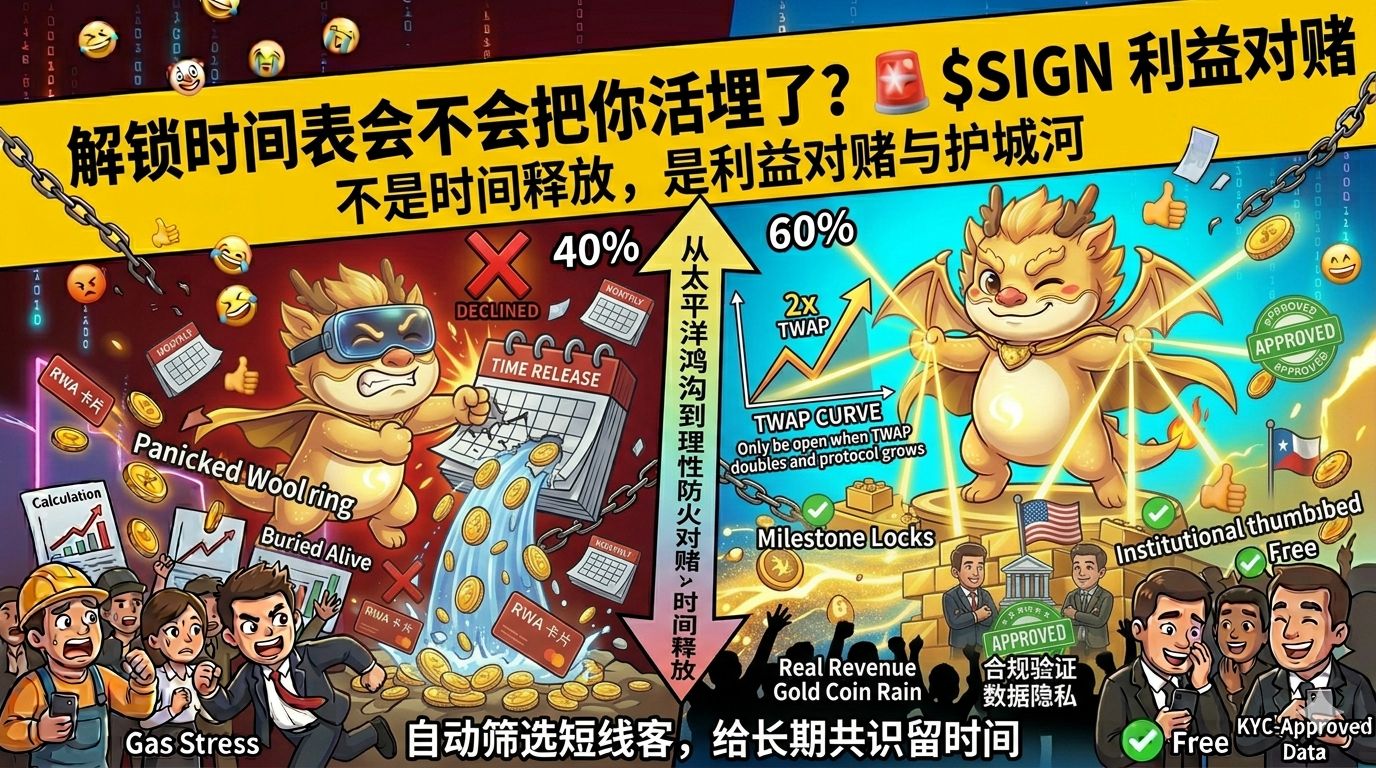
Selling pressure mainly comes from three directions:
@SignOfficial The daily release of community incentives: 40% of community shares, this is the biggest variable. But if you take a closer look at its usage—motivating verification nodes and ecological developers—you will find that these coins are actually 'means of production'.
The exit of early opportunists: this selling pressure has basically dissipated in the six months following the TGE (Token Generation Event).
Arbitrage of nodes: this is a healthy market behavior. As long as the demand for SIGN’s verification (such as government digitization, RWA verification) is growing, this part of selling pressure will be directly hedged by strong demand.
3. Moat: Why is the confidence of $SIGN harder than life itself?
For long-term holders, your moat is not just those few lines of code, but 'path dependence'.
Monopolistic access at the sovereign level: when governments in the Middle East or Southeast Asia start using SIGN for digital identity endorsement, this trust is 'exclusive'. Have you ever seen a government doing business, using Office today and switching to an unknown small software tomorrow?

The 'linguistic hegemony' of full-chain intercommunication: just as PDF unified document formats, Sign Protocol is unifying the trust format of Web3 with its schema. Once the RWA projects in the ecosystem get used to calling its interfaces, the switching costs will be astonishingly high.
The real support for cash flow: don’t forget, this project had already achieved revenue of 15 million USD in 2024, with a net profit margin of 40%. While 99% of projects are still relying on financing to 'survive', SIGN has already been 'self-sustaining' through its business.
Pixiu Summary
If you ask me whether $SIGN will fall? In the short term, look at the market's face; in the medium term, look at the release of chips.
But if you ask me how deep its moat is? I would tell you: when a protocol becomes an 'industry seal', it is no longer a purely speculative target, but a 'rent-seeking right' for Web3 trust infrastructure.
The unlocking period does indeed have pressure, but if this pressure can lead to deep ties with top institutions and governments, then this 'growing pain' is the necessary path to establish barriers.
Advice for long-term holders:
If you are optimistic about Web3's 'digital transformation', then consider SIGN as a long-term equity. Don’t be intimidated by those short-term unlocking announcements; what you should focus on is: how many real-world assets have been 'secured' under SIGN's schema.
After all, in the world of code, a seal that can make money is always more valuable than air that can tell stories.