
Every morning I first take the kids to school, then I come back and make breakfast myself. After eating, it's probably around 9:30, I open my computer and summarize yesterday's transaction records into my trading system. I usually operate on more than ten cryptocurrency orders at the same time. From 9:30 to 10:50 in the morning is generally the busiest, while the afternoon sees lighter transactions, and there aren't many opportunities for scalping. I can manage everything on my phone, and if the trading is slow, I don’t stare at the computer and take a break for my eyes.
In the afternoon, when I have nothing to do, I usually go for a run in the park or the woods, then I pick up the kids after school, go home, and sometimes I cook dinner myself, other times I order takeout.
In the evenings, I usually just place orders, dedicating more time to sharing and answering questions, as well as writing reviews! If trading is light or there is a one-sided decline with few trading opportunities, I might drive to a quiet place to fish. As long as there is a mobile signal, I can trade on Binance while fishing, which is quite enjoyable. Overall, it’s about being free and at ease.
In cryptocurrency investment, maintaining liquidity in the account is crucial. That is, 'the market has coins, the account has money, and the pocket has cash', which is an important guarantee against market uncertainty. Never risk it all; allocate funds reasonably and master risk control strategies. This not only stabilizes the investment mindset but also effectively controls risk. Use spare money for investment rather than borrowed capital, as this is the foundation of investment. Master basic operational skills and thought processes, develop the habit of recording and summarizing, using the high and low point data from each operation as valuable experience, and gradually cultivate the ability to filter information and make decisions.
In addition to solid technical skills, I also adhere strictly to the following six iron rules: grasp the elements of successful investing!
As long as retail investors can accomplish the following six points, turning 100,000 into 5 million is not difficult. These six points may seem simple, but very few can truly achieve them. Below are the 'six iron rules' that guarantee success in the cryptocurrency market, assisting you in navigating the market with ease!
1. Understand stop-loss and take-profit. Trading cryptocurrencies is for profit and not for holding indefinitely. When the position trend goes wrong, decisively sell to avoid the need for a revelation? In the cryptocurrency circle, do not be greedy when making money, and do not hesitate when facing losses.
2. Do not pursue absolute highs and lows. The market will always have lower lows and higher highs; it is very difficult for ordinary people to grasp them precisely. We just need to buy in the bottom area and sell in the top area to catch the big trends.
3. Volume and price must perfectly match. Rising with no volume or reaching new highs with no volume often signals that the main force is distributing or that the rise is exhausting. It’s better to miss out than to chase high prices and end up as the bag holder.
4. React quickly. When favorable news emerges in the market, swiftly identify related sectors and projects. If you miss the first tier, timely position in the second tier to still achieve decent returns.
5. Learn to rest. The main wave of price increase is short-lived, while the rest of the time is mostly fluctuating or correcting. Seize the main wave and learn to rest during other times to avoid losses caused by frequent trading.
6. A market crash is the biggest advantage. A market crash often breeds greater opportunities. Be greedy when others are fearful, and be fearful when others are greedy. When the market crashes, do not panic; choose quality assets to build positions in a timely manner and wait for a rebound.
Bitcoin has soared, bringing some of the previous trading strategies back into focus. The simplest and most direct MACD trading strategy.
It can be said to be simple; it is merely about finding opportunities for continuous divergence in MACD.
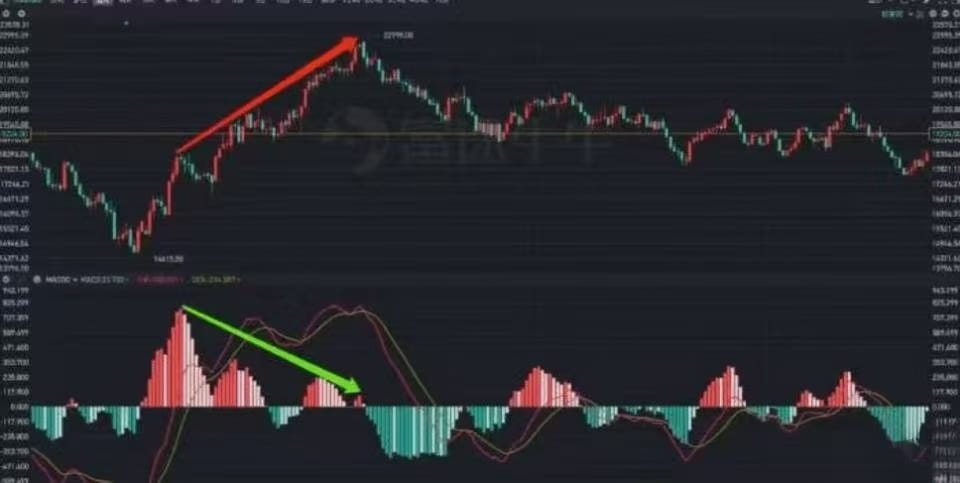
The above figure is a good example, clearly illustrating the two core points of this trading strategy: continuity and divergence.
What counts as continuous?
When the MACD is above the zero axis, if a peak appears and does not drop below the zero axis before rising again to form another peak, or if it drops below the zero axis and quickly crosses bullish again to form a peak, this is what is called continuity.
What counts as divergence?
The peaks of MACD are gradually decreasing, but the stock price is gradually rising, which means that the MACD trend is inconsistent with the stock price trend, which is what is known as divergence.
Of course, the inconsistency in trends can be divided into two situations: when the indicator declines while the stock price rises, it is a top divergence; when the indicator rises while the stock price declines, it is a bottom divergence.
The above chart is an example of a top divergence. Similarly, for the Hang Seng Index, a bottom divergence had already appeared before the market began at 924.
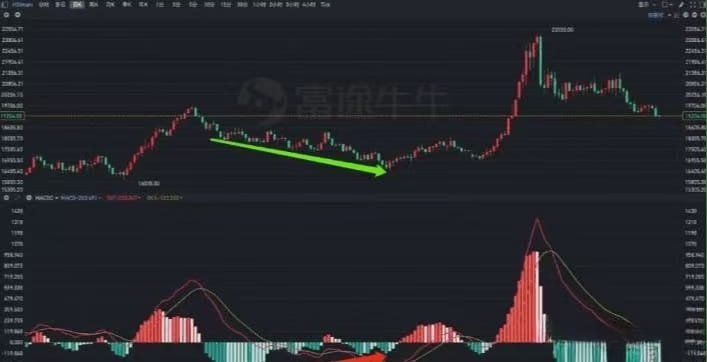
The trading strategy of Zeng Shao is to look for opportunities where the MACD indicator shows continuous divergence.
First, modify the default parameters of MACD from 12 and 26 to 13 and 34, then look for consecutive divergences where the peaks and troughs differ significantly. Short in case of a top divergence and go long in case of a bottom divergence, and then set stop-loss based on the ATR with a parameter of 13.
Causes of Divergence
From the above two screenshots, it is clear that going short during a top divergence and going long during a bottom divergence are indeed excellent opportunities. Everyone can test this strategy on the assets they are interested in to see if it can capture some significant opportunities.
During this process, you might encounter two issues. First, the built-in MACD indicator on the platform only has fast and slow lines and a histogram, and does not include divergence recognition, making it very inconvenient to verify the validity of divergence signals when backtesting historical data. Second, after backtesting, you are likely to find that divergence signals are quite effective, but bottom divergences tend to be more effective than top divergences.
To address the issue of recognizing divergence signals, we will analyze the causes of divergence and why bottom divergence signals are more effective.
First, we need to take a look at the code for the MACD indicator to analyze its construction logic.
DIF: EMA(C, 12) - EMA(C, 26), COLORRED;
Yes, the original MACD indicator is that simple; achieving the so-called 'king of technical indicators' MACD requires only three lines of code.
The first row calculates the difference between two different time period moving averages based on the closing price and displays it as a curve.
In the second row, the average of the difference between the two moving averages from the previous step is calculated and displayed as a curve.
In the third row, subtract the two and enlarge the result, then display it as a histogram.
Therefore, even if we have not studied the design principles of the MACD indicator, we can analyze the causes of divergence based solely on its code.
If a top divergence occurs, that is, the peaks of MACD are decreasing while the stock price is rising to new highs, it indicates that the value of MACD is declining.
The value of MACD is obtained by subtracting DEA from DIF, which indicates that the gap between DIF and DEA is narrowing.
DEA is the average of DIF, which indicates that DIF is gradually decreasing or its growth is slowing. At the same time, due to DEA's smoothing effect, when DIF's growth narrows, DEA may still be rising, causing the gap between the two to narrow or even reverse.
DIF is the difference between two moving averages of different periods. As DIF gradually narrows or the growth rate slows down, it essentially means that the gap between the two moving averages is diminishing. The short-term moving average is sensitive, while the long-term moving average is smooth; thus, the narrowing gap can be seen as the slope of the short-term moving average starting to converge with that of the long-term moving average.
The slopes of the short-term and long-term moving averages starting to converge can be attributed to two reasons: stock prices have fallen or the growth rate has decreased. The condition for a top divergence is that stock prices are still rising and reaching new highs, so the narrowing gap actually indicates a decrease in growth, which means stagnation has occurred, and the price is no longer moving up.
The same derivation process can lead to the conclusion that the cause of bottom divergence is that a stagnation has occurred, and the price can no longer fall.
After a long period of fluctuations, once a trend is formed, it is difficult to reverse. After a top divergence, some profit-taking funds may cash out, but those who initially did not believe are now gradually entering as they just started to believe. Although momentum has weakened, the trend remains, and after a top divergence, there may still be another top divergence, leading to the possibility of forming higher highs in stock prices.
Similarly, after a bottom divergence occurs, there may also be lower lows. However, compared to rising prices, declines usually happen quickly and with more intensity, especially after several rounds of panic selling, where people begin to feel numb to negative news and there’s no further room to fall. At that point, the remaining participants are likely to be firm holders, coupled with the psychological advantage of buying at low prices, which often triggers a strong rebound, making bottom divergence signals more likely to materialize.
Identifying Divergence
When the stock price reaches a new high but the indicator does not, it is considered a top divergence, indicating that the strength of the bullish trend is weakening, and the market may undergo a top reversal; when the stock price reaches a new low but the indicator does not, it is considered a bottom divergence, indicating that the strength of the bearish trend is weakening, and the market may undergo a bottom reversal.
Since this is a 'potential reversal', it indicates a type of left-side trading. If trading contracts, it is understandable why the semi-god can achieve such high returns relying on this strategy.
Of course, since it is a left-side strategy, there may be situations where 'there is a top within a top, a bottom within a bottom, and divergence after divergence'. Therefore, the semi-god's trading strategy also specifically adds ATR-based stop-loss to avoid trading against the trend in a strong market, which could lead to losses or even liquidation.
With both entry signals and stop-loss rules, this appears to be a relatively complete trading strategy logically. However, the problem is that if one relies on the naked eye to identify continuous MACD divergence, the efficiency may be very poor.
Although there are related indicators in TradingView to assist in trading, there are few such toolbox-type indicator tools in domestic trading software. Most have a flashy name, misleading people into thinking that they can trade based solely on indicator signals with guaranteed profits.
However, we all know that for different markets, different assets, and different times, the trading signals emitted must be treated differently.
In a strong trending market, the KDJ indicator may remain in the overbought or oversold range; in a fluctuating market, the moving average indicators may repeatedly flash buy and sell signals. Relying entirely on a single signal may lead to losing everything after some time.
Therefore, technical indicators should actually be seen more as a supplementary tool, with their main function being to improve efficiency. For instance, for continuous divergences in MACD, if we can use technical indicators to automatically recognize this pattern, it can help us better seize these opportunities.
There are three key points to recognizing divergence: triggering mechanism, time range, and judgment method. In a previous article, we introduced a simple method for recognizing divergence regarding the color change and divergence of MACD.
This recognition method is quite simple. It uses the golden and death crosses of MACD as the triggering mechanism, utilizing two golden/death crosses as the time range, and then judging whether divergence has occurred based on the trends of DIF and stock prices at the time of the golden and death crosses.
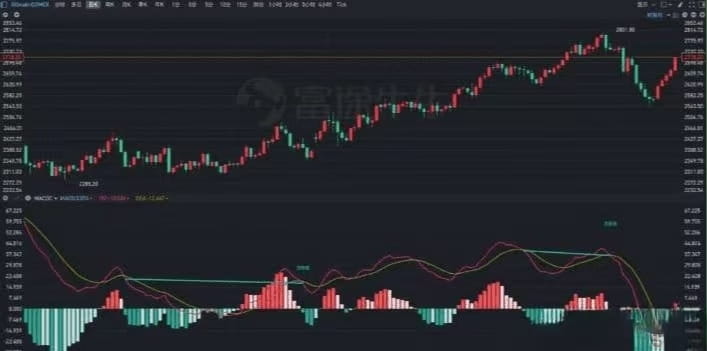
In fact, it is a somewhat opportunistic approach. For general situations, it can still be used to a certain extent, but if one relies on the semi-god's trading strategy to identify signals, it is clearly incorrect.
For instance, continuous top divergence refers to several consecutively decreasing peaks, and between each peak, there should not be a retracement below the zero axis, or if there is a retracement, it should only be a few bars.
Therefore, its triggering mechanism first requires finding peaks, then tracing back to see where the previous peak was, whether there are any segments below the zero axis between the two peaks, and if so, whether the number of bars below the zero axis exceeds the threshold. Finally, it determines whether the two peaks are descending while the corresponding stock price is still rising.
Similarly, for consecutive bottom divergences, peaks must first appear, then trace back to the last trough. Check whether there are any segments above the zero axis between the two troughs, and if so, see if the number of bars above the zero axis exceeds the threshold. Finally, determine whether the two troughs are ascending while the stock price is still falling.
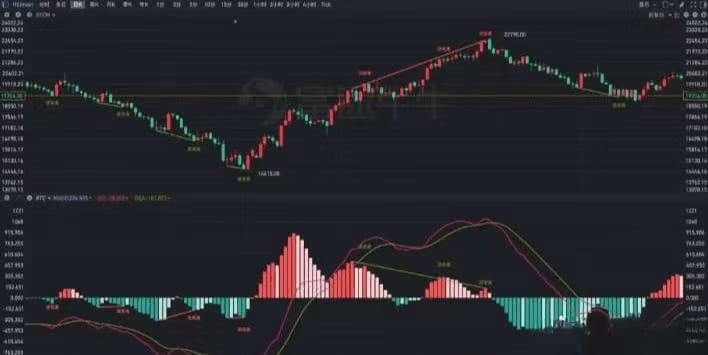
By comparing the screenshot provided at the beginning of the article, we no longer need to draw lines manually to measure whether continuous divergence has occurred. Through customized technical indicators, we can recognize whether MACD has diverged in the sub-chart and connect the peaks and troughs. In the main chart, connect the corresponding highest or lowest price at the peaks and troughs of MACD, making the recognition of divergence clear at a glance.
Of course, since it is a custom indicator, the conditions for the appearance of continuous divergence can be set according to personal preferences, such as whether peaks and troughs should appear consecutively as two or three, the number of bars below the zero axis between peaks, and how much the difference between consecutive peaks and troughs should be. These can all be adjusted.
Identifying Trends
The trading strategy based on divergence enters the market before the trend is fully confirmed, embodying the characteristics of left-side trading. Therefore, ATR-based stop-loss is indispensable as an important component of Zeng Shao's trading strategy.
However, we can completely combine other technical indicators to further reduce the potential risks associated with left-side trading. MACD measures the strength of the trend; for the trend itself, we can naturally use moving average indicators for measurement.
Generally, most are based on the crossover of short-term and long-term moving averages to identify trends. However, there is a significant problem here; if the two time parameters are too close, the two moving averages may frequently cross, leading to a large number of invalid signals. Conversely, if the two time parameters are too far apart, the timing for entering and exiting will be severely delayed.
Therefore, we can use this method: choose a personal preferred time parameter, and then choose different moving average algorithms to obtain fast and slow lines.
For example, we first calculate MA10 based on the closing price, then calculate EMA10 of MA10. This mimics the calculation principles of DIF and DEA, resulting in two fast and slow lines, which are then used to formulate buy and sell signals based on the crossover of these two lines.
Of course, this method, compared to the traditional dual moving averages, although it has only one time parameter, it inevitably encounters the problem of filtering out invalid signals.
The market is mostly in a state of fluctuation. Therefore, we can use overbought and oversold conditions as filters for moving average crossover signals.
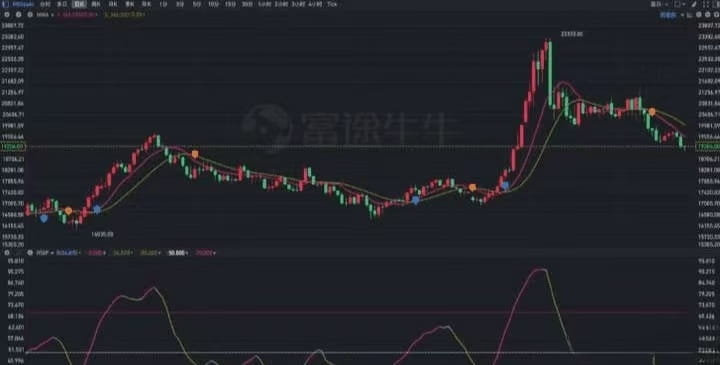
For instance, when the dual moving averages cross bullish, if the RSI indicator's value is in the 50-70 range (above 70 is considered severely overbought, do not chase highs) and is rising, it is considered an effective buy signal; when the dual moving averages cross bearish, if the RSI indicator's value is in the 30-50 range (below 30 is considered severely oversold, do not chase lows) and is falling, it is considered an effective sell signal.
At the same time, we can impose further restrictions on the candlesticks, requiring that the lowest price be above the fast line when going long, and that the highest price be below the fast line when going short. This way, we can achieve the effect shown in the image below.
Optimization Iteration
Thus, we have constructed a trading strategy using moving averages, RSI/KDJ, and MACD, which are the most basic technical indicators.
For those with ample patience, trading contracts, options, or futures while pursuing win rates can wait patiently for the appearance of continuous MACD divergence signals. Other traders can take short positions based on moving average crossovers and RSI filters.
Moreover, the start of a market trend will inevitably trigger a crossover of the dual moving averages, while the end of a trend often forms MACD divergence.
Therefore, by combining them, we can observe when to take profits based on divergence signals after going long or short based on moving average crossover signals; when entering from the left side of divergence signals, we can then confirm on the right side through moving average crossover signals.
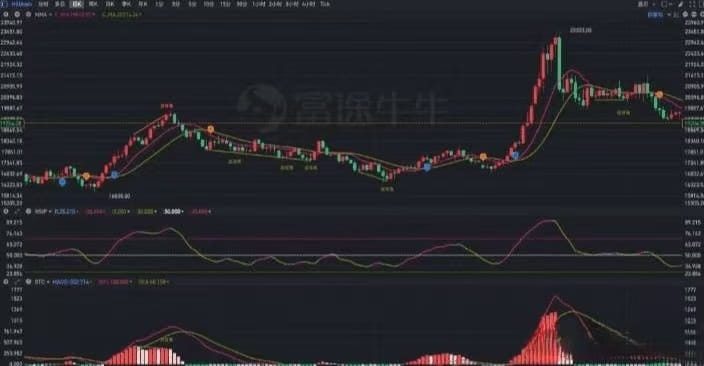
Therefore, this is actually a complementary system, but there is still considerable room for improvement regarding signal prioritization, compatibility of short and long-term strategies, backtesting historical data, and parameter tuning.
We welcome all friends in the cryptocurrency circle to provide more feedback during the use of indicators so that we can further optimize and iterate them.
The current market is in a bottoming phase. If you have no direction, remember to follow in my footsteps; standing on the shoulders of giants can save you ten years of detours!
Zeng Shao only does live trading, and the team still has positions available, hurry up to get on board $BTC $ETH.


